
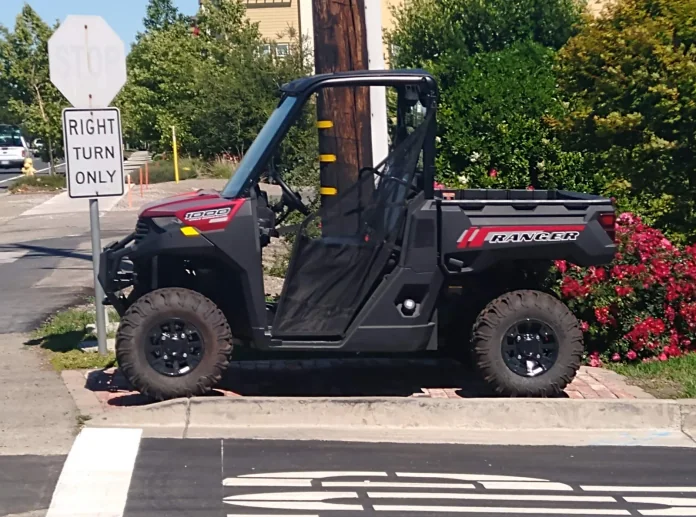
Featured reference photograph: 2021 Polaris Ranger 1000. It illustrates the vehicle family or accessory context, not the exact current trim or an independently tested installation. DestinationFearFan / Wikimedia Commons / CC BY-SA 4.0. Resized and converted to WebP; photograph retains its stated license.
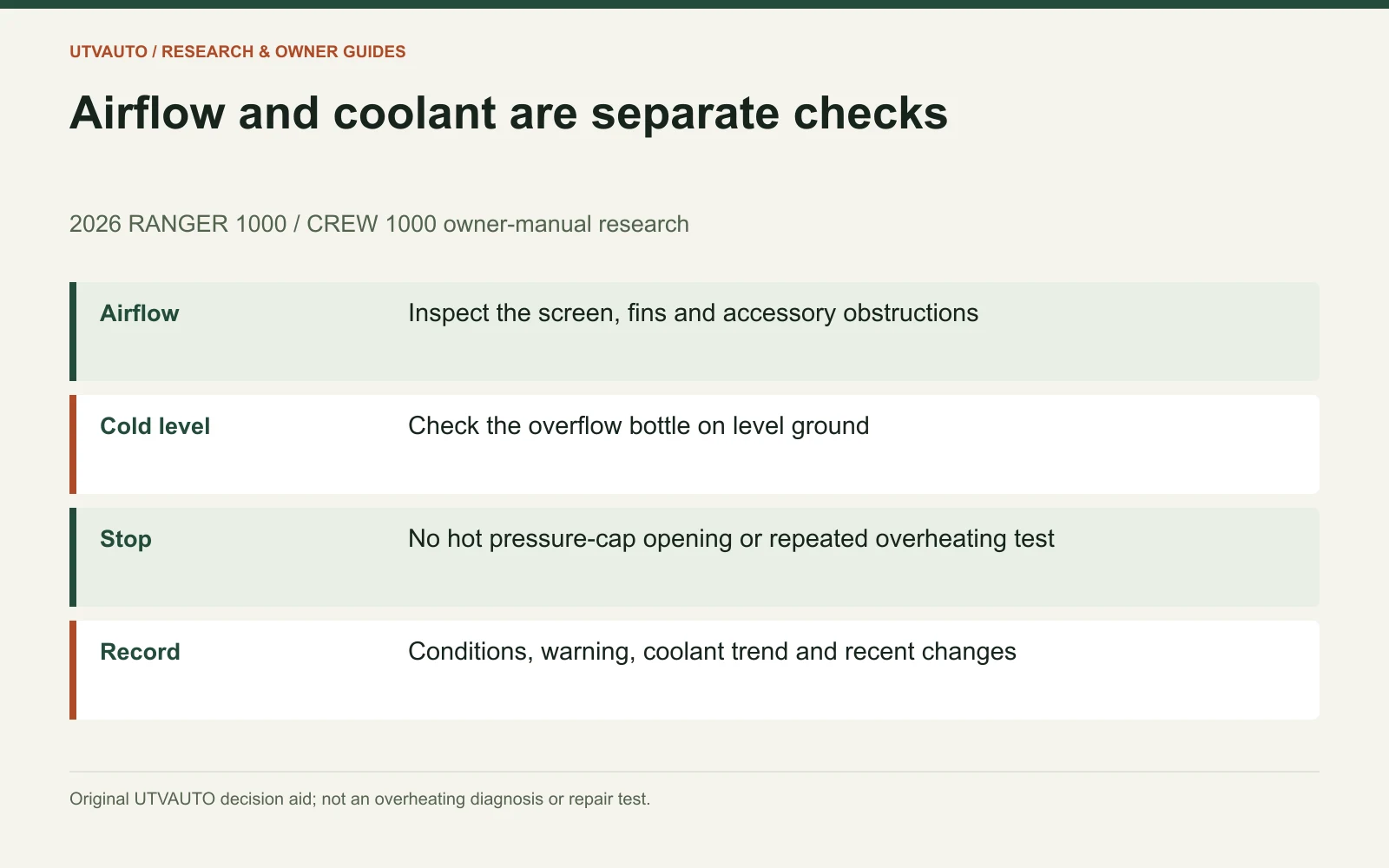
For a 2026 Polaris RANGER 1000 or CREW 1000, check radiator airflow and the cold overflow-bottle level as separate maintenance tasks. A clean-looking screen does not establish that the cooling system is healthy, and adding coolant is not a diagnosis of repeated overheating.
This guide follows the U.S. 2026 owner manual, P/N 9942448, particularly its cooling-system and washing sections. It does not cover XP 1000, XD 1500, electric models or a different year. No workshop test or repair outcome is claimed.
Decide whether this is maintenance or a fault
Routine inspection starts with a vehicle that can be parked and checked safely. An active temperature warning, steam, visible leakage or repeated coolant loss changes the task. Stop operating, follow the matching warning instructions and arrange qualified diagnosis rather than driving another loop to see whether it improves.
| What you observe | Useful next step | What it does not prove |
|---|---|---|
| Debris over the screen | Inspect the permitted cleaning access with the vehicle off and cool | That debris is the only cause of a temperature warning |
| An accessory covering the cooling-air path | Identify its exact application and required clearance | That a larger fan will compensate for the obstruction |
| A recurring fall in coolant level | Record the cold-level trend and request inspection | That repeated topping-up has repaired the system |
| Steam or a warning that returns | End the ride and obtain help | That continued operation is a safe diagnostic test |
Protect the airflow path during cleaning
The manual calls for screen and fin inspection at its scheduled intervals, warns against obstructing cooling airflow with unauthorized accessories, and advises against high-pressure radiator washing. Its general washing guidance favors a garden hose with mild soap and water. Read those instructions together; a pressure-washer specification elsewhere is not permission to blast the radiator.
Park securely, turn the engine off and let components cool before inspection. Keep hands and tools away from the fan. If cleaning requires uncertain panel removal, electrical work or access behind a guard, obtain the correct procedure instead of improvising. This article does not specify a nozzle pressure, fan bypass or fin-straightening technique.
Look at the installed vehicle, not just its accessory receipt. A light mount, front storage item or aftermarket panel may occupy an air path even if each individual part looks secure. Photograph the arrangement while safely parked so a supplier can assess the exact combination. Do not remove structural or protective components to gain airflow.
Check the cold bottle without confusing it with the radiator cap
In the manual’s overflow-bottle section, the vehicle is level and coolant is cool; the level belongs between the bottle’s minimum and maximum marks. The radiator pressure cap is a different access point and must never be opened warm or hot. A dry bottle or frequent replenishment calls for further inspection under the matching procedure.
For a useful comparison over time, use the same parked location and cold condition. Write down the date and whether the level is within the marked range. A reading taken after a ride and another taken cold are not equivalent observations. Do not describe a warm-to-cold change alone as a measured leak.
Build a short cooling-system record
| Record | Why it helps |
|---|---|
| Full model, year and installed accessories | Keeps the inquiry tied to the correct cooling layout |
| Warning text and when it appeared | Separates an actual warning from a subjective impression of heat |
| Load, speed range and terrain | Describes the operating conditions without claiming a cause |
| Cold bottle level on comparable checks | Makes the trend more useful than one isolated reading |
| Debris, damage or recent work | Gives the technician a concrete inspection starting point |
Ask the service provider what has been verified, what remains uncertain and what check confirms the repair. An observation such as “screen cleared” is narrower than “cooling fault resolved.” Avoid replacing a fan, cap or thermostat solely because an online list names it as a possible cause.
Return to normal maintenance only after the fault is resolved
Use the complete schedule for your configuration and operating conditions. This guide does not create a new universal cleaning interval or coolant formula. Retain the service record and follow any post-repair checks supplied for the actual work.
For related preparation, use the pre-ride checklist and pressure-washing precautions. The RANGER research center connects model-specific operation and maintenance topics.