Unknown water is a reason to stop and reassess
A UTV does not have one universally safe water-crossing depth. Vehicle instructions, current, bottom conditions and the available exit all matter. If you cannot establish those conditions from a safe location, choose another route. A snorkel, large tires or a photograph of another rider crossing does not resolve the uncertainties for your vehicle and the conditions in front of you.
This is a route-decision guide, not a driving tutorial or a recovery procedure. Its contribution is a stop-and-reassess record that helps groups avoid treating an unknown crossing as a challenge. It deliberately does not provide a generic depth figure. Use the exact owner manual and current land-manager information, and do not enter water to measure or investigate a crossing that may itself be hazardous.
Start with the vehicle instructions and route status
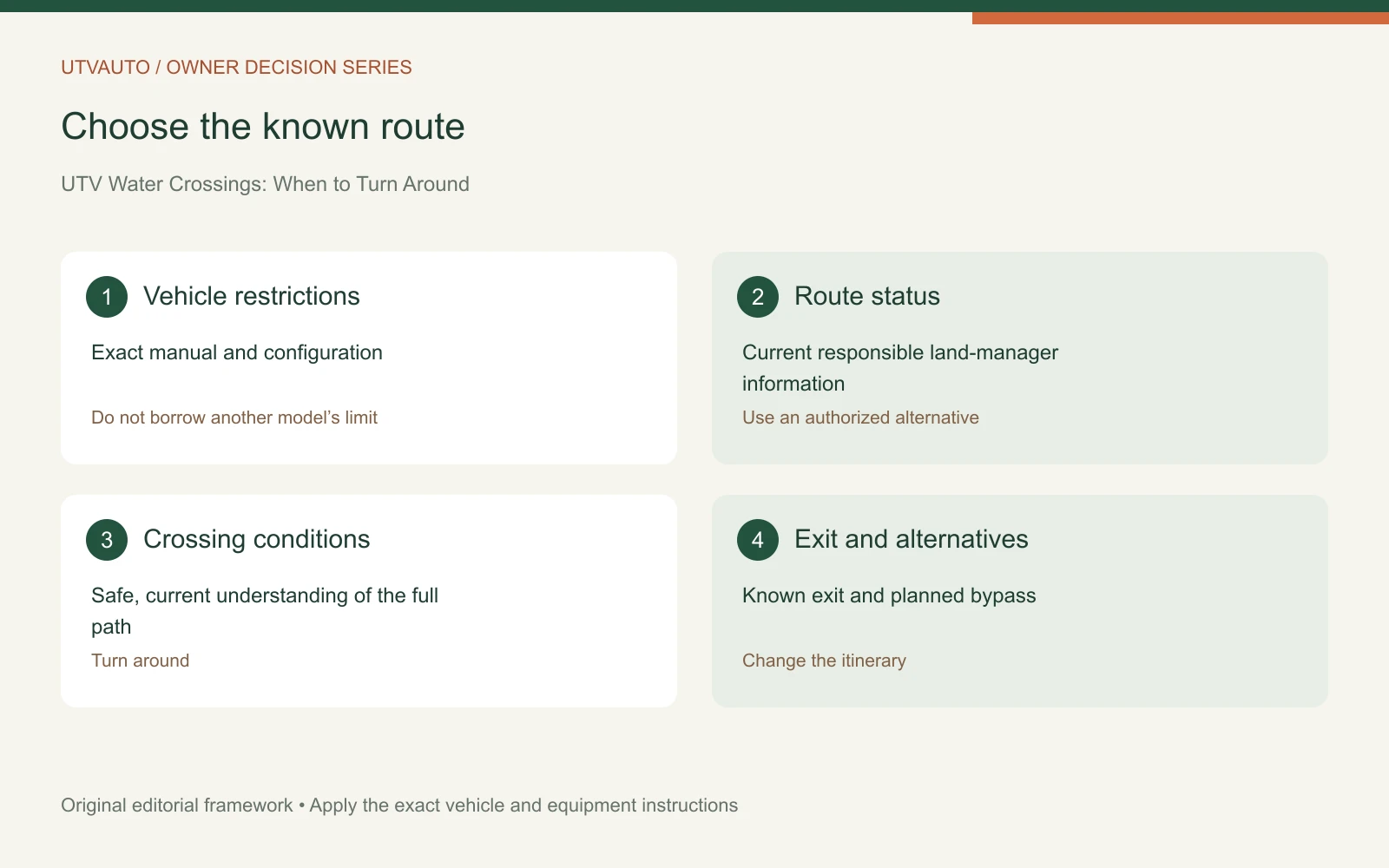
The 2026 RANGER 1000 manual linked below prohibits fast-flowing water and water above the vehicle floor level. That is a model-scoped restriction, not permission to cross every shallower stream. Different vehicles need their own instructions. Record the manual reference before planning a route, and do not substitute intake height for the manufacturer’s operating restrictions.
Separately verify whether the route is open and whether the crossing is an authorized part of it. A visible track is not proof of current permission or a stable crossing. Save the date and source of the route information. If a closure, damaged crossing or changing condition is reported, revise the plan. Vehicle capability and land access are separate questions, and both must be resolved before considering the rest of the trip.
Do not let a depth estimate answer every question
A shallow-looking surface can hide changes in the bottom, submerged objects or an abrupt edge. Clear water can also be difficult to judge from a vehicle seat. A single depth measurement, even if obtained safely by an appropriate authority, does not describe every wheel path or prove that the bottom will support the vehicle. Record what is actually known rather than converting a visual impression into a numerical limit.
Ask whether the information applies to the whole intended path and the current conditions. A measurement from a previous ride may no longer describe the crossing. The worksheet should distinguish observed facts, recent official information and assumptions. Any assumption that controls whether the route is acceptable deserves to remain an unresolved question. Do not improve the appearance of the plan by replacing an unknown with a reassuring guess.
Treat moving water and escape routes as separate gates
Do not use a manageable-looking entrance as evidence that the complete crossing is suitable. Consider the exit from a safe viewpoint before reaching the water. A route that enters easily but has an uncertain or damaged exit can leave the group with a problem it cannot reverse safely. If the required view is unavailable without entering a hazardous area, the information remains missing and the route should change.
Do not attempt to calculate an acceptable current from internet videos or the apparent success of a larger vehicle. Riders, loading and vehicle configuration differ, and a successful crossing by someone else is not a controlled test. Keep the decision rule simple: prohibited conditions or unresolved critical information lead to a turnaround. This approach removes pressure to improvise a numerical justification at the edge of the water.
Make a group turnaround plan before departure
Select an alternate route, a turnaround location and a meeting point during trip planning. Tell participants that bypassing a crossing is an expected option. A rider should not have to argue against the whole group after everyone has assembled at the bank. Make the most cautious unresolved requirement govern the route rather than asking each person to copy the machine ahead.
Record how the group will communicate a route change and what happens if vehicles become separated. Keep the process compatible with safe operation; do not require riders to handle a phone while moving. If there is no practical alternate route, reconsider the itinerary before departure. A plan that depends on one uncertain crossing has little resilience, especially when daylight, weather or access conditions may change during the day.
Understand what accessories do not establish
Record any intake, exhaust, driveline or electrical modification when assessing the vehicle, but do not treat that list as a water-capability certificate. An aftermarket description may address one component while leaving other operating restrictions unchanged. Ask the vehicle manufacturer and component supplier about the exact installation. If the answers conflict or remain incomplete, do not resolve the conflict by choosing the more permissive claim.
The same discipline applies to flotation assumptions and recovery equipment. The presence of a winch does not make a crossing suitable, and carrying a rope is not a rescue plan. Keep emergency arrangements separate from the decision to enter. Equipment intended to help after a problem should not become the reason to accept a problem that the route plan could avoid in the first place.
Record an incident without experimenting with the vehicle
If a vehicle becomes submerged, stalls in water or shows a problem afterward, stop treating the event as routine trail operation. Follow the manufacturer’s instructions and obtain qualified assistance. Do not repeatedly restart the engine or improvise a repair from a generic online checklist. If people are in immediate danger, prioritize emergency assistance and avoid placing additional riders into the same hazard.
When it is safe, record the vehicle identity, approximate event time, observed symptoms and what happened before the problem. Distinguish a rider’s estimate of depth from a confirmed measurement. Provide photographs taken from a safe place only if they help the service provider understand the event. The purpose is to preserve useful information, not to build a story that proves the vehicle should have been capable of the crossing.
Keep a short route decision record
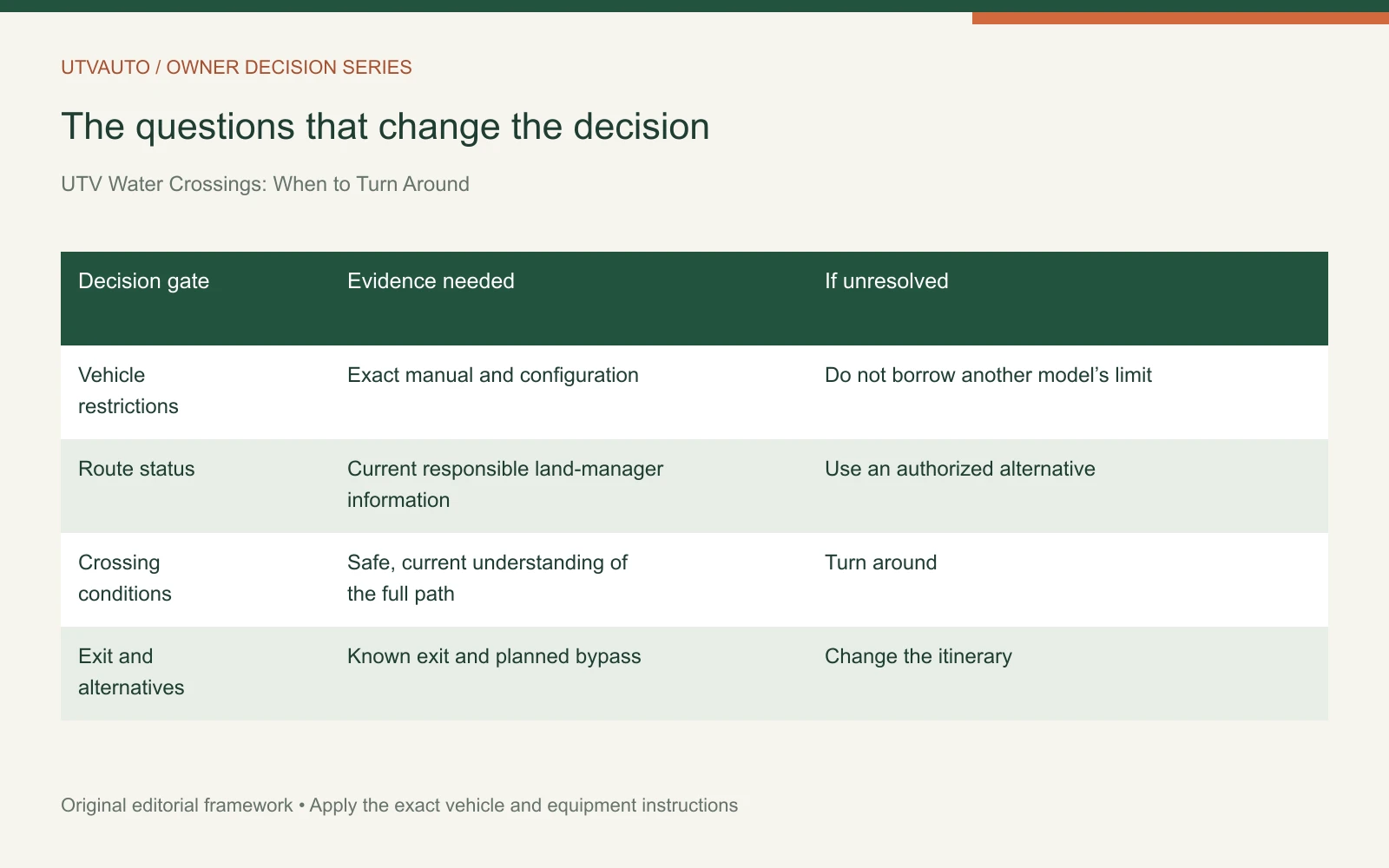
A useful record has fields for the crossing location, information date, manual restriction, route status, known current conditions, known exit conditions, unanswered questions and selected alternative. Add the person responsible for checking the route before departure. This makes it easier to review why a crossing was bypassed and what information would be needed to plan a different trip in the future.
For a hypothetical example, a group has a mapped crossing but no recent information about the exit after heavy rain. The result is not “probably fine because it was fine last month.” The result is an unresolved route condition and use of the alternate itinerary. That decision protects the purpose of the ride: completing an enjoyable trip with clear expectations, rather than converting missing information into an unnecessary test of the vehicle.
Example: replace an uncertain crossing with a known itinerary
Suppose a route normally follows a designated crossing and then continues to a planned lunch stop. Before departure, the group learns that recent conditions may have changed the approach, but no responsible source has confirmed the current state. The route leader has an alternative that reaches the same meeting area without using the crossing. Selecting that alternative is a complete plan, not an unfinished attempt at the original route.
Write the revised departure information so every participant has the same itinerary. Remove old directions that could send a separated rider toward the crossing. Confirm that the alternative is itself authorized and suitable for the group. Do not describe an unverified bypass around a closure as an acceptable workaround; a substitute route needs its own access and suitability checks.
After the trip, save a short note explaining the change. If reliable information later becomes available, it can support planning another outing without rewriting the earlier uncertainty as a mistake. This keeps the learning process honest. A conservative decision made with incomplete information should not be judged solely by a later photograph showing that somebody else got through. The earlier decision must be assessed against what was actually known at the time.
Working reference table
| Decision gate | Evidence needed | If unresolved |
|---|---|---|
| Vehicle restrictions | Exact manual and configuration | Do not borrow another model’s limit |
| Route status | Current responsible land-manager information | Use an authorized alternative |
| Crossing conditions | Safe, current understanding of the full path | Turn around |
| Exit and alternatives | Known exit and planned bypass | Change the itinerary |
Related UTVAUTO resources
- Prepare the vehicle before a ride
- Separate washing guidance from water operation
- Evaluate records when buying used
Sources and scope
Research and editorial planning framework, checked November 9, 2026. UTVAUTO has not tested these vehicles, measured their noise, or inspected the reader’s machine. Examples are explicitly hypothetical. Use the exact vehicle manual and obtain qualified assistance for unresolved safety questions.
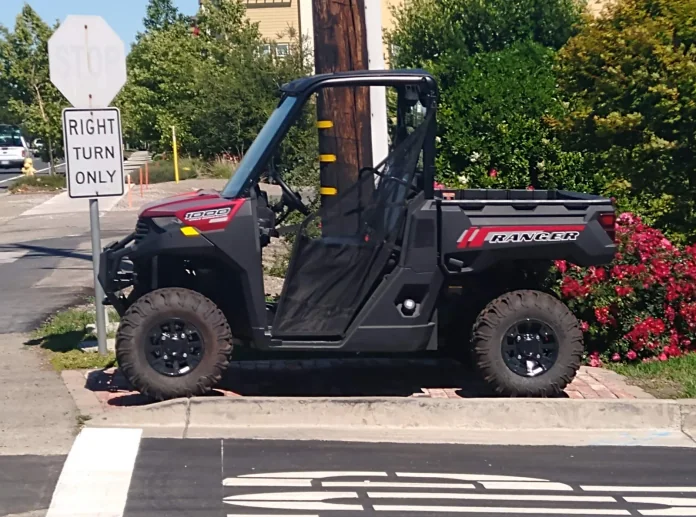
Featured archival reference photograph: 2021 Polaris Ranger 1000. It illustrates vehicle context, not a UTVAUTO test, the exact equipment discussed or an endorsement. DestinationFearFan / Wikimedia Commons / CC BY-SA 4.0. Resized and converted to WebP; photograph retains its stated license.