
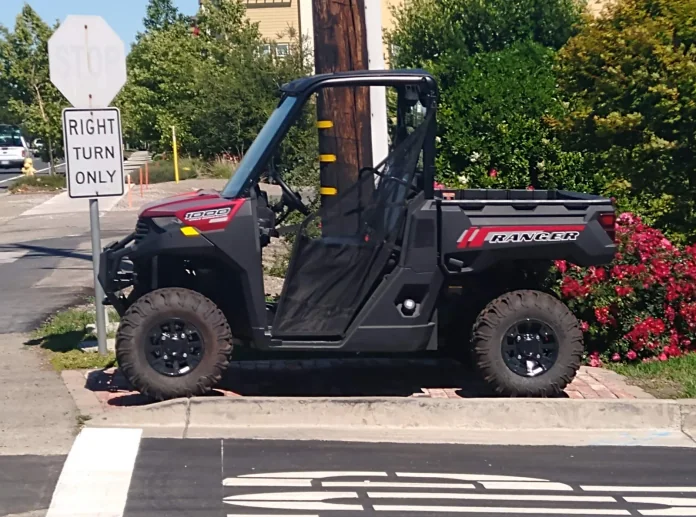
Featured reference photograph: 2021 Polaris Ranger 1000. It illustrates the vehicle family or accessory context, not the exact current trim or an independently tested installation. DestinationFearFan / Wikimedia Commons / CC BY-SA 4.0. Resized and converted to WebP; photograph retains its stated license.
Use a UTV’s hours, miles, calendar age and service records together; none supplies a reliable remaining-life score by itself. Low mileage can coexist with substantial idle or low-speed operation. A higher hour count with documented maintenance may tell a different story from a lower count with no records, but the numbers alone cannot settle condition.
This guide provides an evidence worksheet for used-vehicle buyers. It does not estimate failure probability or define a universal hour/mileage cutoff.
Calculate a ratio, then keep its meaning limited
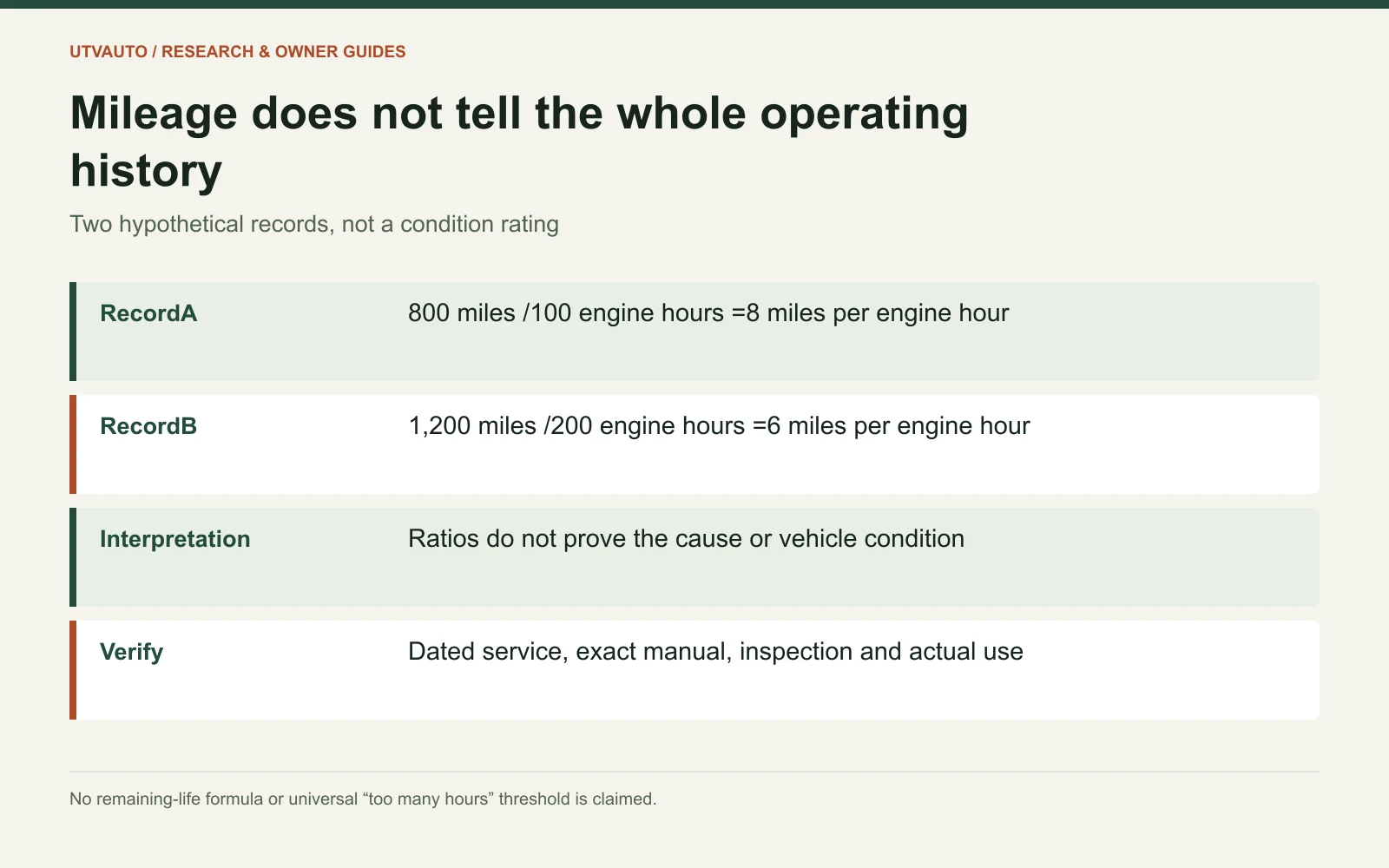
A hypothetical record of 800 miles and100 engine hours gives8 miles per engine hour. Another with1,200 miles and200 hours gives6. These are whole-record ratios, not measured moving speeds. They cannot distinguish every combination of idle time, short trips, slow work and faster travel.
| Observed record | What it can support | What it cannot prove |
|---|---|---|
| Hours and odometer agree with documented services | A consistent sequence to investigate | The absence of damage or future faults |
| Low miles relative to hours | A question about how the machine was used | A diagnosis of abuse |
| Long gaps in dated records | A maintenance-history gap | That all omitted work was performed |
| Replaced display or uncertain meter history | A need for supporting documentation | That the displayed count is lifetime use |
Compare the records with the correct service schedule
The 2026 RANGER 1000 manual specifies service triggers using hours, miles and calendar time, including an initial service and later vehicle milestones. The 2026 RZR XP manual uses a different periodic schedule. Do not carry one vehicle’s intervals into another because both are Polaris.
For example, the RZR XP normal periodic oil/filter row follows a50-hour/1,000-mile/12-month schedule after its initial service. It does not mean an owner can wait until all three conditions are met. Severe use and task-specific directions can require earlier attention.
The RANGER manual also warns that its first later milestone can be closer to break-in service than subsequent repeating services. A record that “resets every interval from the first oil change” may therefore require careful checking against the actual table.
Ask for the kind of use, not an unsupported health score
Request a description of normal work: idle time, short cold trips, heavy low-speed loads, dust, mud/water exposure and storage. Compare that description with the manufacturer’s severe-use definition. It is a maintenance-context question, not proof that a machine has a defect.
Then look for the corresponding records: dates, hour/mile readings, task, parts/fluids and who performed the work. An oil-change receipt alone does not document every item in a service interval.
Use an inspection to resolve condition
Have the actual vehicle assessed for safety, wear, leaks, damage and modifications. Keep recall/VIN checks separate from a general impression of mileage. A service record or completed recall does not prove the entire vehicle is mechanically sound.
The used UTV buying checklist organizes that inspection and document review. Ask the seller to resolve an unexplained meter change or missing identity information before treating the displayed counts as complete history.
Compare the actual purchase risk and cost
Obtain a written list of overdue or unverified work and an itemized repair/service quote where needed. Do not invent a fixed dollar deduction for every hundred hours or assume a particular remaining engine life.
Use the quote worksheet for known costs, and retain unresolved condition as uncertainty rather than disguising it as a precise valuation.
Editorial collection: November 2026. This is a topic collection label, not a backdated first-publication date.


