

Featured reference photograph: 2021 Polaris RZR Pro XP. It illustrates the vehicle family or accessory context, not the exact current trim or an independently tested installation. DestinationFearFan / Wikimedia Commons / CC BY-SA 4.0. Resized and converted to WebP; photograph retains its stated license.
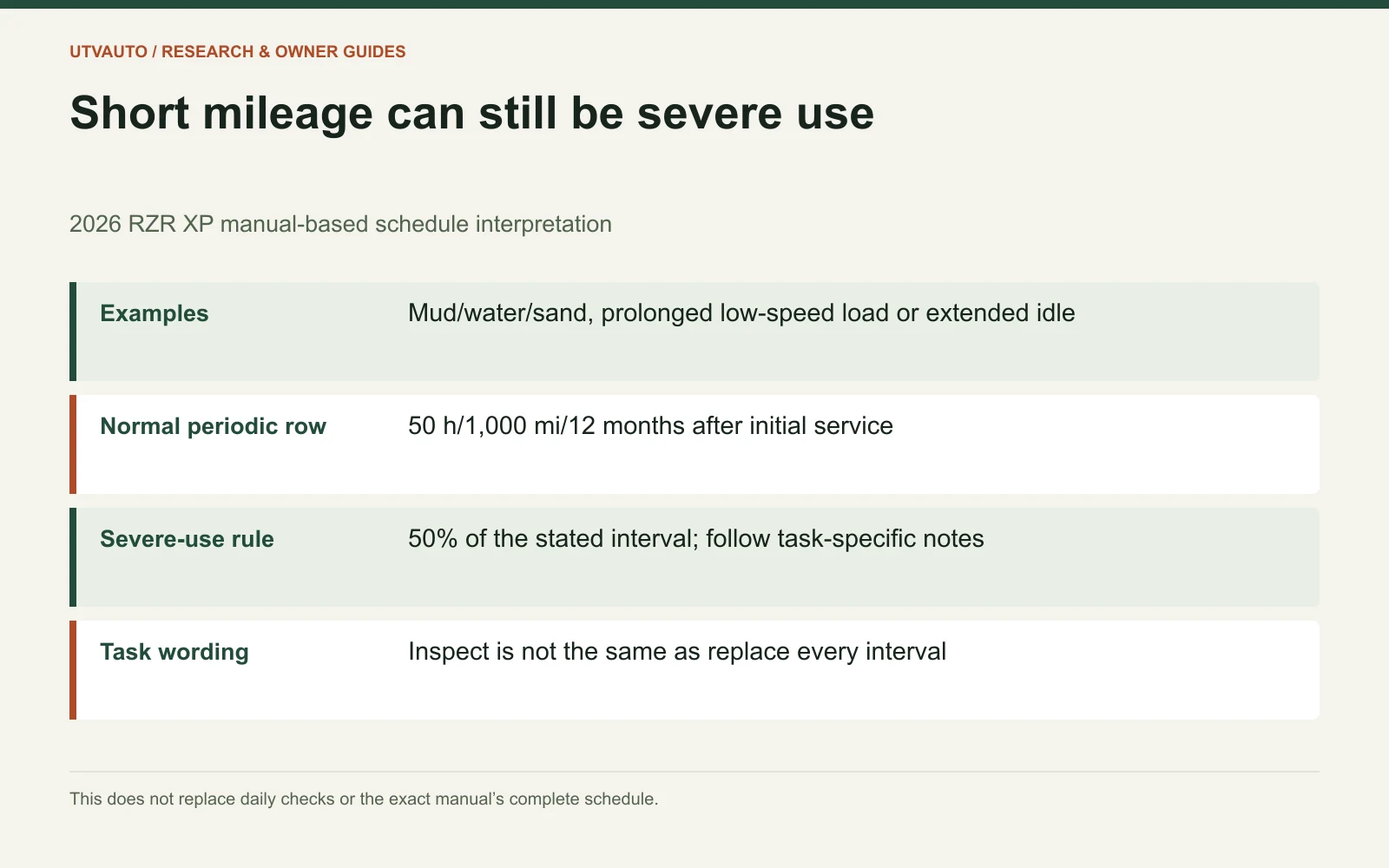
The 2026 RZR XP manual requires earlier servicing for its defined severe-use conditions, including work that may accumulate few miles. Extended idle, prolonged low-speed heavy load and frequent short cold trips can matter alongside mud, water, sand and high-RPM operation. Do not judge the schedule from the odometer alone.
The source is the 2026 RZR XP family manual’s maintenance chapter. It is not the schedule for RANGER, RZR Pro XP, Turbo R or every Polaris sport vehicle.
Identify the actual duty conditions
| Manual example | Question for the service record |
|---|---|
| Frequent mud, water or sand exposure | What inspections or cleaning were needed after the actual use? |
| High-RPM or prolonged high-speed operation | Does the operating history fall within the listed severe-use definition? |
| Low-speed heavy load or extended idle | Were hours recorded even when few miles accumulated? |
| Frequent short cold trips | Was the engine often operated without reaching normal operating temperature? |
These are maintenance-context definitions, not proof that a fault exists or a guarantee that operation in a particular environment is permitted. Continue to follow the vehicle’s operating restrictions.
Read the periodic table and the severe-use rule together
After initial break-in service, the normal periodic table is headed50 hours/1,000 miles/12 months. The manual states that severe-use vehicles must be serviced at 50 percent of the stated interval. For a time/distance example, half of50 hours is25 hours and half of1,000 miles is500 miles.
Do not ignore the calendar trigger, special task notes or earlier condition-based work. Use the complete current schedule for the actual vehicle and ask the dealer to resolve any uncertainty about how its calendar and task-specific requirements apply. The example arithmetic is not a complete maintenance plan.
Inspection does not mean replacing every item automatically
The table calls for changing engine oil/filter, but other entries specify inspection, cleaning, adjustment or replacement as needed. Those actions are different. For example, a belt inspection entry is not a blanket order to replace every belt at the same interval.
Likewise, filters, brakes, bearings and suspension components require the actual inspection and service criteria. Do not invent a pad-thickness limit, torque or oil specification from this schedule summary.
Pay attention to a rising oil level
The manual notes that a rising oil level during cold-weather operation can indicate contamination. It directs an oil change when the level begins rising and requires discontinuing use and determining the cause if the rise continues. Do not treat an unexplained continuing rise as an invitation to drain a little oil and keep riding.
Use the model-specific inspection method and obtain qualified help for unresolved warnings, leaks or unsafe mechanical conditions. A shorter service interval does not repair an existing fault.
Make the service record useful
Record the date, actual hour/mile readings, duty description, tasks performed, materials/part numbers and any unresolved observations. Keep initial break-in service separate from later periodic work and from immediate condition-based repairs.
For the individual jobs, see RZR XP air-filter checks and the exact-model belt procedure guide. The hours-versus-miles worksheet helps buyers interpret the records without inventing a remaining-life score.
Editorial collection: November 2026. This is a topic collection label, not a backdated first-publication date.


