
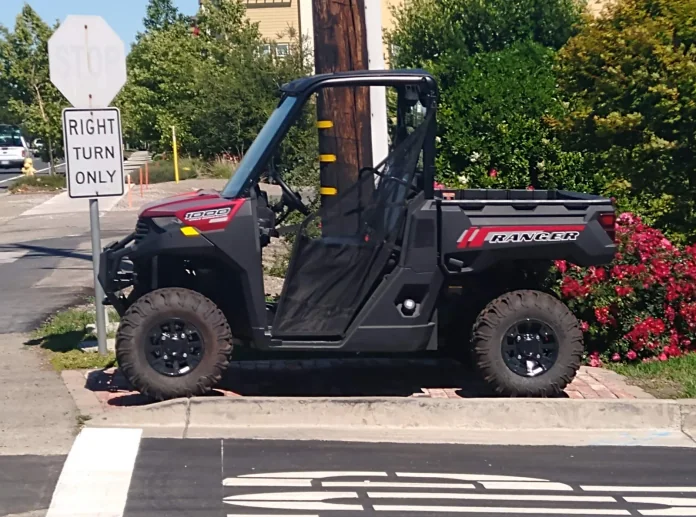
Featured reference photograph: 2021 Polaris Ranger 1000. It illustrates the vehicle family or accessory context, not the exact current trim or an independently tested installation. DestinationFearFan / Wikimedia Commons / CC BY-SA 4.0. Resized and converted to WebP; photograph retains its stated license.
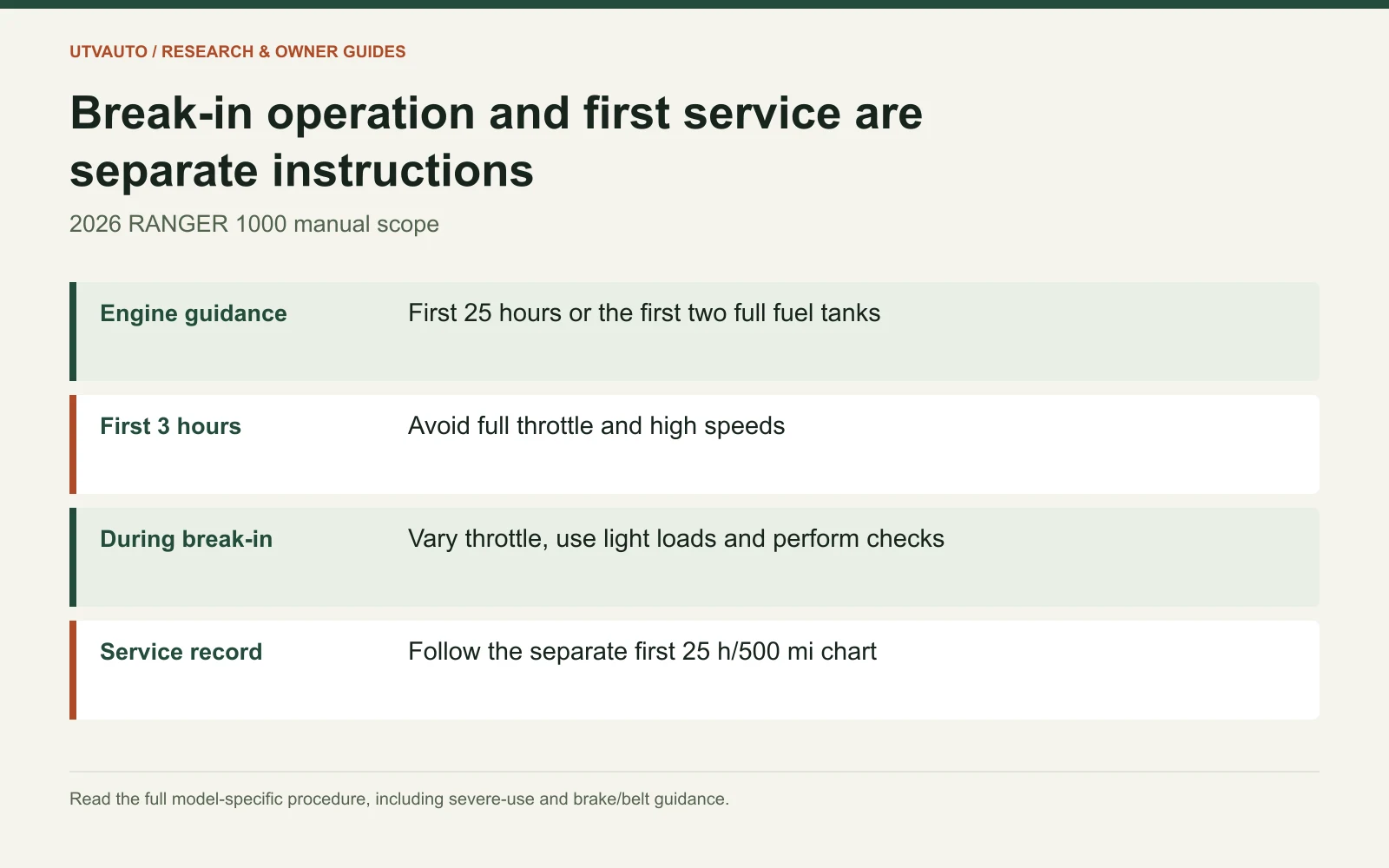
The 2026 RANGER 1000 manual treats break-in driving and the initial service as related but separate instructions. It describes engine/drivetrain break-in using the first 25 hours or the first two full tanks of gasoline, while the initial service table specifies the first 25 hours/500 miles. Do not use one wording to postpone the other requirement.
This guide is scoped to the 2026 RANGER 1000/CREW 1000 owner manual. XP 1000, XD 1500, other years and replaced components can have different procedures.
What to plan before the first work trip
Review the safety and operating sections, verify the daily inspection items and identify the correct fuel and fluid requirements. Confirm that any installed accessories are documented for the vehicle and included in its load plan.
Do not schedule the first hours around the heaviest towing or hauling task. The break-in section calls for light loads and careful operation; it is not a period for testing the headline towing rating.
The manual’s early-operation priorities
| Stage or instruction | What the named manual says | What not to infer |
|---|---|---|
| First 3 hours | Avoid full throttle and high speeds | An invented universal RPM ceiling |
| Throttle use | Vary throttle and avoid sustained idle | Letting the engine idle for hours completes every break-in requirement |
| Loading | Carry light loads | The usual maximum work load is appropriate throughout break-in |
| Checks | Check fluid levels, controls and pre-ride items | A new vehicle cannot have an assembly or adjustment issue |
The source also includes separate brake and drive-component guidance. Follow those actual procedures rather than assuming the engine summary covers every component or copying a generic belt break-in distance.
Book the initial service using the actual table
The initial service chart includes engine oil/filter, front gearcase and transmission fluid work, brake inspection and shift-cable checks. Use the task wording in the current manual; an “oil change” entry alone does not document the entire service.
The first-service guide addresses that appointment in detail. Record actual date, hours, miles, tasks and materials. Severe use has its own earlier-service directions, so identify the duty conditions before planning the work.
Do not restart every vehicle milestone from the first oil change
The manual specifically notes that the first later vehicle milestone can be closer to the initial service than subsequent repeating services. Preserve the vehicle’s hour and mileage readings and follow the table rather than turning every interval into a new countdown from a break-in receipt.
If a dealer service summary and the manual appear inconsistent, ask for clarification tied to the exact model and table. This is more useful than substituting an interval from another RANGER family.
What needs attention rather than more running time
Stop and obtain the specified support when warning indications, leaks, unsafe braking, damaged controls or other safety issues appear. Do not assume an abnormal symptom will disappear because the vehicle is “still breaking in.” Follow the manual’s relevant stop/service instructions.
After a belt or other component is replaced later, check whether its installation instructions specify a new component-specific procedure. The vehicle’s original break-in date does not automatically answer that question.
Keep a concise first-use log
Record the vehicle identity, delivery reading, early trips, loads and observed issues, followed by the documented initial service. That log establishes what was actually done without claiming that a particular break-in routine guarantees a fixed engine life.
Visit the RANGER research center for the fuel, drive-mode and maintenance-record guides.
Editorial collection: November 2026. This is a topic collection label, not a backdated first-publication date.