
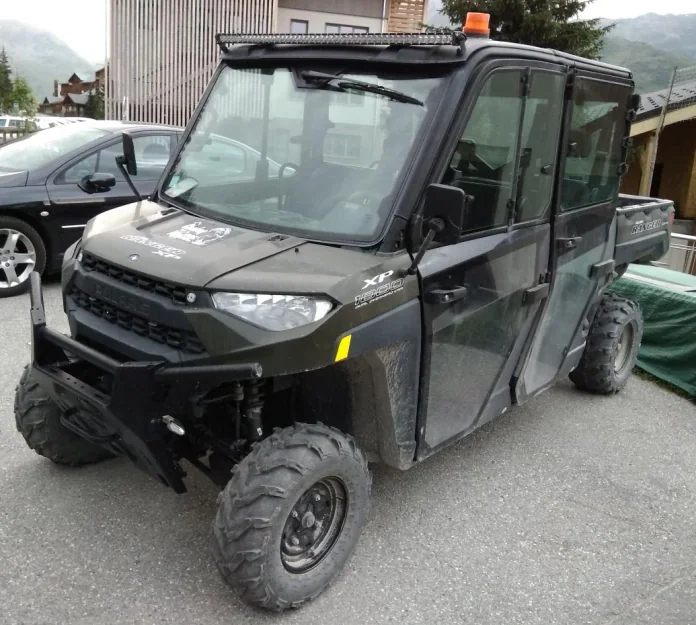
Featured reference photograph: Polaris Ranger XP 1000 black. It illustrates the vehicle family or accessory context, not the exact current trim or an independently tested installation. SolanaBogon / Wikimedia Commons / CC BY 4.0. Resized and converted to WebP; photograph retains its stated license.
A useful UTV heater must suit the exact vehicle and cab, provide the visibility function you need and work within its approved power and installation limits. Do not assume a small plug-in heater can replace a documented cab heat/defrost system, or that a gas-model kit fits an electric UTV.
Engine-coolant systems use engine heat with a blower and a model-specific installation; resistance-electric systems depend directly on their electrical supply. This physical distinction does not tell you which generic kit fits. The actual vehicle, heater instructions and electrical architecture decide that.
A documented platform and CREW distinction
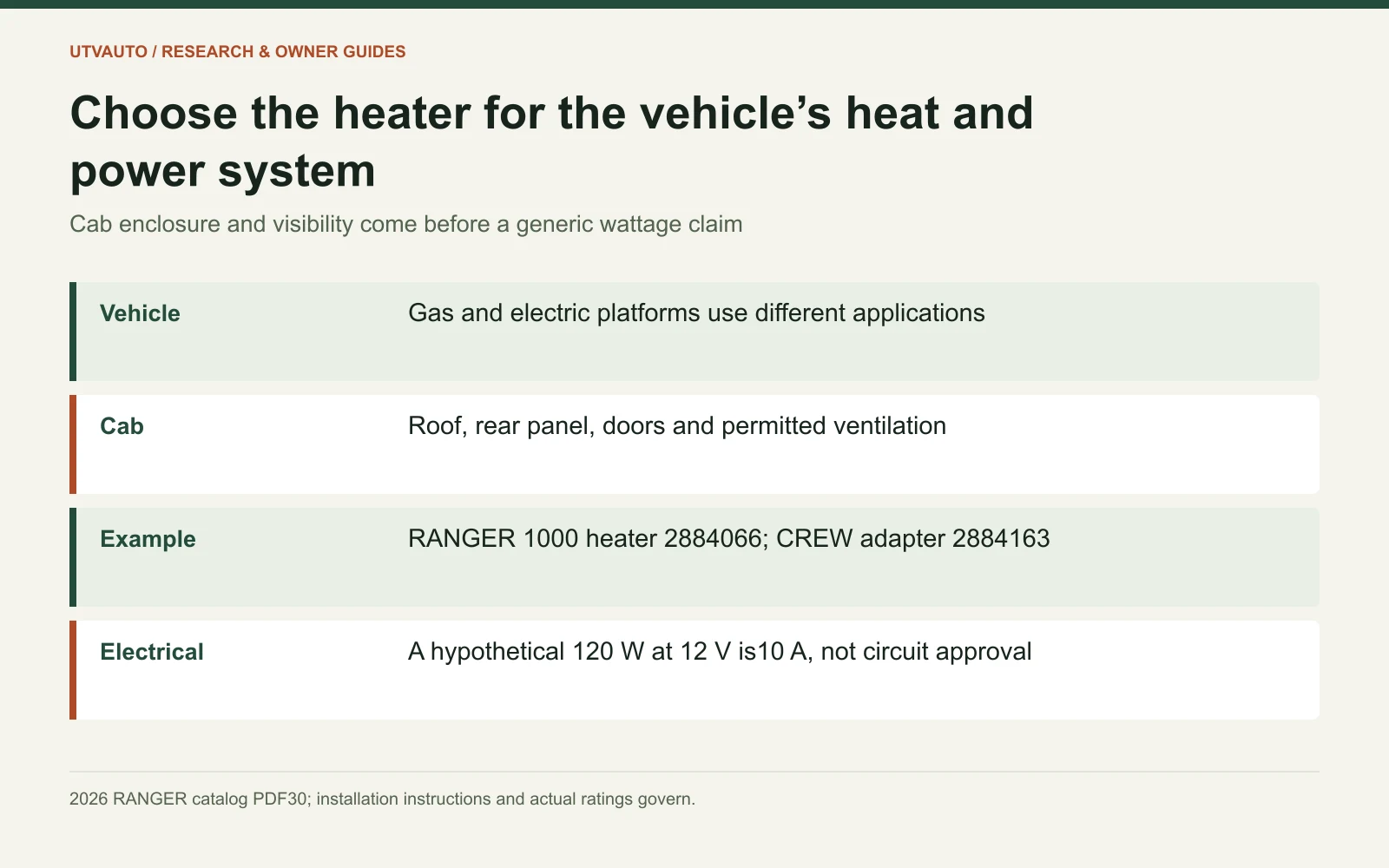
The 2026 RANGER cab-convenience page lists 8-vent heater/defrost kit 2884066 for the stated RANGER 1000 applications and requires adapter 2884163 on CREW 1000. The same page lists a different XP Kinetic heater application, 2889449, with high-voltage busbar 2889667 required.
| Question | What to verify |
|---|---|
| Is this the correct vehicle platform? | Full model, year, engine/powertrain and seating version |
| Is CREW hardware needed? | The exact adapter, hose/duct or harness requirements |
| Is defrost included? | Duct arrangement and compatible windshield, not merely a warm-air outlet |
| What is the power architecture? | Approved supply and electrical components; no gas/electric interchange assumed |
| What is supplied? | Kit contents, required extras and installation/service documentation |
The presence of “12 V” on an outlet is not evidence that a high-output heater may be plugged into it. Nor should the XP Kinetic catalog listing be interpreted as permission to work on high-voltage equipment without the specified procedure and qualified support.
Use a simple load calculation only as a screening tool
For a hypothetical resistive heater rated 120 W at 12 V, power divided by voltage gives approximately 10 A. A hypothetical 300 W load at the same voltage gives 25 A. These are illustrative arithmetic inputs, not specifications of the catalog kits above or recommendations for an accessory outlet.
A concrete restriction shows why arithmetic is insufficient: the 2021 Honda Pioneer 1000 manual, printed page 78 rates its accessory socket at 12 V, 120 W or 10 A maximum, but also prohibits heat-generating accessories. A heater that fits the numerical limit is therefore still outside that socket’s permitted use. This is a 2021 Honda example, not a rating for a 2026 RANGER circuit.
The actual supply, wiring, connector, protection, charging conditions and other vehicle loads must support the approved installation. Do not select a larger fuse or invent a wiring size to make a generic heater fit. The electrical-load planning guide explains the same distinction for powered accessories.
Check the cab before evaluating heat
Identify the roof, rear panel, doors, seals and ventilation arrangement. A heater in a largely open cab is a different application from an enclosed factory system. Follow the permitted closure and ventilation configuration rather than sealing every opening without instructions.
Ask how the specified system directs air to the windshield. Warm occupants and a clear viewing surface are different requirements. A component called a heater does not prove that a proposed installation provides effective defrost under your conditions.
Inspect for faults before treating fog as an accessory problem
If coolant leaks, an unusual fluid smell, overheating warnings or unsafe visibility occur, stop and obtain qualified diagnosis. Do not open a hot pressurized cooling system or continue operating to test a new heater idea. Follow the exact vehicle’s cooling and electrical service instructions.
For a used kit, confirm that every required part and instruction is present. A partially removed system may have missing adapters, damaged hoses or an unidentified electrical modification. Its low purchase price is not a complete installation quote.
Price one finished system against another
Get a written quote that identifies the vehicle, heater, adapter, compatible cab parts, installation and any required electrical components. Compare it with the exact factory-cab alternative if one is on your shortlist; do not compare a bare heater price with an entire enclosed vehicle package.
See factory-cab comparison checks for that broader decision, and roof fitment checks when planning the cab interfaces.
Editorial collection: September 2026. This is a topic collection label, not a backdated first-publication date.


