
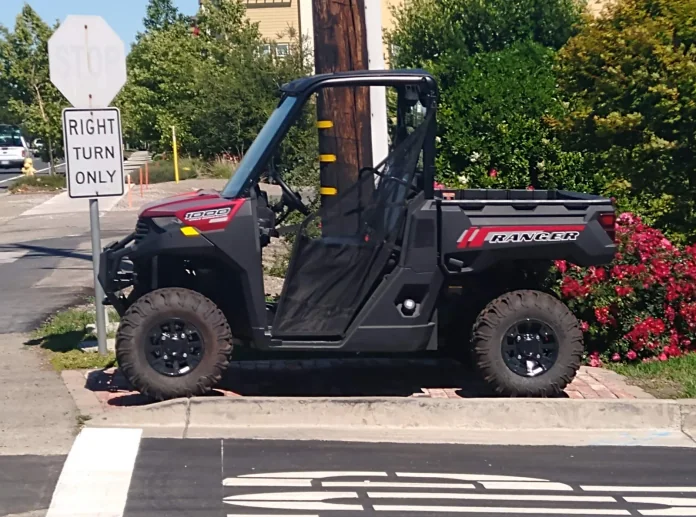
Featured reference photograph: 2021 Polaris Ranger 1000. It illustrates the vehicle family or accessory context, not the exact current trim or an independently tested installation. DestinationFearFan / Wikimedia Commons / CC BY-SA 4.0. Resized and converted to WebP; photograph retains its stated license.
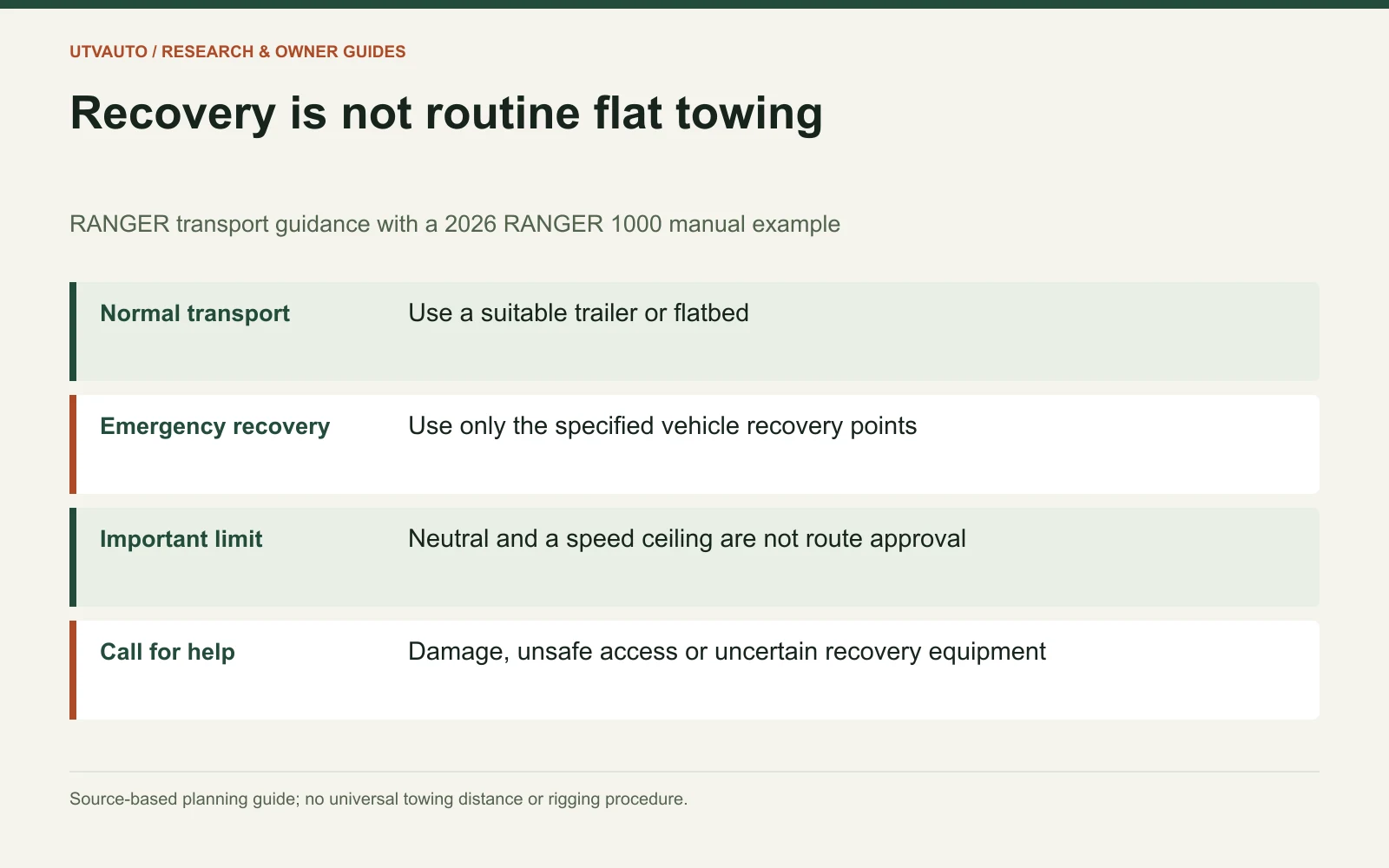
Polaris does not recommend towing a RANGER behind another vehicle for ordinary transport; use a suitable trailer or flatbed. An emergency provision for moving a disabled vehicle does not turn the RANGER into an approved vehicle for routine four-wheels-down towing behind an RV.
This guide separates the manufacturer’s RANGER transport guidance from emergency recovery provisions in the 2026 RANGER 1000 / CREW 1000 manual, P/N 9942448. Other platforms and manuals require their own checks. UTVAUTO has not tested towing, recovery equipment or drivetrain durability.
First identify which job you mean
| Your intended job | Treat it as | Next decision |
|---|---|---|
| Take the RANGER to a riding area | Normal transport | Select a suitable trailer or flatbed and verify loaded fit |
| Pull a stuck vehicle free | Emergency recovery | Use the exact recovery instructions and assess the scene |
| Move a disabled machine for loading | Recovery/loading | Tell the operator whether it rolls, steers and brakes |
| Tow behind an RV over a travel route | Proposed flat towing | Do not infer approval from a recovery paragraph |
These jobs can use similar-looking straps while imposing different demands. A recovery loop, trailer hitch and transport tie-down location serve different functions. The presence of any one of them is not evidence that an improvised attachment is suitable for another task.
What the emergency instructions actually allow
The 2026 manual describes designated front and rear recovery loops for emergency recovery, including pulling the vehicle onto transport. It specifically distinguishes these loops from towing a vehicle to another location. It also identifies neutral and a 10 mph (16 km/h) maximum for moving a disabled Polaris vehicle; these are restrictions, not a recommendation to move every disabled machine at that speed.
The same section limits recovery to an equal-or-smaller vehicle in size and weight. That condition alone cannot establish that a proposed pull is safe: damage, terrain, attachment geometry and equipment instructions still matter. If the scene or the vehicle cannot be handled safely, contact a qualified recovery service.
Do not turn the speed ceiling into an invented distance allowance. This guide supplies no “safe number of miles,” roadside towing setup, tow-bar adaptation or authorization to remove drivetrain parts. A universal answer would need evidence for the exact vehicle and towing configuration.
Give the recovery operator a useful brief
Before anyone loads equipment, describe what is actually known. An operator arriving for a freely rolling machine may need a different plan from one with a damaged wheel or a transmission that cannot be shifted. Report the observation rather than diagnosing the fault over the phone.
| Information to collect safely | Useful wording |
|---|---|
| Exact vehicle | Year, complete model and seating configuration |
| Condition | Whether it rolls, steers and brakes; visible damage or leaks |
| Location and access | Surface, obstacles and where a recovery vehicle can safely reach |
| Installed equipment | Roof, windshield, cab, plow or other added weight and dimensions |
| Documentation | Matching manual and identified recovery/tie-down locations |
Keep people away from tensioned recovery equipment and an unstable vehicle. If it has rolled over, has significant damage, or cannot be safely approached, leave assessment and movement to qualified personnel. Reaching the recovery point is not worth creating another casualty.
Choose transport using loaded measurements
Trailer choice needs more than the unmodified vehicle’s catalog width. Check the actual opening, ramp and deck, then the rated capacity of the complete transport arrangement. Account for installed accessories and cargo; a towing-capacity number on the RANGER describes a different task from a trailer carrying the RANGER.
Use the vehicle’s designated transport tie-down locations and the exact vehicle/accessory instructions. A full windshield, roof or removable part can add transport restrictions. Confirm the completed configuration with the carrier before loading rather than relying on a photograph of a similar vehicle.
Finish with a documented handoff
Record the vehicle condition before loading when it is safe to do so, agree on the destination and tell the receiving service provider why the machine became disabled. Moving it successfully does not establish that it is fit to drive afterward.
Use our trailer-fit worksheet and transport preparation guide for the next planning step. For equipment inspection rather than transport approval, see synthetic winch-rope checks.


