
A UTV fits a trailer only when it passes both the space check and the loaded-weight check. Compare the actual vehicle with the narrowest loading opening, usable deck and ramp—not just a trailer’s advertised width and length. Then confirm the trailer, ramp, tie-down points, hitch and road tow vehicle are suitable for the loaded combination.
This measurement worksheet covers utility trailers and enclosed trailers used to transport a UTV. It does not certify a particular pairing. Factory dimensions are a starting point; measure your machine with its current tires, mirrors, roof, windshield and cargo installed.
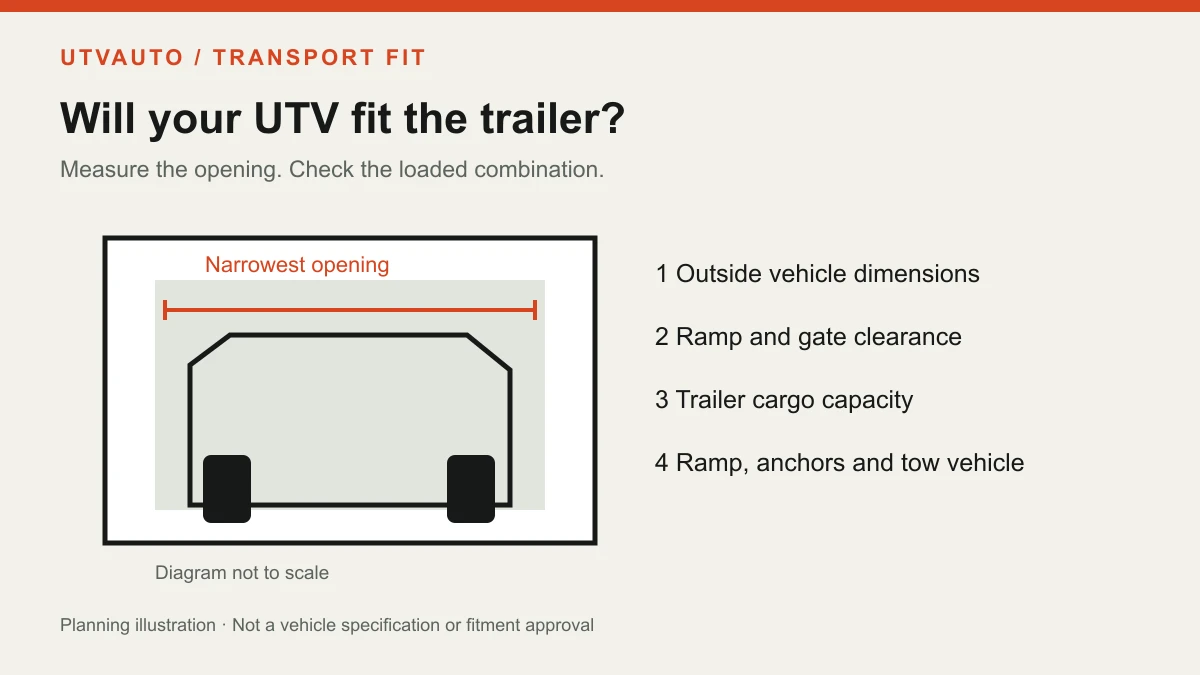
Measure the vehicle as it will be transported
Record three outside dimensions on level ground: maximum width, total length and maximum height. Identify which components create each measurement. A mirror can define the width while a roof or light bar defines the height. Include a front bumper, rear tire carrier or hitch accessory when it stays installed for transport.
Do not use wheelbase as overall length or tire-track width as overall width. If an accessory can fold or detach, measure the transport position and follow its manufacturer’s instructions for securing or removing it. Do not assume a windshield or roof may stay in place at road speed without checking.
Swipe sideways to view every column.
| UTV measurement | Value | What defines it? |
|---|---|---|
| Maximum outside width | ________ in | Tires, mirrors or accessory: ________ |
| Overall transport length | ________ in | Bumper / carrier / hitch: ________ |
| Highest transport point | ________ in | Roof / light / other: ________ |
| Ready-to-load vehicle weight | ________ lb | Weighed / documented estimate: ________ |
Find the trailer’s real bottlenecks
Measure between obstacles, not outside the trailer frame. On an open trailer, fenders, gate posts, rail brackets and tie-down hardware can be narrower than the deck. On an enclosed trailer, the door opening can be smaller than the interior. The door’s top edge may become the limiting point while the UTV is climbing the ramp.
A vehicle that clears on a level floor may not clear through the ramp transition. Approach angle, breakover clearance, ramp width and the change in vehicle pitch need checking. Do not use a loading attempt to discover an uncertain clearance. Have the trailer supplier confirm the combination and use the prescribed loading procedure.
Swipe sideways to view every column.
| Trailer check | Record | Decision |
|---|---|---|
| Narrowest gate or doorway | ________ in | Wider than the vehicle, with practical loading clearance? |
| Usable deck between obstructions | ________ × ________ in | Room for parking position and restraints? |
| Door height and ramp transition | ________ in; supplier confirmation ________ | Vehicle’s moving envelope clears throughout loading? |
| Ramp width, rating and support | ________________ | Suitable for this vehicle and its wheel loads? |
| Rated anchor points and access | ________________ | Can the required securement be installed and inspected? |
Example: why “the deck is wide enough” can be misleading
Imagine a 64-inch-wide UTV and a trailer advertised with a 76-inch deck. The arithmetic suggests 12 inches of total difference. If gate hardware reduces the opening to 65 inches, the loading bottleneck leaves only one inch total. That figure is not a recommended clearance. Steering corrections, measurement error and sidewall movement have not been evaluated.
Similarly, an 82-inch-high vehicle below an 84-inch doorway has only a static comparison. It does not establish clearance while the front wheels climb a ramp. The lesson is to record the limiting opening and loading geometry, rather than selecting a trailer from its model name.
Calculate cargo capacity using the trailer’s actual empty weight
Available trailer cargo capacity = trailer GVWR − actual empty trailer weight. GVWR is the maximum permitted gross trailer weight, including the trailer and its contents. Added spare tires, storage boxes and other equipment change the empty weight. The Big Tex owner’s manual, sections 1.2.8 and 3.1.1, also requires compliance with axle ratings; a total below GVWR does not prove that each axle is within its limit.
Here is a hypothetical capacity screen, using invented values:
Swipe sideways to view every column.
| Input | Weight |
|---|---|
| Trailer GVWR | 3,000 lb |
| Actual empty trailer, with installed equipment | 900 lb |
| Calculated cargo capacity | 2,100 lb |
| UTV ready for transport | 1,850 lb |
| Restraints and loose equipment not already counted | 120 lb |
| Total added cargo | 1,970 lb |
| Loaded trailer gross weight | 2,870 lb |
| Unused gross-weight capacity | 130 lb |
This passes only the example’s gross-weight arithmetic. It says nothing about ramp capacity, wheel or axle loading, tongue weight, securement or the tow vehicle’s limits. Use a scale and the manuals to resolve those checks. Do not treat a small difference between two estimated weights as verified headroom.
Complete the tow-vehicle and securement checks
The truck or other road tow vehicle must be suitable for the trailer under its own manual’s conditions. Check its towing, payload, axle and combination ratings, the hitch and coupling, and the actual tongue load. Passengers and cargo in the tow vehicle consume its load capacity too. Brake requirements and road rules depend on the equipment and jurisdiction; verify them for your trip.
Use the UTV manufacturer’s transport attachment points and procedure, together with the trailer and restraint manufacturers’ instructions. Do not assume a roof structure, suspension arm or accessory is a rated anchor. Park and restrain the vehicle as directed, secure loose equipment and verify that loading has not obstructed the trailer’s lights or inspection access.
A practical purchase rule
Before paying for a trailer, send the supplier your measured UTV dimensions, transport weight, tire configuration and tow-vehicle information. Ask them to confirm the opening, ramp and capacity questions in writing. A wider or longer deck may solve the geometry problem while a different rating is needed to solve the load problem.
Changing tires can change this result; use the larger-tire fitment checklist before relying on factory width or height. If you want the UTV to pull a work trailer instead, use our separate payload versus towing worksheet.
Method: UTVAUTO measurement framework and hypothetical arithmetic, with rating definitions checked against the linked trailer manual. No specific UTV/trailer combination was physically tested. Reviewed November 2, 2026.

