
Decide what the demonstration needs to answer
A useful UTV dealer test ride answers a short list of purchase questions about the identified machine. It can help you assess access, controls, visibility and the suitability of a demonstrated configuration. It cannot establish long-term reliability, certify an unknown used vehicle or prove how every trim in the family behaves. Define the questions before the appointment so the demonstration produces more than a general impression.
This guide is a buyer’s observation framework, not operator training or a driving tutorial. The dealer’s permitted route, the exact vehicle instructions and the participant’s qualifications govern whether and how a demonstration proceeds. Ask for instruction and appropriate preparation before operating an unfamiliar machine. A purchase deadline is not a reason to accept an unsuitable demonstration or skip the questions that matter to your use.
Match the demo vehicle to the quoted vehicle
Record the model year, full name, trim, seating version and installed equipment. Compare that information with the written quote. A cab, windshield, tires, suspension package or accessory can change the arrangement you observe. Ask which features are standard, which are optional and which belong only to the demonstration vehicle. Keep that list with your notes rather than relying on memory after seeing several machines.
If the exact quoted version is unavailable, identify what the substitute can reasonably show. A stationary look at a related model may answer a seat-access question while leaving dimensions or controls unresolved. Do not transfer a subjective impression across different tires, cabs or configurations as if nothing changed. The useful outcome can be a clearly stated limitation and a follow-up appointment, rather than a rushed decision based on the wrong machine.
Prepare the people and the questions
Tell the dealer how the vehicle will be used and who will normally occupy it. Ask about the requirements for the demonstration, available instruction and appropriate protective equipment. The 2026 RANGER manual illustrates why driver and passenger qualifications and new-operator preparation are specific topics to review. The buyer checklist does not replace those requirements or make an unqualified participant eligible.
Write a small set of observable questions. Can the intended driver reach and identify the controls while properly positioned? Can occupants enter and exit as directed? Does the proposed cab arrangement give the required visibility? Can you identify the parts that will be included in the order? Clear questions create a record that another person can review without needing to share your immediate enthusiasm or disappointment.
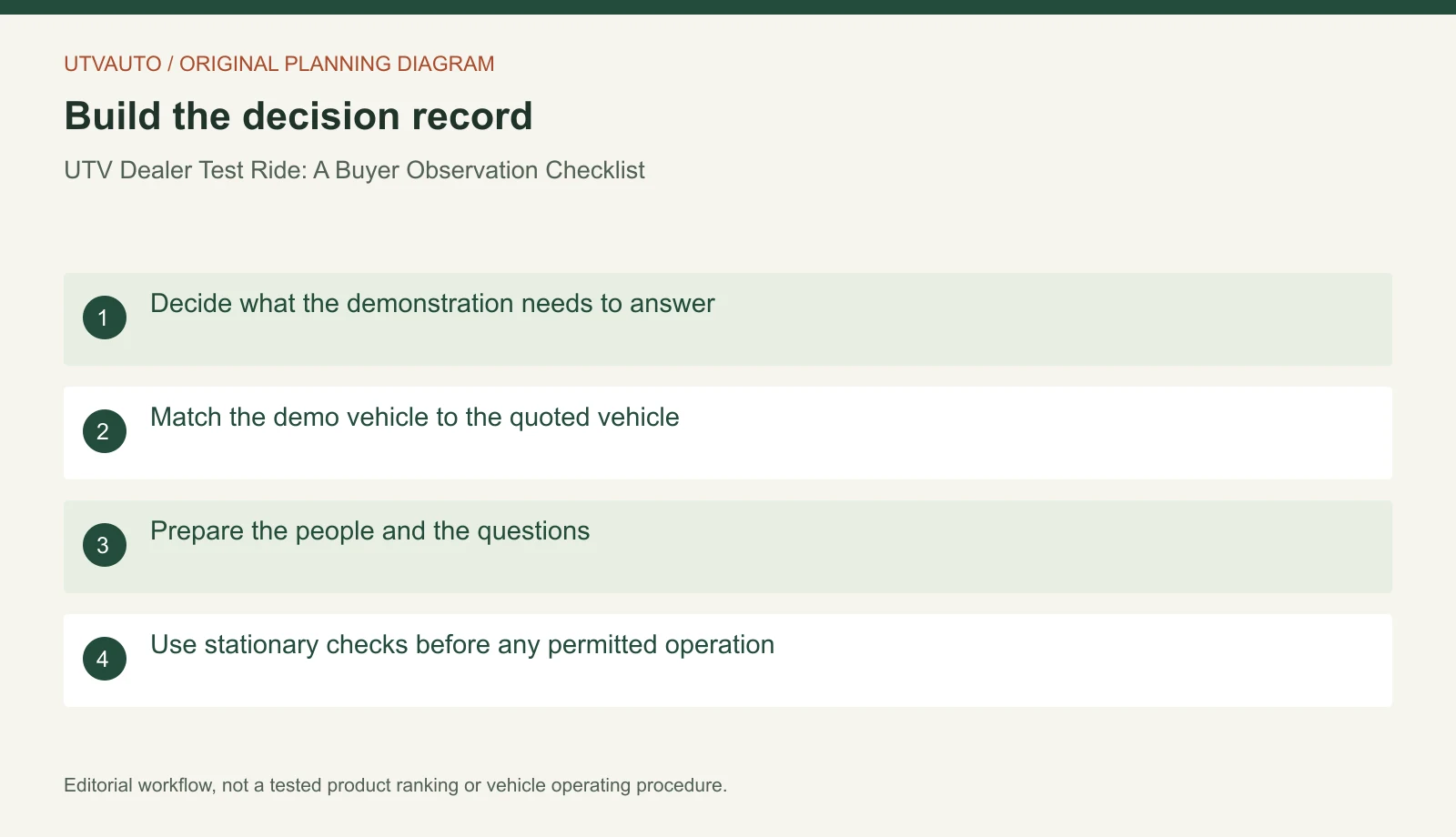
Use stationary checks before any permitted operation
With the vehicle parked and prepared as instructed, review seating, restraint arrangements, control locations, storage access and sight lines. Ask the representative to demonstrate unfamiliar adjustments or equipment. Record what was demonstrated and what remained unclear. Do not alter a setup or experiment with controls simply because the vehicle is stationary; the applicable procedures still govern its preparation and use.
Bring dimensions that matter to the purchase. A vehicle may feel roomy in a showroom and still be unsuitable for a garage or transport opening. Compare the exact configuration with your measurements and use the existing clearance worksheet to organize unresolved questions. A visual estimate at the dealership is not evidence that the completed machine fits the route into your storage area.
Keep the route and comparison conditions explicit
Use only the route and operating conditions that the dealer permits and that fit the vehicle and participants. Describe the surface and the configuration in the notes. If you compare two machines, record material differences in route, equipment or conditions rather than describing the result as a controlled test. A short demonstration with different loads is not a basis for a precise performance ranking.
Do not turn the appointment into a search for maximum speed or a test of uncertain limits. A practical purchase question may be answered by understanding control behavior or the layout, while an operating condition outside the demonstration scope remains unresolved. Ask how the dealer proposes to address that question appropriately. Uncertainty is a legitimate result; inventing confidence from an unrelated maneuver is not.
Write observations separately from explanations
Use two columns: what you observed and what someone said it meant. A displayed warning, a difficult access point or an unexpected sound can be described without diagnosing it. Record the representative’s explanation with its source and any proposed next step. Do not convert an informal explanation into a confirmed mechanical finding merely because it appears beside your own observation.
For a used vehicle, retain the need for an independent condition assessment and the relevant records. A machine completing a brief demonstration does not establish that every system is in good condition or that a campaign repair was completed. If an issue appears, stop the relevant activity and follow the instructions or dealer process. The purpose is to make an informed purchase, not to keep operating until a concern becomes more obvious.
Turn accessory impressions into a complete quote
Identify the exact doors, windshield, roof, mirrors and storage components that helped create the demonstrated arrangement. Ask whether those same components are in the order and whether other parts are required to make the installation complete. A pictured finished cab can conceal separate costs for seals, brackets, wiring or labor. Record each item at the part or package level where possible.
Keep pricing distinct from the demonstration notes. A salesperson’s verbal estimate is not the same document as an itemized offer for the identified configuration. Use the quote calculator to compare the same scope across candidates. A preferred seating arrangement may justify investigating an option, but it should not silently erase a difference in equipment or delivered price.
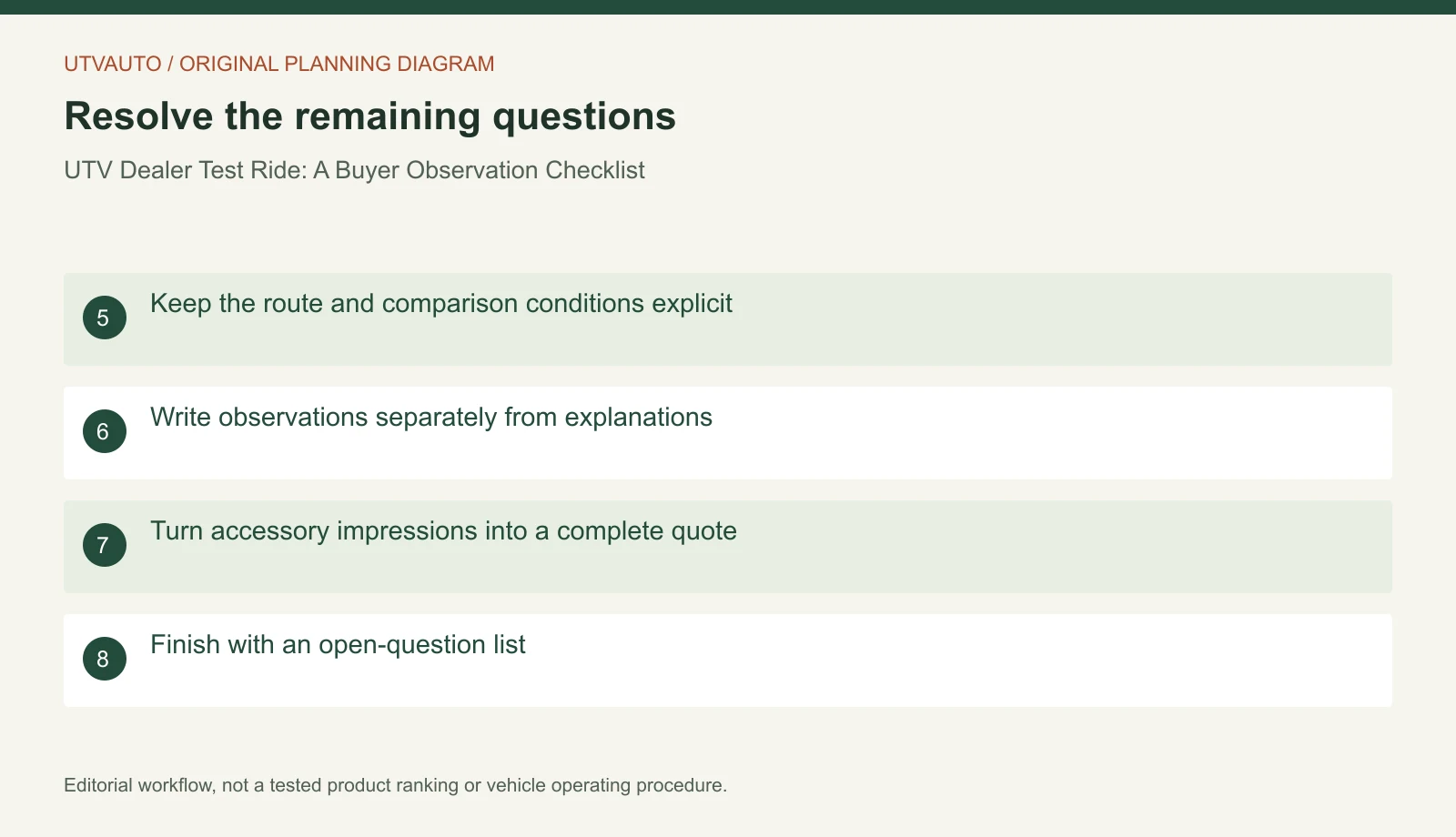
Finish with an open-question list
Before leaving, review which questions were answered, which were only discussed and which still need evidence. Give each unresolved item a next action: a source document, a fitment confirmation, a condition assessment or a different demonstration. Ask for the relevant follow-up in a form you can retain. This reduces the risk that an important condition disappears between the test ride and the purchase paperwork.
For example, a buyer may like the demo vehicle’s visibility but discover that its windshield differs from the quoted package. The correct next step is to identify the actual ordered parts and evaluate that arrangement, not to assume the view will be identical. A useful demonstration ends with a better-defined vehicle and fewer unexplained assumptions. It does not need a universal winner or a numerical score unsupported by the conditions of the visit.
Use an observation sheet that can be compared later
A practical sheet has fields for the demonstration date, exact vehicle, fitted equipment, permitted route and the purchase questions being investigated. Under each question, record the observation, the conditions and the follow-up needed. Keep subjective impressions labeled as impressions. A statement that a control felt different during one demonstration is not the same kind of evidence as a documented difference in control layout or equipment.
Suppose a buyer compares an open-cab vehicle with an enclosed demonstrator and prefers the second experience. The useful next question is which elements of the enclosure and configuration contributed to the preference, and whether they are included in the quote. It would be misleading to attribute the entire difference to the vehicle brand when the demonstrated equipment was not matched. The observation sheet keeps that uncertainty visible.
Review the sheet before a deposit rather than after delivery. Confirm the actual ordered configuration and close any question that determines whether the vehicle can do the intended job. If an important question remains unanswered, document what further demonstration or evidence is needed. This process does not demand a perfect laboratory comparison. It asks for a clear separation between what the buyer experienced, what the dealer explained and what the purchase documents actually promise.
Related UTVAUTO resources
- Compare itemized dealer offers
- Identify exact year and trim specifications
- Separate purchase inspection from a demonstration
Sources and scope
This is a research-based planning guide, not a UTVAUTO product test, installation or professional inspection. Manufacturer and safety references were checked November 9, 2026. Use the exact vehicle and component instructions for operational requirements.
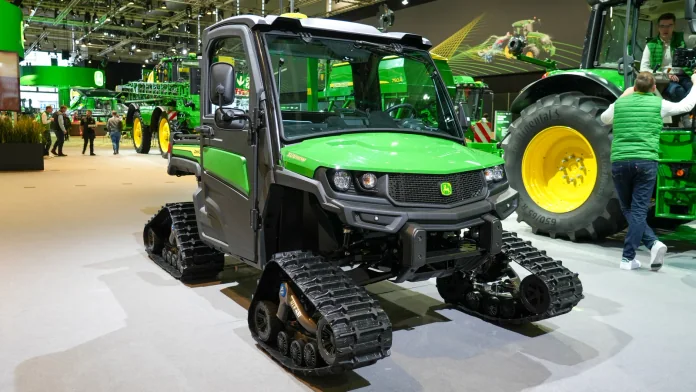
Featured archival reference photograph: John Deere Gator XUV865M Agritechnica 2023 (DSC03731). It illustrates vehicle context, not a UTVAUTO test, the exact equipment discussed or an endorsement. MarcelX42 / Wikimedia Commons / CC BY-SA 4.0. Resized and converted to WebP; photograph retains its stated license.