
A load needs both capacity and a secure arrangement
A UTV cargo load is acceptable only when the vehicle limits and the arrangement both work for the actual trip. A bed that is not over its weight rating can still contain items that move, interfere with controls or prevent required access. Begin with an inventory and the exact vehicle instructions, then verify the attachment method for the equipment being carried. Do not interpret a large-looking cargo box as approval for every object that fits inside.
This planning guide helps owners prepare repeatable property-work loads. It is not a tie-down engineering specification or permission to carry hazardous materials. It separates the load-budget calculation from the practical questions of movement, attachment and access. If the manufacturer does not identify a suitable method for your load, obtain qualified advice instead of assigning an improvised anchor point a made-up rating.
List the actual items before arranging the bed
Write down every container, tool, accessory and consumable that will travel with the vehicle. Record measured or reliably documented weights, including the contents of boxes and tanks. A container’s empty shipping weight is not the weight of the loaded item. Mark unknown values for measurement rather than hiding them within a rough total. Keep the list specific enough that another operator can reproduce the intended load.
Group the items by the job they serve and remove equipment that is not required. This can create more useful space than adding another rack. Record items that need separate specialist handling, such as fuels or chemicals, and follow their applicable requirements. A general cargo worksheet should not invent a transport solution for those materials. If an item requires approved equipment or instructions, resolve that requirement before including it in the working load.
Check the limits that apply to this vehicle
The linked 2026 RANGER manual treats cargo and total vehicle loading as separate limits. Use the correct model and market information for your machine rather than assuming that the bed rating is its remaining capacity. Include the people and installed equipment in the vehicle-level budget. Keep the documented limits beside the inventory so the calculation can be reviewed without searching through several unrelated files.
If two limits apply, the load must satisfy both; a favorable result for one does not cancel the other. Do not count unused trailer capacity as extra cargo-bed capacity. For an uncertain accessory weight or a missing configuration detail, obtain the information before declaring the load acceptable. The worksheet is useful because it exposes missing inputs, not because it can produce an answer from incomplete data.
Map the load and identify every attachment
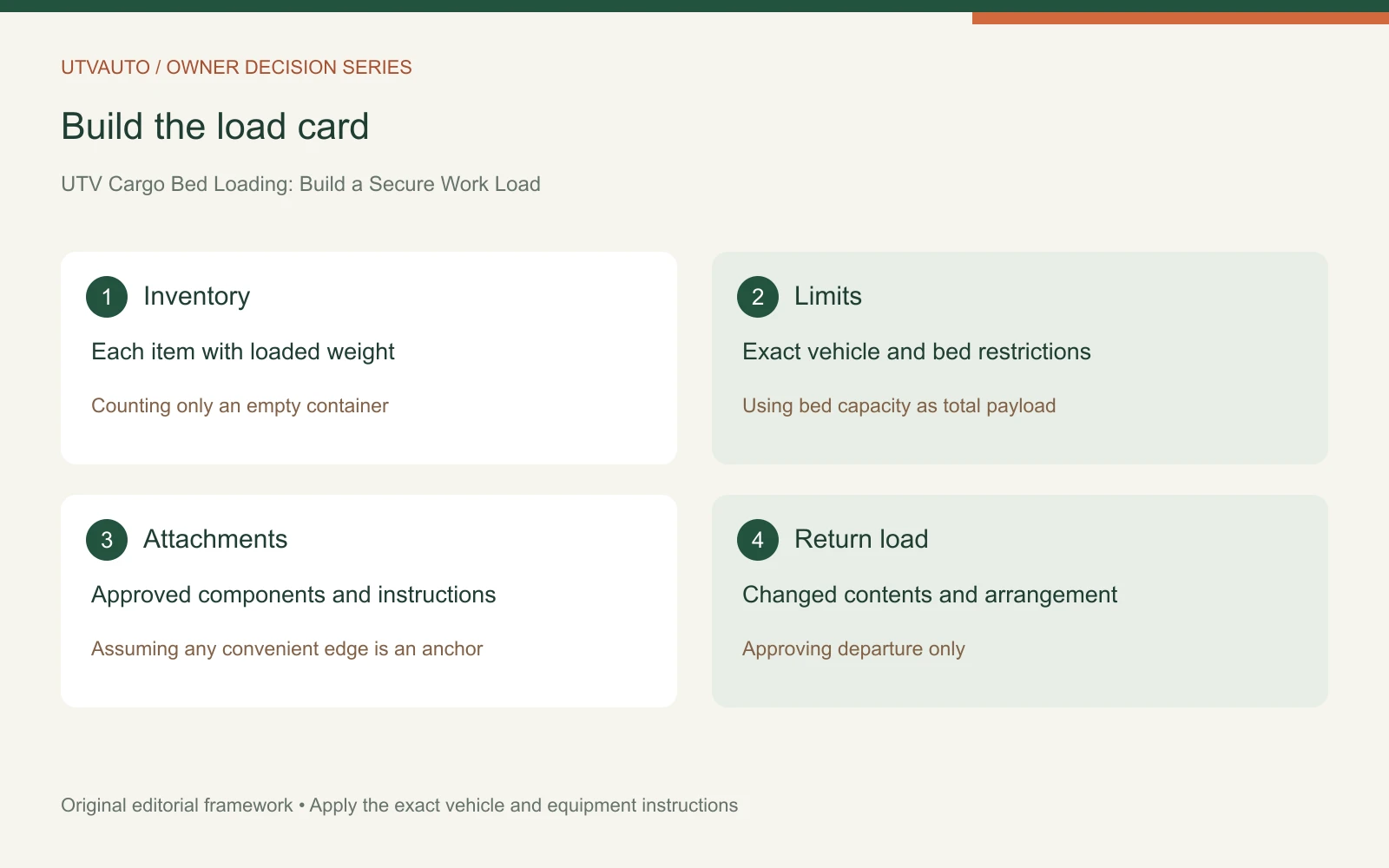
Sketch the bed from above and label the intended position of each item. Identify attachment locations using the vehicle and accessory documentation. A convenient opening, plastic edge or rack tube is not automatically a suitable anchor. Record the component and supporting instruction for the method selected. If you cannot explain what the restraint attaches to, the arrangement is not yet ready to repeat.
Think about separate movement of the container and its contents. Securing a box does not necessarily secure loose tools inside it, and closing a lid does not establish that the latch is suitable for the conditions. Ask the equipment supplier about the actual application. Do not invent strap tension, anchor strength or a universal number of restraints. Those details depend on the documented equipment and the load, which a generic article cannot inspect.
Keep working access separate from carrying convenience
Check access to the bed latch, required service areas and the items needed during the job. A heavily packed arrangement that must be dismantled for every ordinary task can encourage shortcuts. Design the normal workflow before the first trip: where the vehicle stops, how tools are accessed and what must be secured again before moving. Keep people clear of cargo movement and follow the manufacturer’s operating procedure.
Inspect the load from the operator’s position with the vehicle stationary. Do not accept an arrangement that intrudes into occupied space or compromises required visibility and access. If an item is too long or awkward for an approved bed configuration, use another appropriate transport solution. “Only a short distance” does not make an unresolved interference problem disappear, and a tailgate position should never be assumed acceptable without the correct instructions.
Test the plan with changing work supplies
Many property-work loads change during the day. Consumables are used, collected materials are added and tools return in a different order. Create a return-load case rather than evaluating only the neat departure photograph. Define where newly collected items will go and what must be removed if the planned load changes. If the return load cannot be reasonably anticipated, establish a conservative process for reassessing it before moving.
For a hypothetical example, a crew leaves with hand tools and returns with removed fence components. The return trip is a new load case, not an automatic extension of the first approval. The inventory, weights and restraint arrangement need another look. Avoid assuming that empty space created by used supplies is appropriate for whatever material the job produces. Different shapes and contents can create different attachment and access problems.
Create a pre-movement and stop-check routine
Before moving, compare the actual load with the approved plan and check the components according to their instructions. Look for omitted items, changed contents and restraints that no longer match the arrangement. If cargo shifts, a latch fails or an attachment appears damaged, stop in a safe place and reassess. Do not have a passenger hold a loose item as a substitute for a suitable cargo solution.
Include a check after the load has been accessed during work and whenever the arrangement changes. The appropriate routine depends on the operation and equipment; this guide does not prescribe a universal time or distance interval. Assign responsibility clearly when several people use the vehicle. A photograph can help show the intended layout, but it cannot replace a physical check or prove the hidden condition of an anchor or restraint.
Save a repeatable load card for common jobs
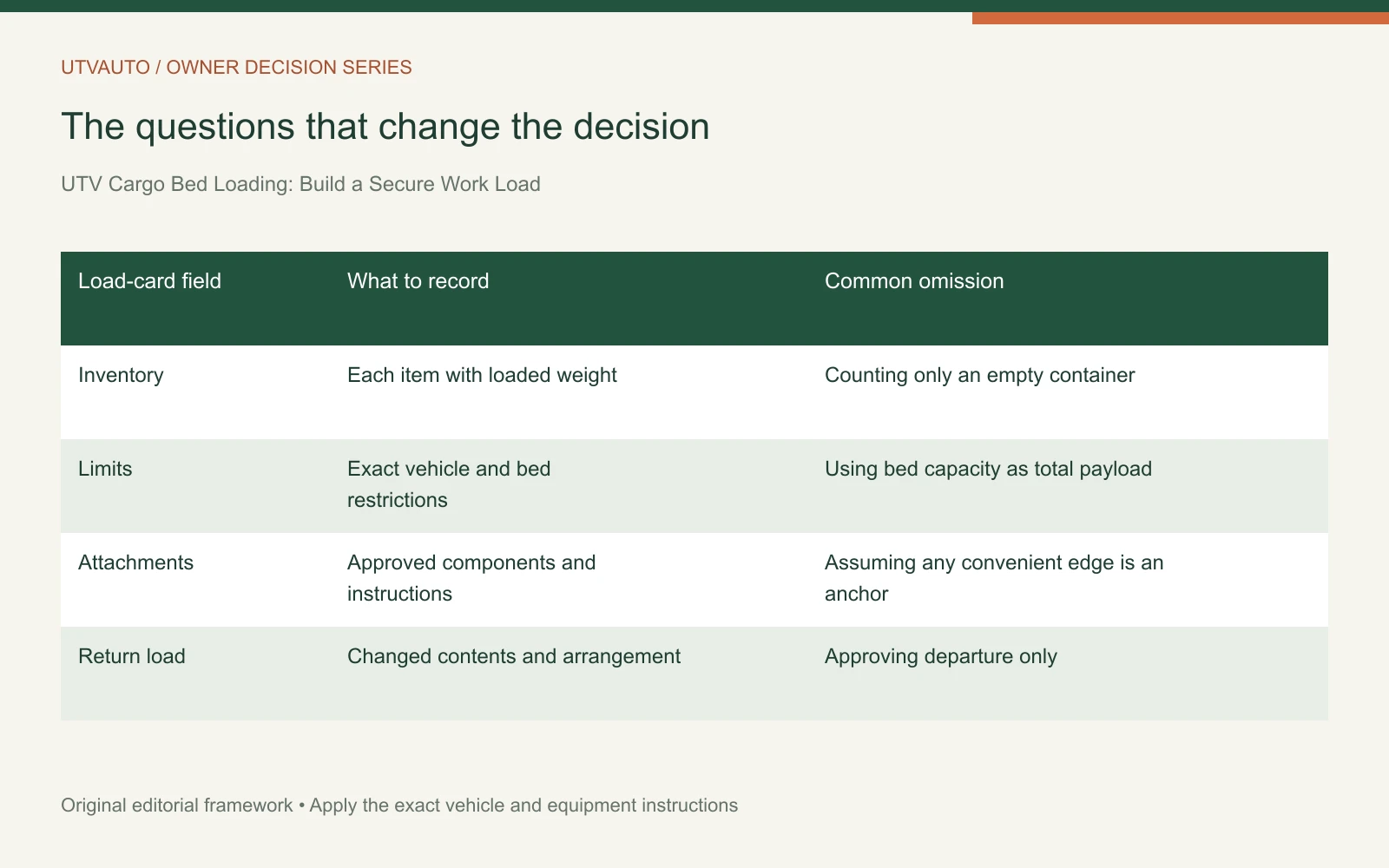
A useful load card names the vehicle configuration, the task, the item inventory, documented limits, attachment references and the permitted layout. Add a date and a field for changes. Keep a simple photo or sketch with numbered items so another trained operator can compare the real load with the record. Avoid printing private information that does not help the work, such as unrelated purchase documents.
Review the card when an accessory, container or job changes. If the new configuration lacks an approved attachment method, suspend use of that arrangement while you resolve it. The card should make ordinary work simpler while keeping uncertainty visible. It should never become a permanent certificate that every future load is suitable merely because it uses the same cargo box and has a similar total weight.
Example: redesign an awkward tool load before adding storage
Imagine a property-work load containing a large toolbox, several hand tools and supplies for a maintenance job. The box fits within the bed, but it blocks access needed during the work. Adding a second rack may look like the obvious solution. First review whether every item is required and whether a different approved arrangement can restore access without increasing the equipment carried.
Create two sketches with the same inventory and mark which items are reached at each work stop. Ask whether either arrangement has a documented securing method and leaves required controls and access unobstructed. If neither does, change the load or use another suitable transport method. Do not declare the least inconvenient sketch acceptable simply because its total weight fits a capacity calculation.
Once a suitable arrangement is established, number the containers and keep the inventory with the load card. Record what belongs inside each container so later users do not silently substitute heavier contents. When supplies change, reassess the actual load. The practical gain is a repeatable job setup with less searching and fewer assumptions, rather than a bed packed as densely as possible. Space utilization is useful only after the configuration itself is appropriate.
Working reference table
| Load-card field | What to record | Common omission |
|---|---|---|
| Inventory | Each item with loaded weight | Counting only an empty container |
| Limits | Exact vehicle and bed restrictions | Using bed capacity as total payload |
| Attachments | Approved components and instructions | Assuming any convenient edge is an anchor |
| Return load | Changed contents and arrangement | Approving departure only |
Related UTVAUTO resources
- Calculate payload and cargo limits separately
- Evaluate cargo storage boxes
- Distinguish vehicle transport tie-downs from bed cargo
Sources and scope
Research and editorial planning framework, checked November 9, 2026. UTVAUTO has not tested these vehicles, measured their noise, or inspected the reader’s machine. Examples are explicitly hypothetical. Use the exact vehicle manual and obtain qualified assistance for unresolved safety questions.
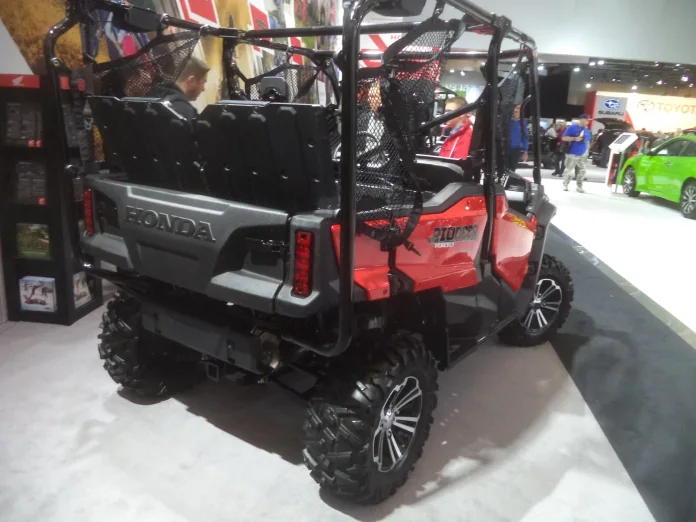
Featured archival reference photograph: Honda Pioneer 2 (31859498244). It illustrates vehicle context, not a UTVAUTO test, the exact equipment discussed or an endorsement. Zytonits / Wikimedia Commons / CC BY-SA 2.0. Resized and converted to WebP; photograph retains its stated license.


