
The useful answer is a budget for your usage
UTV ownership cost is the money required to keep and use a particular vehicle over a defined period, plus any economic costs you choose to include. There is no defensible single annual figure for every owner. A machine used daily on property creates a different spending pattern from one trailered to a few weekend events. Begin with your expected tasks and operating hours, then attach documented prices to the items those tasks require.
This worksheet separates the purchase decision from the annual operating decision. It is an editorial budgeting method, not a dealer quote, investment forecast or claim about average repair costs. Work in US dollars if that matches your receipts, and label every other currency. Keep a cash budget and an economic comparison in separate columns so depreciation does not accidentally become another bill you must pay this month.
Divide fixed commitments from usage-dependent spending
Make one list of costs that remain even during a quiet season: storage, any applicable registration, insurance you actually obtain, and other recurring commitments. Verify amounts with the relevant provider or authority. A charge on a neighbor’s bill is not evidence of the same charge applying to you. Do not put an insurance estimate in the confirmed column until the provider has described the vehicle, use and coverage being quoted.
Put fuel, consumables, scheduled maintenance and transport fuel in a second list. These depend more directly on use, although not always in a straight line. Some service is time based even when annual hours are low. The planning question is which events will actually occur during the budget period. If a category has no reliable amount yet, write a range and an action to obtain a quote rather than quietly treating the cost as zero.
Calculate fuel with an explicit measurement basis
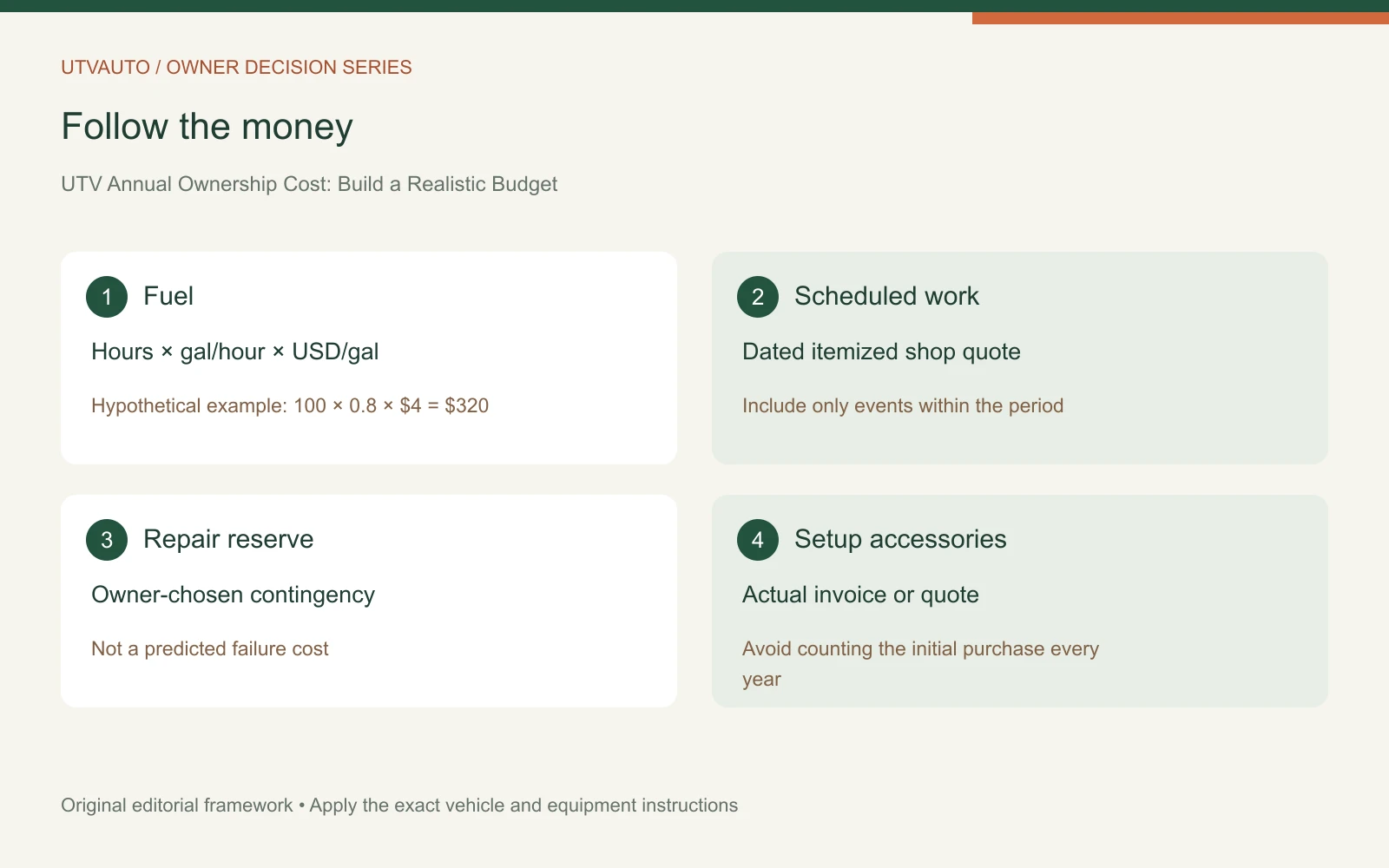
If you track consumption in gallons per engine hour, annual fuel cost equals planned hours multiplied by gallons per hour multiplied by the price per gallon. For a deliberately hypothetical example, 100 hours times 0.8 gallons per hour times $4 per gallon equals $320. These inputs are invented to show arithmetic. They are not RANGER specifications or a promised consumption rate for any UTV.
Replace the example with your own repeatable records. Note the fill method, operating conditions and measurement period. Long idling periods can make a distance-only calculation misleading, while a trail ride may differ substantially from slow property work. Do not mix miles per gallon with gallons per hour in one formula. When comparing vehicles without trustworthy consumption data, show several fuel scenarios instead of manufacturing a precise winner from engine displacement.
Build maintenance spending from actual scheduled events
Locate the correct maintenance schedule using the complete model, year and market. The linked 2026 RANGER manual is one example of a vehicle-specific source; it does not establish a service interval for other machines. List the work expected during your ownership period and request parts and labor quotes for those tasks. Distinguish a quoted package from a task list you merely hope it includes.
Ask whether the quote includes consumables, shop supplies, tax and any disposal charge. If you plan owner-performed work, budget the required tools and supplies without assuming your time or skill replaces a qualified technician for every job. Preserve the quote date. A documented but older quote is more useful than an unexplained round number, provided you recognize that the shop must confirm current pricing before work is authorized.
Keep repair reserves distinct from predicted failures
A repair reserve is money you choose to hold for uncertainty. It is not evidence that a transmission, engine or belt will fail. Label the reserve separately from known scheduled work. Avoid repeating an unsourced internet claim that every owner spends a particular amount on repairs. That claim often blends unusually hard use, modifications, accident damage and different models into a misleading average.
You can test affordability without predicting failures. Ask whether the household or business could handle a hypothetical unexpected bill while continuing its other commitments. Choose an amount appropriate to your own finances and make the assumption visible. For a used vehicle with an unresolved inspection issue, request a specific assessment and repair quote. A general reserve should not disguise an already identified problem as an ordinary future possibility.
Count transport and accessories without double counting
A UTV that requires trailering has trip costs beyond the fuel in its own tank. Create a separate transport row using actual tow-vehicle trip records or a clearly labeled estimate. Include event or access charges only when they apply to the routes you expect to use. Spread a genuinely shared trip cost using a method everyone understands instead of billing the whole amount to each vehicle.
Treat initial accessory purchases as a setup budget. Replacement wear items may belong in the annual plan, but the original purchase should not reappear every year unless replacement is actually planned. If a dealer quote already includes the roof, windshield and installation, do not add the same items again. Keeping invoice lines visible makes it easier to compare a bare vehicle with a configured alternative on the same basis.
Use two totals and three usage scenarios
The annual cash total adds the payments and purchases expected during that year. An economic comparison can also consider value lost during ownership, but depreciation needs its own assumptions and is not a guaranteed resale result. If financing is involved, avoid adding both the entire purchase price and all loan payments to the same cash-year total. Obtain the actual agreement and seek appropriate advice where necessary.
Create low, expected and high usage columns. Change the uncertain inputs rather than applying a mysterious percentage to the final total. Fuel use, number of towing trips and scheduled service events are useful variables. Keep confirmed fixed charges constant unless the provider says they change. The purpose is to discover which assumption controls affordability, not to present a spreadsheet with more decimal places than the evidence can support.
Turn the budget into a purchase decision
Compare two candidates using the same period, currency, tasks and included equipment. A cheaper machine can become expensive if the required configuration adds substantial setup cost, while a costly feature can be poor value if it never serves your work. Record the actual reason each accessory or capability is needed. Remove items that only entered the list because they appeared in a promotional bundle.
End with three actions: obtain the largest missing quote, verify the service events, and check the plan against actual spending after an initial period of use. Save both the original estimate and the revised version. That comparison can improve your next budget without pretending the original forecast was exact. A useful ownership worksheet explains where the money goes and what remains uncertain before you commit to a vehicle.
Worked comparison: find the assumption that changes the choice
Consider two hypothetical ownership plans for the same vehicle. Plan A uses the machine mainly on property and expects 100 operating hours. Plan B expects the same operating hours but adds twelve trailering trips. The vehicle fuel estimate can remain the same for this exercise while the transport rows change. This isolates one difference instead of pretending the second plan costs more because the vehicle itself suddenly consumes more fuel.
Now add a service event to only the plan in which it actually becomes due. Record why it occurs within that period using the correct schedule. If the amount is not quoted, leave the amount unresolved and request it. The comparison may reveal that transport, setup or a particular service event matters more than a small difference in assumed fuel consumption. That is the decision the worksheet is intended to support.
Keep the example separate from real invoices. Once you replace the hypothetical inputs with documented figures, date the version and save the old assumptions. When the first season ends, compare categories rather than only totals. Two errors can cancel in a grand total while concealing a weak fuel estimate and an overlooked transport cost. Category-level review creates a better plan for the following year.
Working reference table
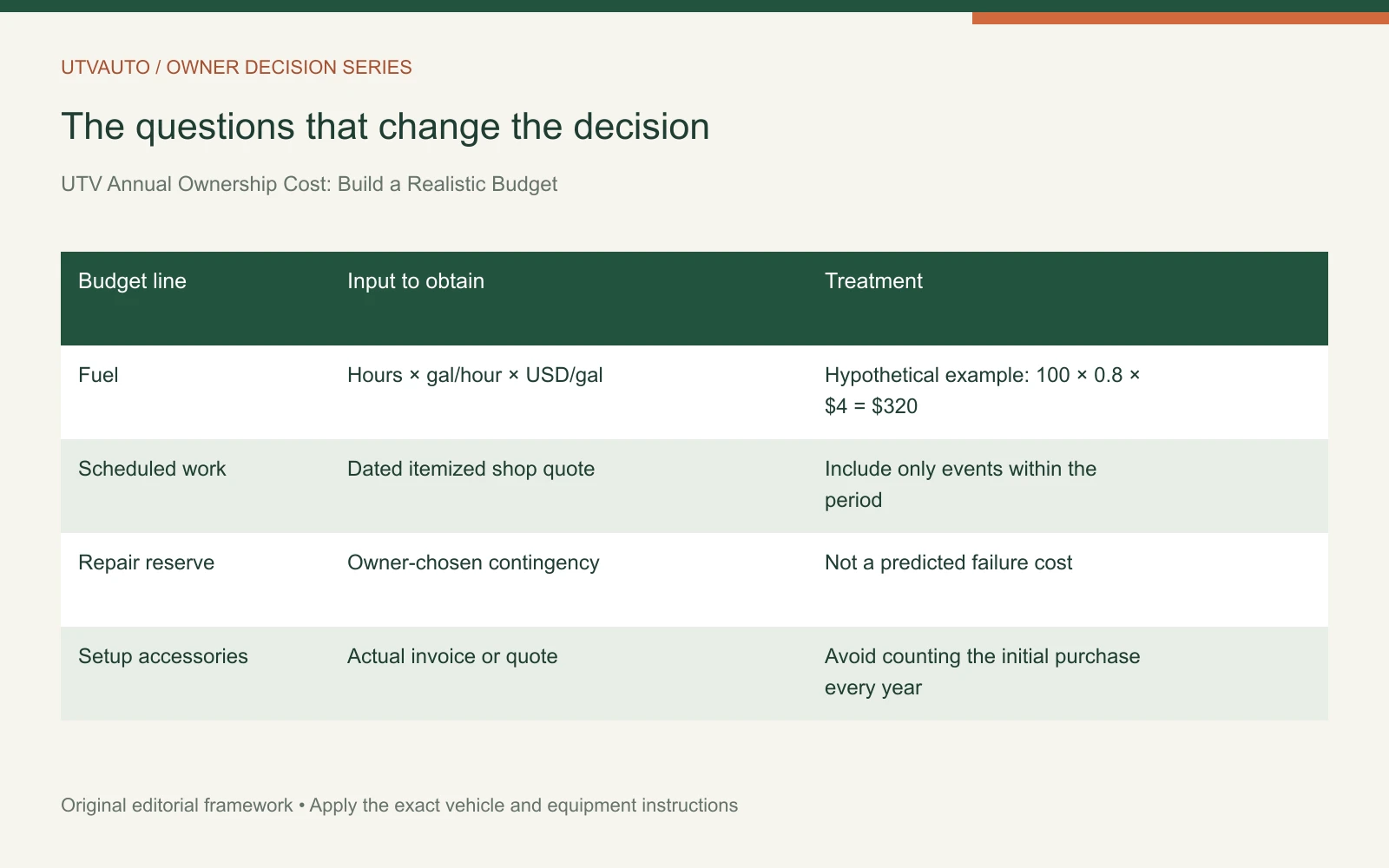
| Budget line | Input to obtain | Treatment |
|---|---|---|
| Fuel | Hours × gal/hour × USD/gal | Hypothetical example: 100 × 0.8 × $4 = $320 |
| Scheduled work | Dated itemized shop quote | Include only events within the period |
| Repair reserve | Owner-chosen contingency | Not a predicted failure cost |
| Setup accessories | Actual invoice or quote | Avoid counting the initial purchase every year |
Related UTVAUTO resources
- Compare purchase-price scope
- Understand operating hours and distance
- Keep a useful maintenance record
Sources and scope
Research and editorial planning framework, checked November 9, 2026. UTVAUTO has not tested these vehicles, measured their noise, or inspected the reader’s machine. Examples are explicitly hypothetical. Use the exact vehicle manual and obtain qualified assistance for unresolved safety questions.
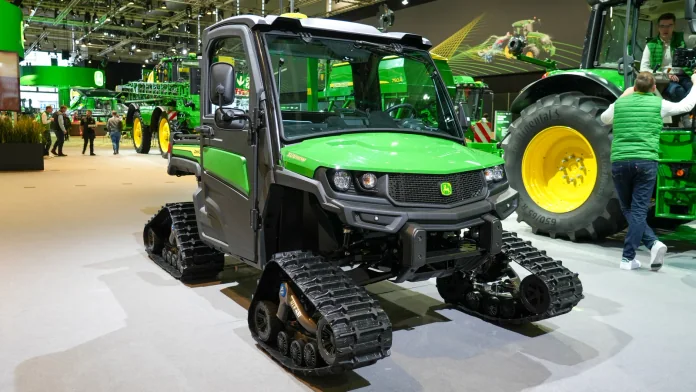
Featured archival reference photograph: John Deere Gator XUV865M Agritechnica 2023 (DSC03731). It illustrates vehicle context, not a UTVAUTO test, the exact equipment discussed or an endorsement. MarcelX42 / Wikimedia Commons / CC BY-SA 4.0. Resized and converted to WebP; photograph retains its stated license.