
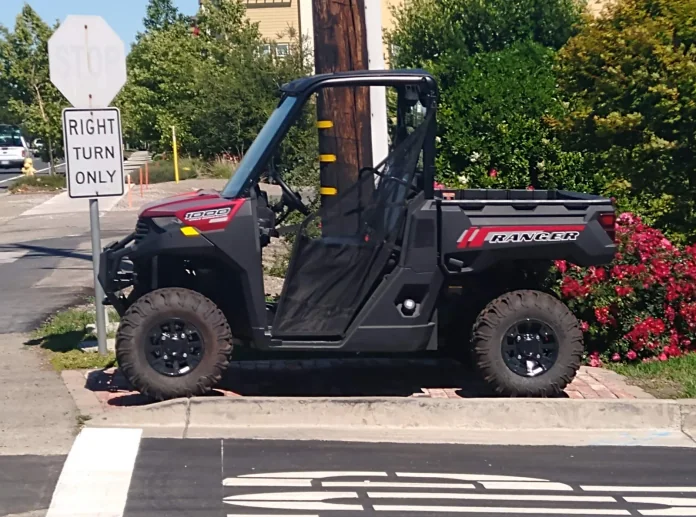
Featured reference photograph: 2021 Polaris Ranger 1000. It illustrates the vehicle family or accessory context, not the exact current trim or an independently tested installation. DestinationFearFan / Wikimedia Commons / CC BY-SA 4.0. Resized and converted to WebP; photograph retains its stated license.
Choose a UTV roof by exact chassis, model year and seating version, then check how it joins the windshield, rear panel and doors. A weather roof does not automatically provide a rack load rating or change the vehicle’s rollover-protection approval.
The concrete examples below come from the 2026 RANGER roof page. They illustrate why a roof purchase needs part-number verification rather than a generic “full-size UTV” description.
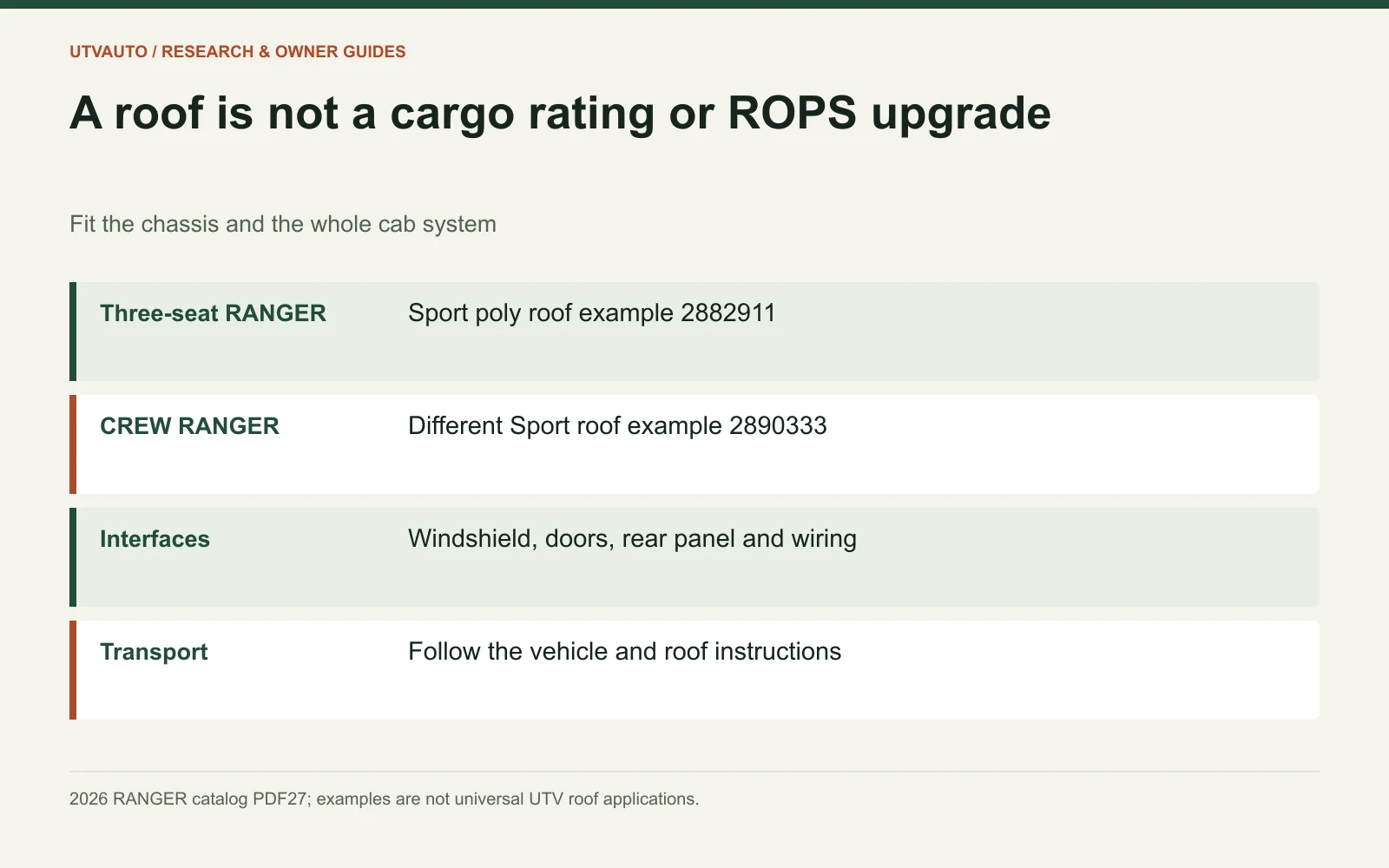
Three-seat and CREW roof applications are different
| Catalog example | Listed part | Application detail to verify |
|---|---|---|
| Sport poly roof | 2882911 | RANGER 1000 2020–2026 and listed XP applications; not a blanket CREW roof |
| Sport poly roof CREW | 2890333 | CREW 1000 2020–2026 and listed CREW XP applications |
| Premium poly roof | 2890684 | A separate roof package with its stated liner/equipment; confirm current application |
| Premium roof liner | 2890526 / CREW 2890527 | Liners are different parts and do not establish roof compatibility on their own |
Read the full application line and current instructions. Shared engine displacement does not make the roof length, mounting points or sealing interfaces identical. Check whether the actual vehicle already includes a roof before ordering another one.
Inspect every interface on the proposed build
List the windshield, doors, rear panel, mirror and roof-mounted electrical accessories. Confirm that an opening windshield can move through its permitted positions and latch correctly. Ask whether the roof requires particular seals, liners or wiring components that are sold separately.
At purchase, distinguish the base roof from a premium package, headliner, electrical distribution component or mounting bracket. A photograph of a finished cab may include optional parts that are not in the roof box.
Do not assume roof cargo is allowed
If you want a roof rack, obtain the rack and vehicle manufacturer’s load limits, required supports and permitted installation. The roof’s ability to shed rain is not a structural cargo specification. Do not drill or modify the ROPS based on a universal bracket claim.
Include the roof, rack, mounts and carried items in the vehicle’s permitted-load accounting. Moving cargo higher also changes the loading arrangement; a simple remaining-payload calculation does not establish that a high-mounted load is safe or approved.
Check the equipped height and transport directions
Measure the tallest point of the completed vehicle, including mounts and other accessories. A catalog vehicle height may describe a different roof arrangement. Use the garage-opening worksheet before relying on a nominal door size.
The 2026 RANGER 1000 transport instructions require a vehicle on a non-enclosed trailer to face forward or have the roof removed. Follow the exact roof and vehicle instructions together; do not extend that statement into universal approval for all other accessories or platforms.
Compare the completed roof setup
Request separate lines for the roof, mandatory hardware/seals, liner, compatible electrical parts and labor. Include removal or relocation of accessories only when actually needed. Obtain a dated quote rather than assuming a universal roof price range.
Use the windshield guide for the front interface and the rear-panel guide for a whole-cab dust question. The accessory research center links roof decisions to lighting, storage and protection checks.
Editorial collection: September 2026. This is a topic collection label, not a backdated first-publication date.