
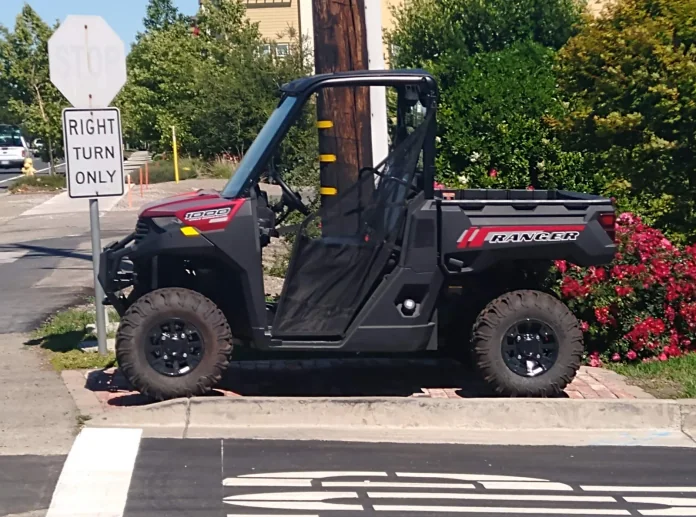
Featured reference photograph: 2021 Polaris Ranger 1000. It illustrates the vehicle family or accessory context, not the exact current trim or an independently tested installation. DestinationFearFan / Wikimedia Commons / CC BY-SA 4.0. Resized and converted to WebP; photograph retains its stated license.
Tie down a UTV using its designated restraint points and the instructions for the vehicle, trailer and securement equipment. Fitting on a deck does not prove that the loaded trailer or restraint arrangement is suitable. A photo of another vehicle’s straps is not an approved rigging plan for yours.
This guide provides a preparation and verification framework. The concrete example is the 2026 RANGER 1000 manual’s transport section. It does not assign universal strap capacity, tension, attachment geometry or a procedure for every UTV.
Separate the three transport questions
| Question | Evidence to obtain |
|---|---|
| Will it fit? | Actual equipped dimensions, usable deck, ramp and opening measurements |
| Can the complete setup carry it? | Loaded weights and the relevant trailer/tow-vehicle ratings |
| Can it be restrained correctly? | Designated vehicle points, approved anchor locations and suitable rated equipment |
Passing one check does not establish the other two. A small vehicle can fit on a trailer with inadequate capacity, while a sufficiently rated trailer can still have an obstructed anchor arrangement.
What the RANGER example actually specifies
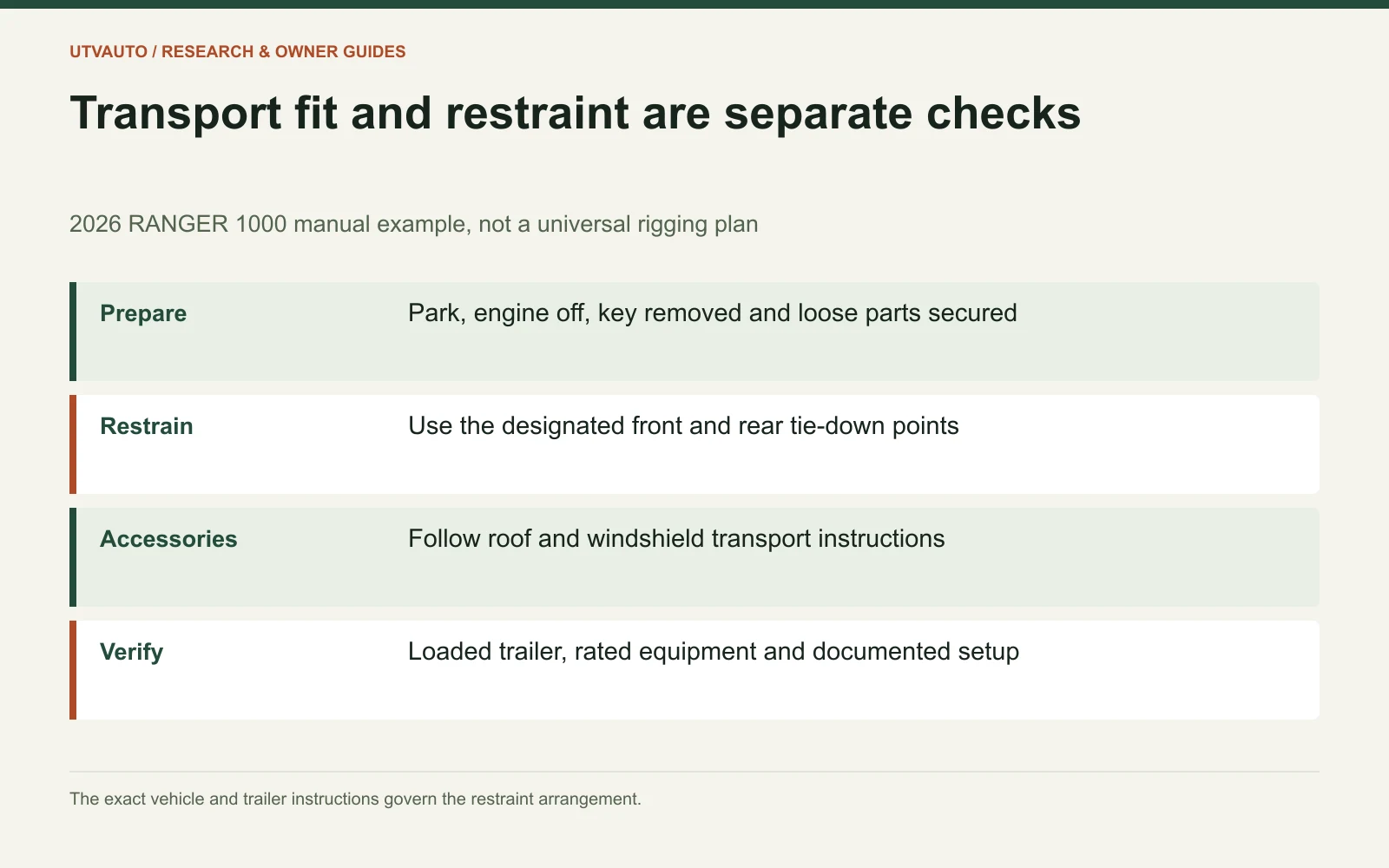
The named manual calls for applying the brake, placing the transmission in PARK, stopping the engine, confirming PARK before exiting and removing the key. It also requires the fuel cap and seat to be secured and loose cargo or components to be secured or removed.
It identifies designated front and rear tie-down locations for securing the vehicle to the trailer. Consult those diagrams on the actual manual rather than guessing from a suspension arm, bumper opening or ROPS tube. A recovery loop and a transport attachment must be used only as permitted by the applicable instructions.
Resolve accessory transport restrictions before loading
For a non-enclosed trailer, the same RANGER manual requires the vehicle to face forward or the roof to be removed. That instruction is specific and material. It is not blanket permission to leave every roof-mounted item, opening windshield or aftermarket panel installed.
Check the exact roof, windshield and other accessory directions as well. If instructions appear inconsistent, obtain clarification before transport. Do not use an unverified latch, bungee or assumed travel position as a substitute for the required method.
Verify rated equipment and access
Identify the actual loaded vehicle weight, tie-down equipment ratings and trailer anchor ratings. Follow the equipment and trailer instructions for the complete arrangement. This article deliberately does not infer a required strap working-load limit from the vehicle’s catalog dry weight.
Have an experienced qualified installer or transport professional resolve a setup when the designated points cannot be reached, the anchor condition/rating is unknown, a strap would contact a sharp or hot surface, or the required arrangement cannot be achieved. Do not improvise by using an unapproved guard as an attachment.
Perform the final condition check
Confirm that loose items and accessories have been addressed, the restraint equipment is in serviceable condition and the loaded arrangement follows all relevant instructions. Use the trailer/equipment guidance for any required checks during the trip; no universal re-tension distance is supplied here.
Return to the trailer measurement checklist if physical fit is still unresolved. Use the roof application guide and RANGER research center for the vehicle-specific equipment context.
Editorial collection: October 2026. This is a topic collection label, not a backdated first-publication date.


