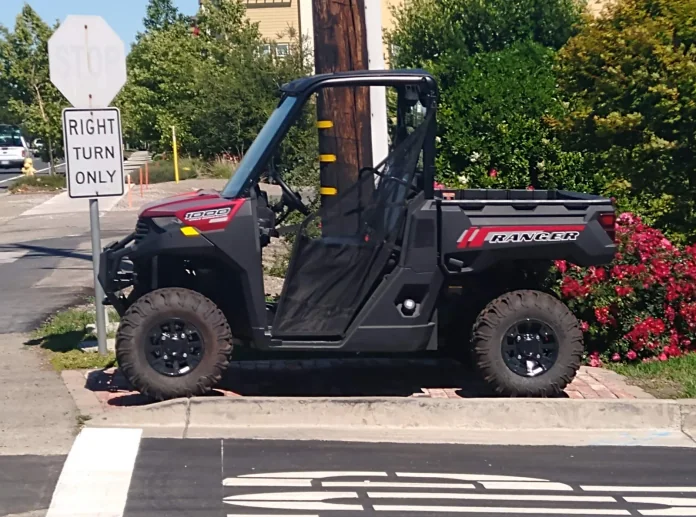
Featured reference photograph: 2021 Polaris Ranger 1000. It illustrates the vehicle family or accessory context, not the exact current trim or an independently tested installation. DestinationFearFan / Wikimedia Commons / CC BY-SA 4.0. Resized and converted to WebP; photograph retains its stated license.
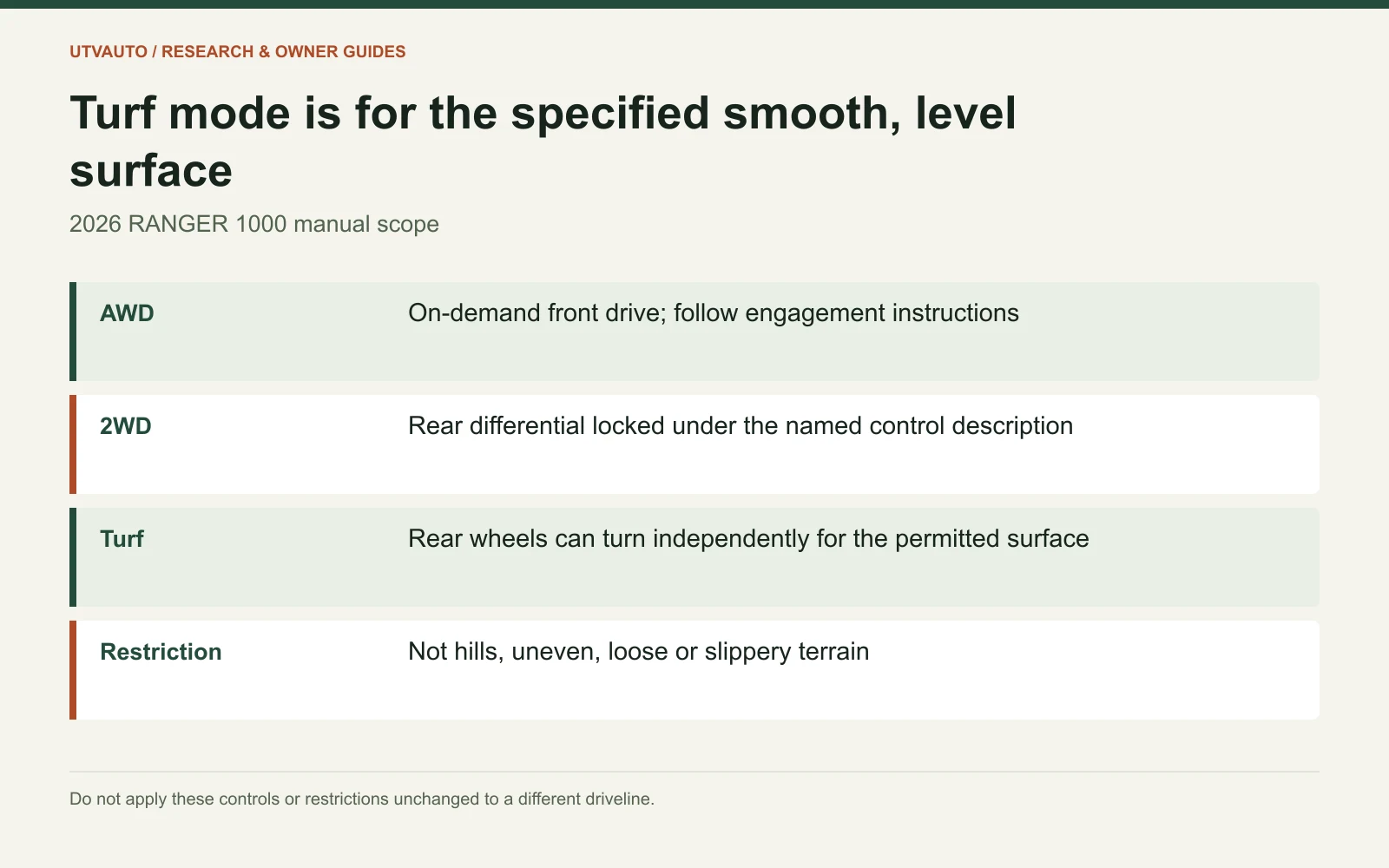
In the 2026 RANGER 1000 manual, Turf mode is for protecting appropriate smooth, level surfaces—not for hills or low-traction terrain. AWD is an on-demand system with its own engagement instructions. The modes are not simply three interchangeable traction levels to test after wheelspin starts.
This explanation follows the 2026 RANGER 1000/CREW 1000 manual’s drive-mode section. Other platforms can use different control logic and restrictions. Confirm the exact manual and controls on the actual vehicle.
What the modes do in this manual
| Mode | Named-manual description | Important boundary |
|---|---|---|
| AWD | Front drive is enabled through the on-demand system when its conditions are met | Not a claim that every wheel is constantly powered or that all terrain is safe |
| 2WD | Rear differential is locked under the stated control position | Do not engage contrary to the speed/wheelspin instructions |
| Turf | Rear wheels can rotate independently, with the stated one-wheel-drive arrangement | Use only for the permitted smooth, level surface conditions |
The manual explains that front drive can remain engaged until the rear wheels regain traction after the switch position changes. A switch movement is therefore not proof that every driveline state changes instantly.
Select AWD before the conditions require it
The source instructs the operator to engage AWD before entering conditions where front drive may be needed. If the rear wheels are spinning, release the throttle before switching to AWD. Follow the complete engagement instructions rather than trying to force the system to engage under wheelspin.
This is not permission to enter an obstacle or slope that exceeds the vehicle’s operating restrictions. Drive-mode selection cannot make a prohibited route or unsafe load acceptable.
Respect the Turf-mode exclusions
The manual excludes Turf mode on hills, sidehills and uneven, loose or slippery terrain, including examples such as gravel, ice, snow, obstacles and water crossings. It directs AWD for those terrain conditions within the vehicle’s permitted operation.
Do not keep Turf selected merely because a job involves grass somewhere along the route. A smooth level lawn and a sloping or loose approach are different conditions. Identify the required mode before reaching the transition, following the actual switching procedure.
Do not diagnose the system from a switch label alone
If a front gearcase appears to remain engaged or steering effort changes unexpectedly, use the manual’s diagnostic/service directions. Do not repeatedly accelerate or attempt an improvised maneuver in an unsafe space to force disengagement.
The named manual supplies a specific disengagement procedure and a service path if the condition remains. That procedure is not reproduced as a universal recovery instruction here. Stop and get qualified support when the condition or safe procedure is uncertain.
Keep drive mode separate from range selection
AWD/2WD/Turf describes the driveline mode; high/low range is a different control and decision. Use the corresponding manual instructions for both. A rule for a RZR’s range selection should not be copied into this RANGER control explanation.
The RZR range guide is deliberately scoped to its own manual. For this vehicle, use the RANGER research center for fuel, break-in and maintenance questions, and retain the actual operator manual with the vehicle.
Editorial collection: November 2026. This is a topic collection label, not a backdated first-publication date.