
Editorial collection: October 2026. Collection month is an editorial label; the page retains its actual first-publication date.
Featured image: original UTVAUTO diagram; supporting sources are explained in the article.
On the 2026 Polaris RZR XP family, low range is required for more than crawling at a walking pace. The owner’s manual calls for it over rough terrain or obstacles, when loading onto a trailer, on hills and when consistently operating below 35 mph in hard-pulling terrain such as mud, rocks or sand. The terrain condition belongs beside that speed figure.
This guide uses manual 9942079, Gear Selector and Using Low Gear. It does not turn 35 mph into a universal range-change speed for every RZR, and it does not describe low range as a driving-speed target. Pro-family models and different years need their own instructions.
Read the conditions together
| Situation in the manual | What to do with the instruction |
|---|---|
| Rough terrain or obstacles | Select low range before the task as directed |
| Loading onto a trailer | Use low range; transport and ramp checks still apply |
| Hills | Follow low-range and hill-operation instructions together |
| Consistent sub-35 mph hard pulling | Keep the terrain qualification: mud, rocks or sand/dunes |
| Heavy cargo work | Observe low-range guidance and every approved load limit |
The manual’s general reference to hauling or towing is not a new tow rating for a sport RZR. A receiver or recovery point does not establish trailer approval. Use the exact vehicle’s specifications and restrictions.
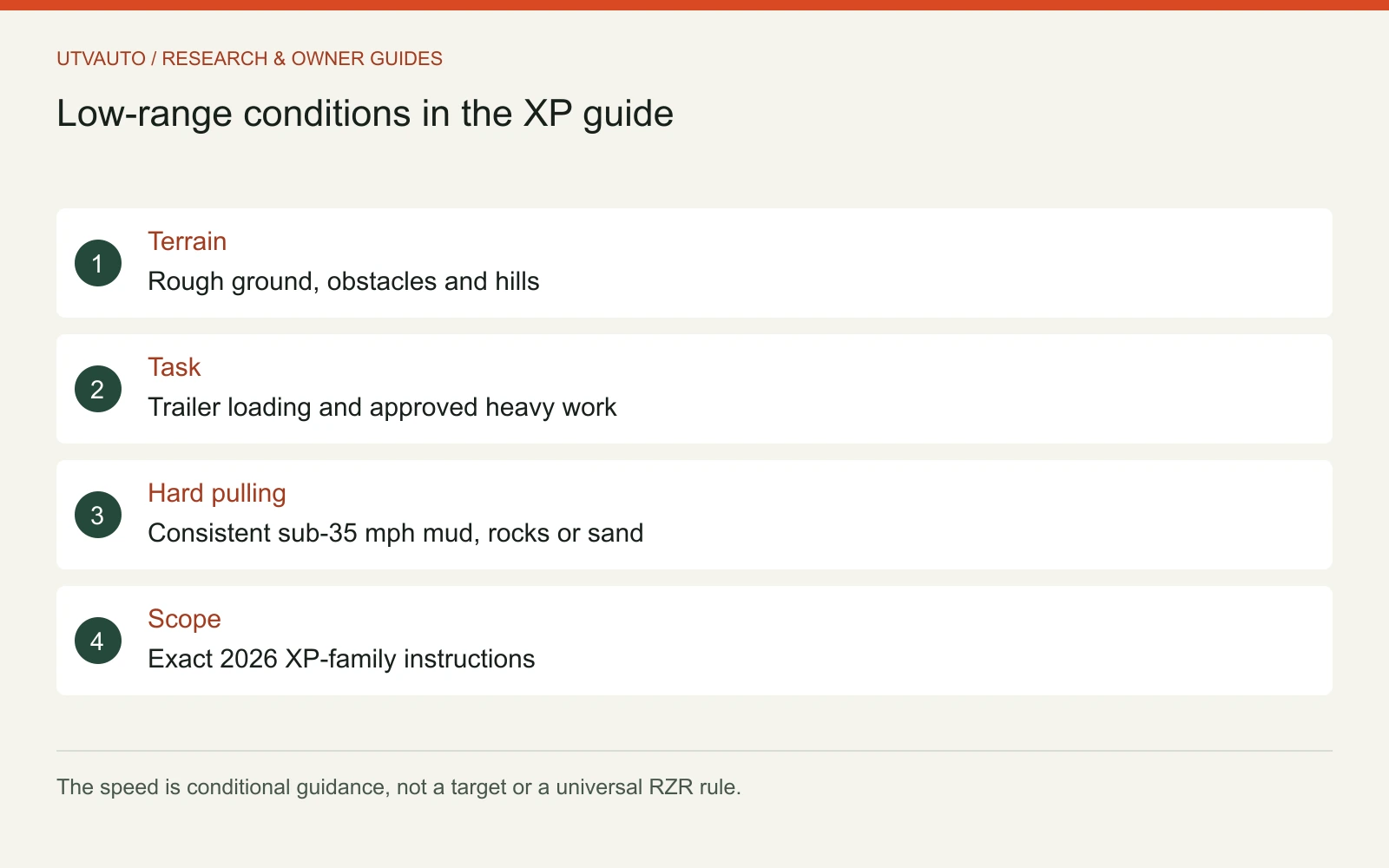
Why a speed-only rule gives the wrong answer
A smooth, permitted route with a light load is not the same drivetrain task as the same indicated speed in deep sand or mud. The manual’s low-range guidance responds to pulling conditions as well as speed. Do not extract the number from its sentence and apply it indiscriminately.
Likewise, selecting low range is not permission to climb an unsafe slope, cross an obstacle beyond the vehicle’s limits or add more cargo. Gear selection is one operating decision within a complete set of restrictions. It does not cancel traction, visibility, load or terrain requirements.
Shift only in the prescribed safe state
Polaris instructs that range changes be made with the vehicle stationary and the engine at idle. Do not shift while moving or with the engine above idle. Use the brake and the exact selector procedure in the matching manual; do not force a lever that is resisting.
If the range will not engage predictably or the selector position is uncertain, stop and arrange assessment of the shift system. Repeatedly forcing the control or using engine speed to make it engage can create another problem. A missing gear indication or vehicle movement inconsistent with the selected position warrants attention before continuing.
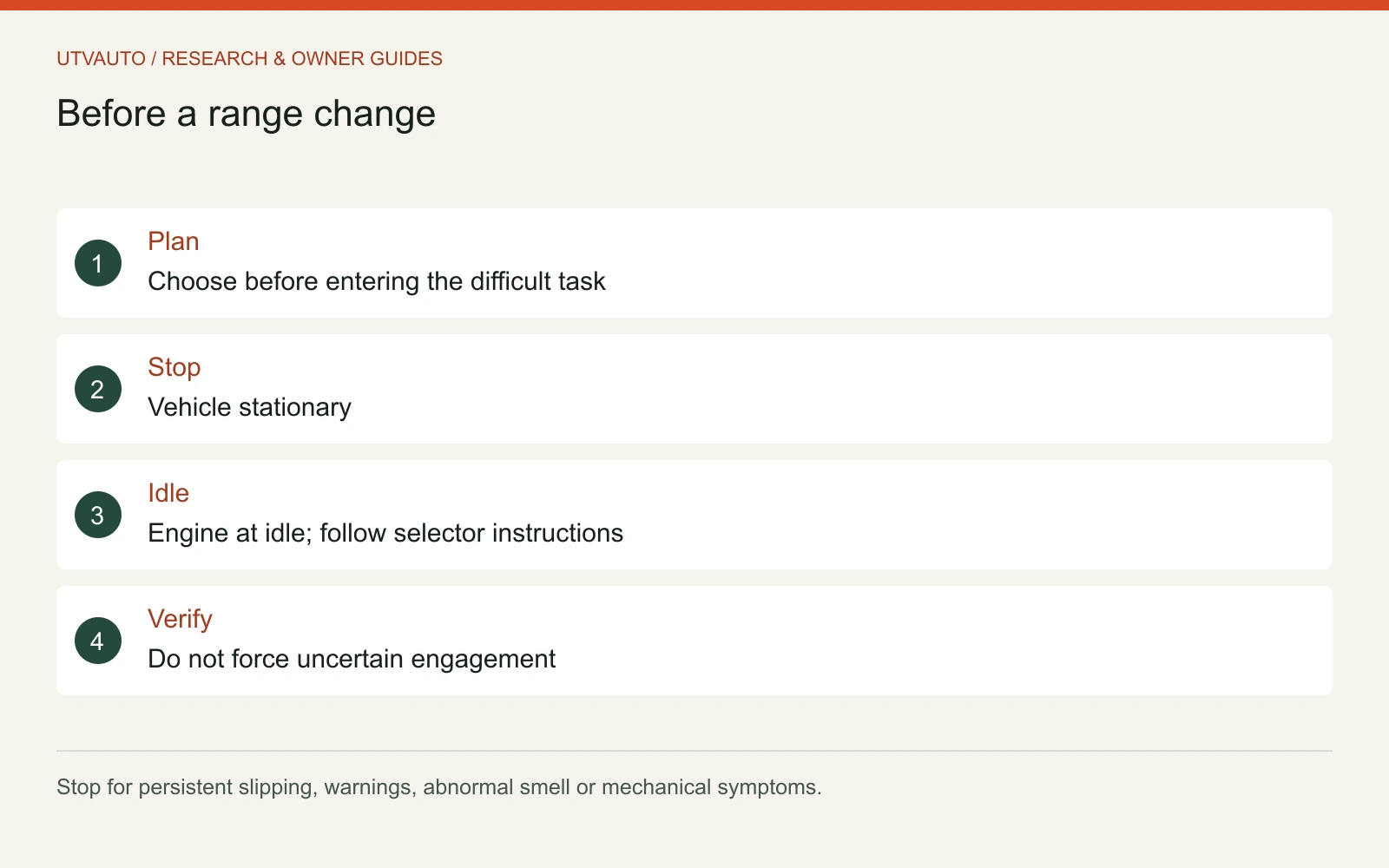
Plan the range before entering the difficult section
Identify the terrain, load and task before committing. A safe, appropriate place to stop is preferable to deciding mid-obstacle that a range change is needed. The same applies before approaching a trailer ramp: low range does not make an unsuitable ramp angle, inadequate ramp rating or poor securement plan acceptable.
For loading and hauling, use the transport checks in addition to the operator guide. Keep bystanders clear and use the manufacturer’s prescribed procedures. Do not carry passengers in the UTV during highway transport.
Watch for a problem rather than assuming low range repairs it
Abnormal belt smell, slipping, unusual noise, a warning indication or a new leak calls for stopping and assessing the condition. Changing range does not repair a damaged belt, contaminated clutch system or obstructed cooling intake. Do not keep testing under load while a symptom persists.
The belt-care guide covers prevention. If service is needed, the 2026 XP belt-replacement guide identifies its limited model scope and completion checks. Neither article diagnoses a failure from one sound or a single owner report.
A useful operating reminder
- Match the instruction to the exact vehicle and year.
- Consider terrain and pulling demand together with speed.
- Shift only stationary, at idle and according to the manual.
- Keep loading, hill and transport restrictions in force.
- Stop for persistent symptoms or uncertain engagement.

