
Payload is what your UTV carries; towing capacity is what it can pull under the manufacturer’s stated conditions. A large tow rating does not give you extra room for passengers or cargo. Check the total vehicle load, cargo-box limit, hitch/tongue limit and loaded trailer weight separately. All applicable limits must be satisfied at the same time.
This guide provides a load-budget worksheet for U.S. recreational and utility side-by-sides. The worked example is hypothetical, not a rating for a particular vehicle. Use the labels and manual for your exact year, model, seating configuration and market before loading.
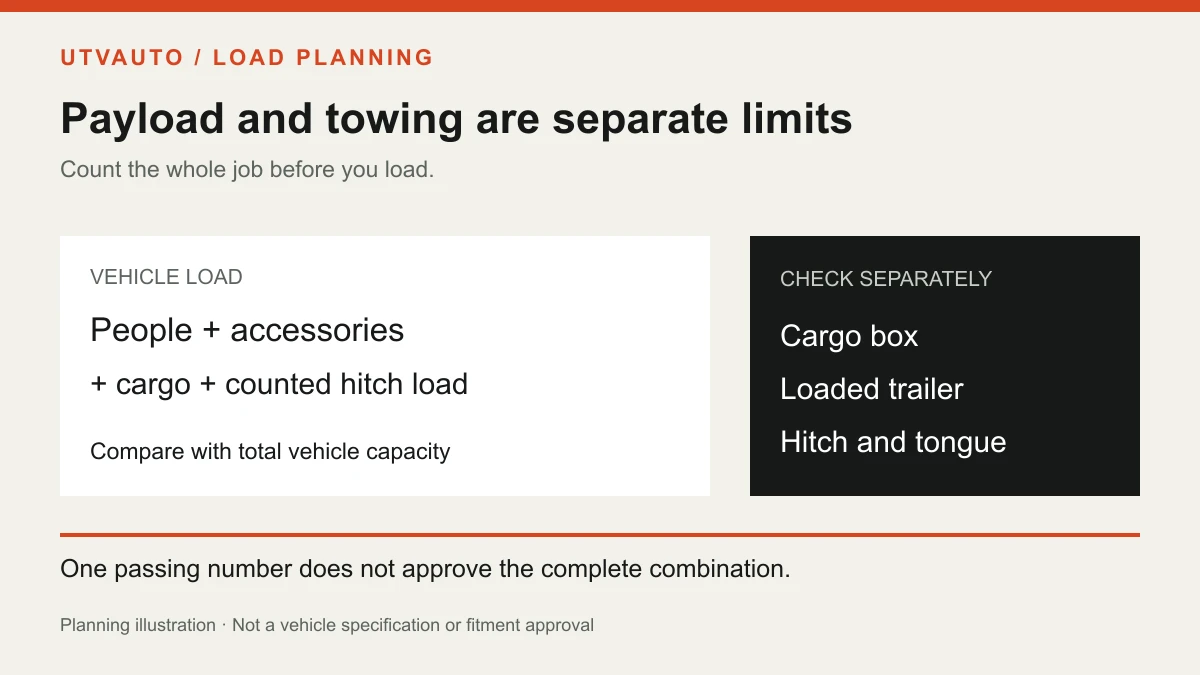
Four limits that answer different questions
Swipe sideways to view every column.
| Limit | What to put against it | Frequent mistake |
|---|---|---|
| Total vehicle capacity / payload | The loads included by your manual: occupants, cargo and added equipment, plus hitch load where specified | Counting only the bed contents |
| Cargo-box capacity | Everything carried in the bed | Assuming unused bed capacity permits exceeding total payload |
| Towing capacity | The actual loaded trailer, including its own weight | Comparing only the cargo on the trailer |
| Hitch and tongue limits | The downward load at the coupling and the ratings of the receiver, mount and coupling | Treating a receiver’s physical size as its load rating |
Manufacturer terminology matters. In its 2025 RANGER XP 1000/CREW manual, Polaris includes the operator, passengers, cargo and accessories in vehicle capacity. That is an example of a definition to look up, not a capacity to transfer to another UTV.
Build the vehicle load budget first
- Record the rating. Photograph the vehicle’s load label and find the matching manual section. Do not substitute a different trim’s sales page.
- List the people. Include everyone who will actually ride, with their carried clothing and equipment. A seat being available does not establish that the remaining payload is sufficient.
- List equipment added to the vehicle. Include the cab, roof, windshield, winch, spare wheel, tool boxes and other additions when the rating definition requires them. Avoid counting factory equipment twice.
- Weigh the trip load. Include tools, water, supplies, coolers and material in the bed or storage areas. Bag dimensions are not a substitute for weight.
- Add hitch load when required. Establish the loaded trailer’s actual tongue weight using the manufacturer’s method and appropriate equipment. Confirm how the UTV manual accounts for it.
- Check every separate limit. Passing the total calculation does not establish compliance with the bed, hitch, tire, axle or operating restrictions.
Available load budget = rated vehicle capacity − all loads already counted by that capacity definition. Keep the definition with the calculation; otherwise two apparently identical worksheets may be counting different things.
Worked example: a trailer can fit the tow rating while the UTV nearly runs out of payload
The following invented numbers illustrate the accounting only. They do not recommend a load distribution or establish a safe operating combination.
Swipe sideways to view every column.
| Example input | Weight |
|---|---|
| Hypothetical total vehicle capacity | 1,200 lb |
| Two occupants combined | 360 lb |
| Added accessories counted by the example rating | 180 lb |
| Gear outside the cargo box | 60 lb |
| Cargo-box contents | 500 lb |
| Tongue weight counted by the example manual | 80 lb |
| Total counted load | 1,180 lb |
| Unused arithmetic capacity | 20 lb |
If the example bed limit were 600 lb, its 500 lb contents would pass that individual check. If a trailer weighed 1,000 lb loaded and the example towing limit were 2,000 lb, that would pass a different check. Neither changes the 1,180 lb vehicle load. The example’s 80 lb tongue load must also satisfy the particular trailer’s distribution requirements and the UTV’s hitch limits; no universal tongue-weight percentage is being supplied here.
Twenty pounds of arithmetic headroom is not a safety margin recommendation. Unknown accessory weights, an extra passenger’s bag or a different trailer load can erase it. If the numbers are estimates, weigh the combination before treating it as acceptable.
Copy this worksheet before a work day or trip
Swipe sideways to view every column.
| Record | Your value / evidence |
|---|---|
| Year, model, trim, seats and market | ________________ |
| Capacity definition and manual page | ________________ |
| Total vehicle capacity | ________________ lb |
| Occupants + counted accessories + all cargo | ________________ lb |
| Hitch load counted as directed | ________________ lb |
| Remaining total capacity | ________________ lb |
| Bed contents / bed limit | ________ / ________ lb |
| Loaded trailer / permitted trailer weight | ________ / ________ lb |
| Measured tongue load / applicable limit | ________ / ________ lb |
| Loaded tire pressures and operating restrictions | Manual section: ________________ |
Three situations where a rating alone is not enough
Hills and rough ground: a headline towing figure does not answer which slopes or surfaces the vehicle may negotiate with that load. Use the manual’s loaded-driving restrictions; change the job or equipment if the route cannot meet them.
Accessories fitted after delivery: ask how their weight was accounted for in the rating you are using. Do not assume a dealer-installed cab is weightless because it was on the vehicle when you bought it.
Moving the UTV on a road trailer: this is a separate calculation. The UTV becomes cargo carried by a trailer, and the road tow vehicle has its own capacity and hitch constraints. Our UTV trailer measurement and capacity checklist covers that decision.
What to do if one box does not pass
Reduce or split the load, remove unnecessary equipment, change the route or use equipment rated for the actual job. Do not offset an overloaded bed by pointing to unused tow capacity. If a capacity definition or tongue-load treatment is unclear, obtain an answer for the exact vehicle from the manufacturer or dealer before operating.
For choosing a vehicle around the job, use the UTV buying guide. Before each departure, work through the pre-ride inspection checklist.
Method: UTVAUTO’s worksheet and hypothetical calculation, informed by the manufacturer manual linked above. No towing or vehicle testing was performed for this guide. Source reviewed November 2, 2026.

