
A useful spare is one you can identify and use appropriately
A useful UTV spare-parts kit starts with the exact vehicle and the tasks its owner can appropriately perform. Buying a universal bag of parts does not establish fitment, provide a diagnosis or make a trail repair suitable. Separate spare components, inspection tools, ordinary supplies and recovery planning. Each serves a different purpose, and one category cannot make up for a missing decision in another.
This is an inventory-building framework, not a field-repair tutorial. It does not specify universal fuses, fluids, belt sizes or fastener torque. Those details belong to the matching vehicle and component instructions. The objective is to carry identifiable, useful items without creating an overloaded or confusing collection that encourages a repair beyond the available evidence, training or conditions.
Define the trip and the support available
List the trip duration, the vehicles involved, the expected operating environment and the available support. Distinguish an ordinary property workday near service access from a remote outing where transport assistance is harder to arrange. Identify how a disabled vehicle would be recovered without assuming that another machine can simply tow it in any manner. A spare component is not a complete recovery plan.
Record the support contacts and access information separately from the parts inventory. Know which relevant documents can be accessed without mobile reception. A downloaded owner manual can support an identification or permitted check, but it is not evidence that every repair described elsewhere is appropriate at the roadside. If the vehicle develops a fault affecting control, braking, heat or fuel containment, the stop and assistance decision comes before experimenting with the contents of the kit.
Build a fitment card for each proposed spare
Give each item a record containing the vehicle year, full model, trim, market, part number, source and any installation limitations. Include the revision or supersession information when the supplier identifies it. A similar engine displacement or a familiar brand name is not proof that two machines use the same belt, filter, connector or fastener. Keep the original packaging or a clearly legible identification label where practical.
For a group kit, show which vehicles an item actually serves. Do not label a component as universal because it fits two particular models. If the fitment is unresolved, move it to a question list rather than placing it among confirmed replacements. This simple distinction helps prevent a person under time pressure from selecting an apparently convenient part whose application was never checked.
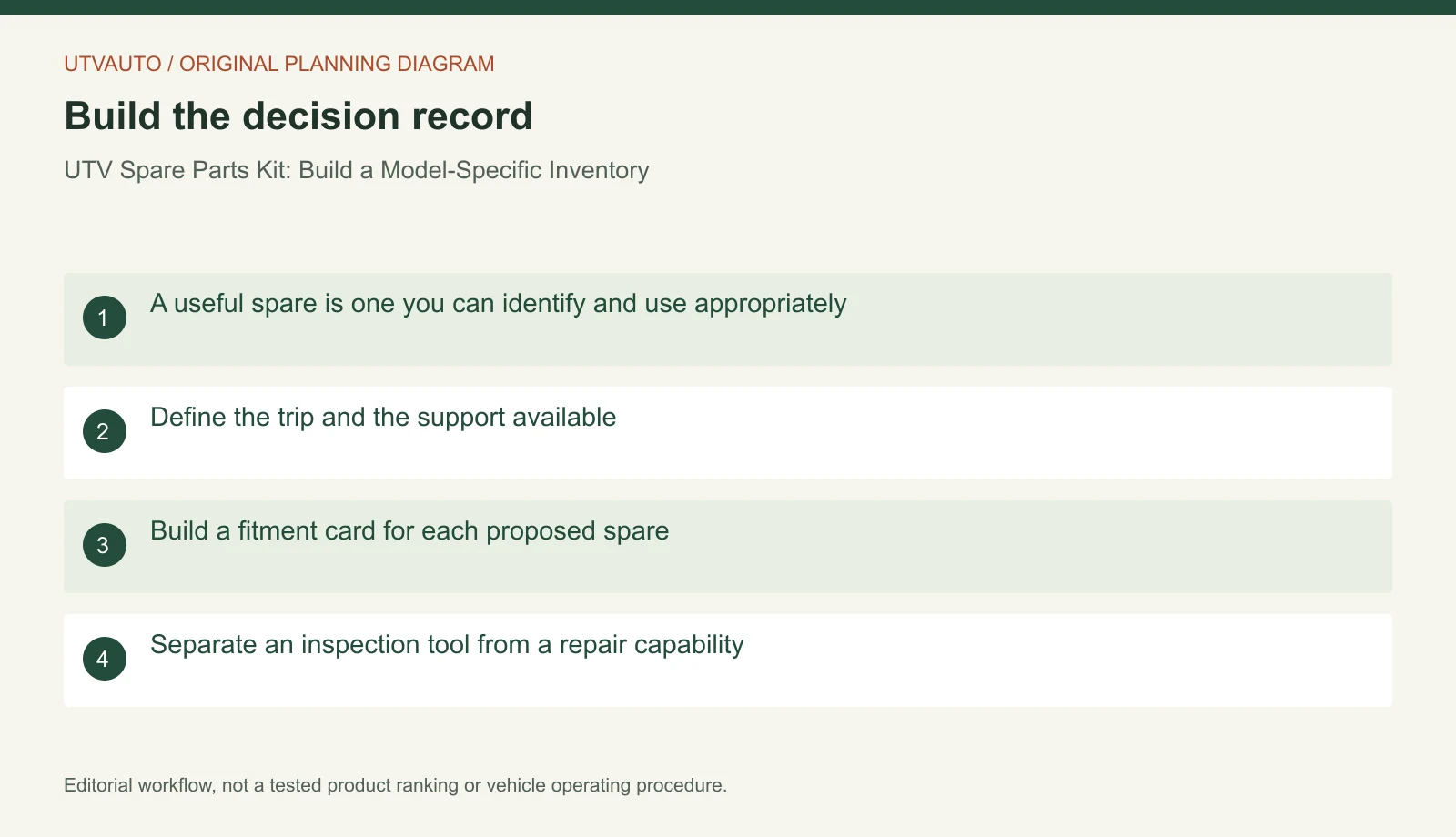
Separate an inspection tool from a repair capability
A tool that lets you observe a condition does not necessarily let you diagnose or safely correct it. A pressure gauge, for example, supports reading pressure; the proper target still comes from the exact application. An electrical test instrument requires an appropriate method and interpretation. Carrying either device does not justify a universal setting or an improvised procedure.
List the planned task beside each tool. If no realistic permitted task can be named, reconsider why that tool is in the vehicle. This also reveals missing instructions or skills before departure. A compact kit should be built around the owner’s actual capability and the manufacturer’s procedures, not the assumption that a long tool list automatically makes the group self-sufficient.
Avoid stocking parts as a substitute for finding a cause
A spare belt, fuse or other replaceable component does not explain why the original stopped working. Record whether the relevant instructions allow an owner-performed procedure and what checks must precede a replacement. Do not keep replacing a failed item while ignoring heat, contamination, damage or an electrical fault. A repeated symptom should remain an unresolved problem until the appropriate assessment supports a conclusion.
Imagine a rider who packs several fuses because an accessory circuit has been opening repeatedly. The useful next step is to resolve the circuit problem under the correct instructions, not to create a larger supply of replacements or install a different rating. The inventory can support a documented repair, but it should never normalize an existing fault that should have been addressed before the trip.
Pack for identification, retention and condition
Protect parts from the conditions their packaging and instructions identify as unsuitable. Keep small hardware organized so an owner can distinguish sizes without guessing. Do not remove essential labels from bottles or containers to save space. If a product has a date or a storage requirement, make it visible in the inventory and check it before relying on the item.
Secure the complete kit as cargo using the permitted arrangement for the vehicle. Count the container, tools and parts in the relevant load budget. Avoid obstructing controls, passenger space, service access or designated equipment. A collection that rolls around the bed is not improved by containing expensive parts. Placement and retention should be planned with the same care as fitment.
Use a three-level inventory instead of a shopping list
Mark each proposed item as confirmed for an owner-permitted task, awaiting verification or reserved for professional support. The first group needs a valid application and accessible instructions. The second group needs an answer before it can be treated as ready. The third group may be useful to a service provider but should not be presented as a task the rider is prepared to perform in the field.
For every confirmed item, record quantity, location and the reason it is carried. After a trip, note what was used, what was damaged and what was difficult to access. This creates a useful purchasing history. Replacing an item because a documented task consumed it is different from repeatedly adding products based only on stories about unrelated vehicles.
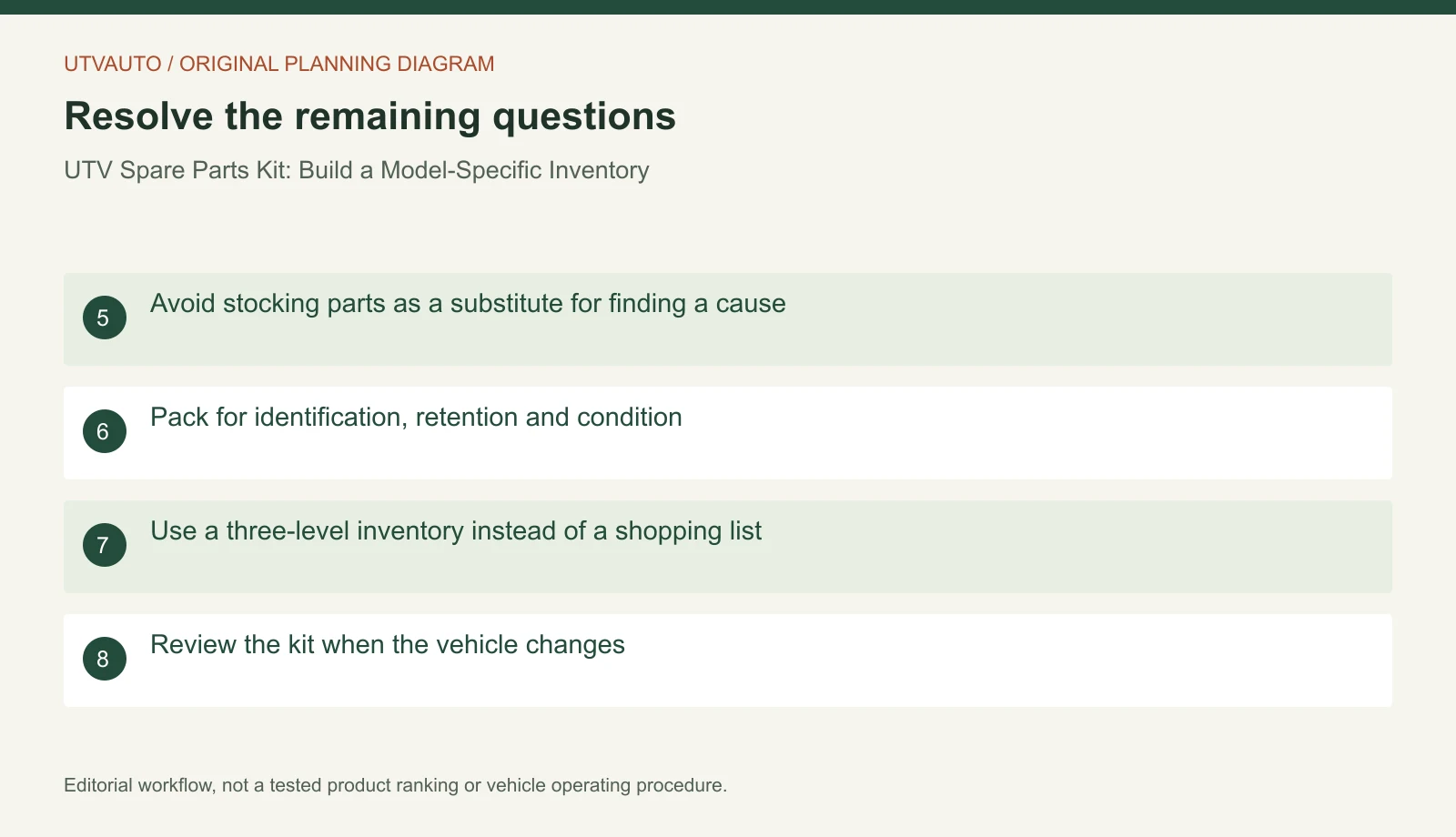
Review the kit when the vehicle changes
Recheck the inventory after changes in model, year, accessories or permitted use. A part that belonged in the previous machine’s kit may look familiar enough to survive several reorganizations without anyone checking it. Keep obsolete or unassigned parts outside the ready-to-use vehicle kit and label them honestly. Do not overwrite the old fitment record to make the inventory appear current.
Before departure, review the open questions with the people responsible for the vehicle. Confirm that the manual, contacts, keys and transport plan are available as well as the hardware. The strongest kit is not necessarily the heaviest one. It is the one whose contents can be traced to the correct vehicle and a realistic task, with a clear decision to stop and seek support when the situation exceeds that scope.
Run a parked inventory review with the people using it
Before a trip, put the proposed kit inventory beside the relevant vehicle documents and ask another responsible participant to identify several items. Can they tell which machine an item serves, where the instructions are and what task the item supports? This is an administrative review, not a mechanical practice session. Its purpose is to uncover ambiguous labels and assumptions before they matter under pressure.
For example, two apparently similar packages may belong to different model years. Keep their identities separate and explain the application on the inventory card. If a participant cannot determine which item is appropriate without guessing, the organization needs improvement. Adding more copies will not solve that problem. The same review should identify items whose condition, storage history or required supporting tools are unknown.
Close the review with a short action list: confirm an application, replace a damaged container, obtain instructions, relocate a heavy kit or arrange appropriate assistance. Identify who will complete each action before departure. After the next outing, record whether the arrangement was accessible and what was actually used. This feedback improves a model-specific kit over time without pretending that every possible fault can be anticipated or that carrying a component establishes the ability to diagnose and repair its failure.
Related UTVAUTO resources
- Belt maintenance and model-specific limits
- Accessory electrical planning
- Recovery versus routine transport
- Record parts and unresolved faults
Sources and scope
This is a research-based planning guide, not a UTVAUTO product test, installation or professional inspection. Manufacturer and safety references were checked November 9, 2026. Use the exact vehicle and component instructions for operational requirements.
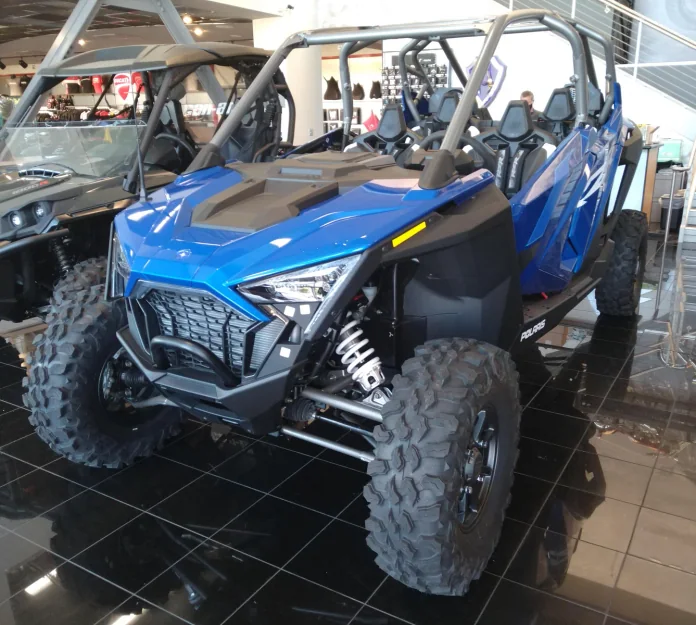
Featured archival reference photograph: 2021 Polaris RZR Pro XP. It illustrates vehicle context, not a UTVAUTO test, the exact equipment discussed or an endorsement. DestinationFearFan / Wikimedia Commons / CC BY-SA 4.0. Resized and converted to WebP; photograph retains its stated license.


