
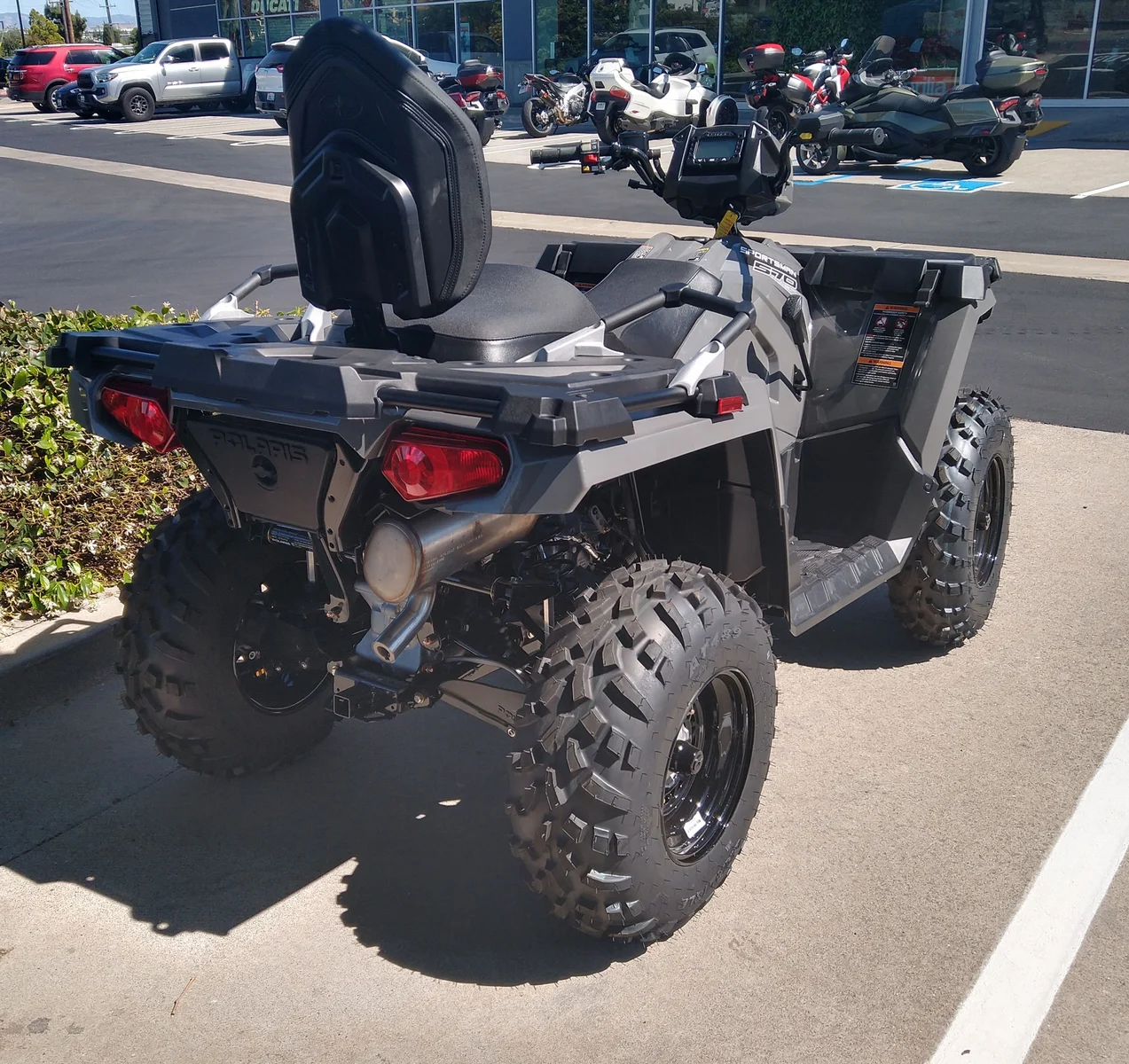
Featured reference photograph: 2021 Polaris Sportsman 570. It illustrates the vehicle family or accessory context, not the exact current trim or an independently tested installation. DestinationFearFan / Wikimedia Commons / CC BY-SA 4.0. Resized and converted to WebP; photograph retains its stated license.
An ATV’s front-rack limit, rear-rack limit and total permitted vehicle load are separate constraints. Include the empty box, mounting hardware and contents on the appropriate rack. Do not add two rack ratings together and call the result the ATV’s available payload.
The examples below use named U.S. 2026 models. Other engine sizes, trims, markets and years can have different limits. The actual vehicle label and operator guidance govern the complete loading arrangement.
Two documented examples
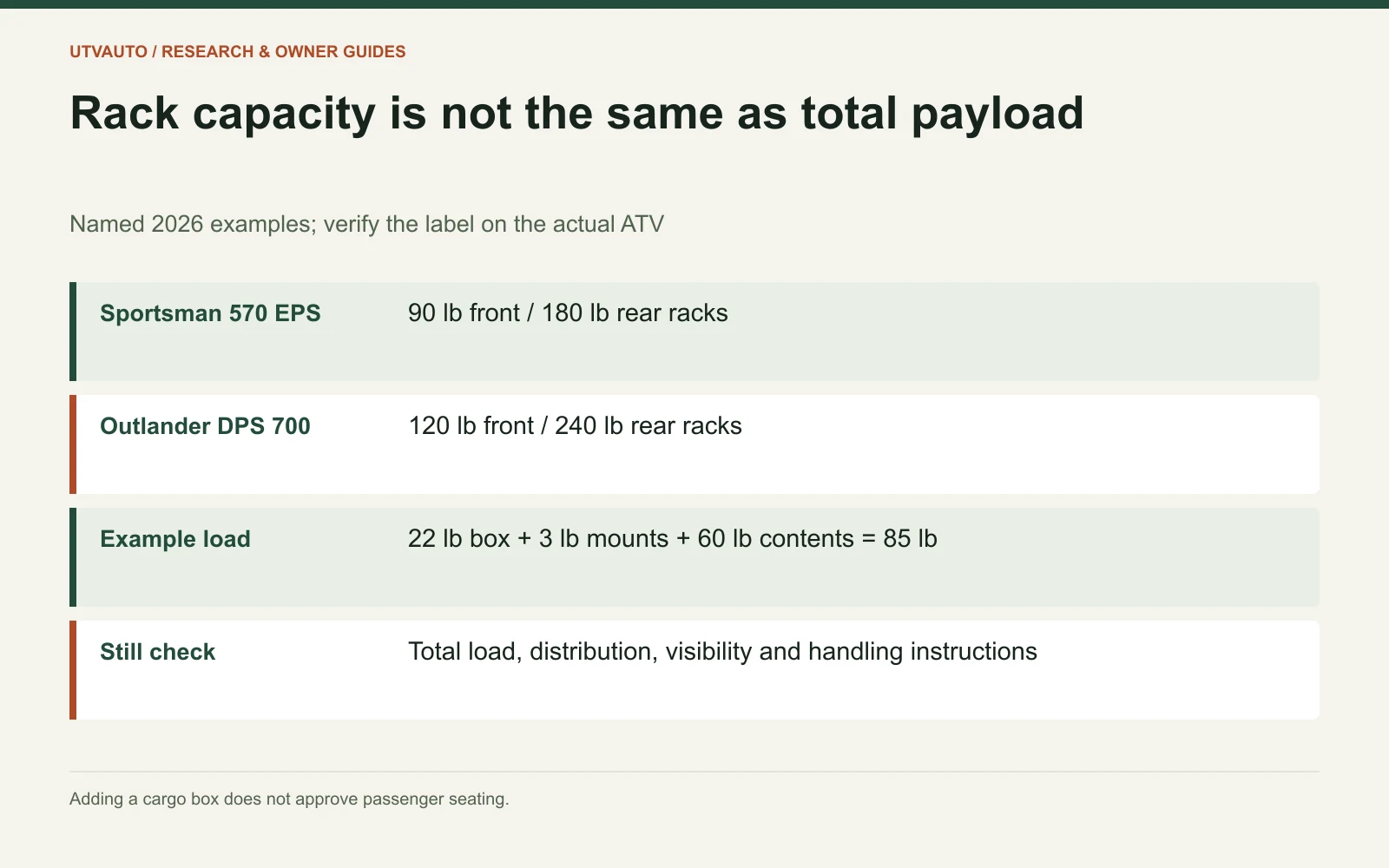
| Published rating | 2026 Sportsman 570 EPS | 2026 Outlander DPS 700 |
|---|---|---|
| Front rack | 90 lb | 120 lb |
| Rear rack | 180 lb | 240 lb |
| Source | 2026 Sportsman catalog | 2026 Outlander DPS sheet |
These numbers describe separate positions, not a test of which ATV carries cargo more safely. Do not move an excess rear load to the front without checking the front limit, total load and the prescribed distribution.
Count the accessory before its contents
Suppose a rear box weighs 22 pounds, its mounting hardware weighs 3 pounds and the contents weigh 60 pounds. The rear-rack load is 85 pounds. Against a stated 180-pound rear limit, subtraction leaves 95 pounds of that rack’s numerical rating. That does not establish permission to carry 95 additional pounds once the other limits and configuration are considered.
Use actual measured weights or reliable product specifications. A box’s liter capacity does not tell you its empty mass or the weight of the items that will fill it. Two similarly sized boxes can produce different load budgets.
| Your worksheet | Enter the actual value |
|---|---|
| Front accessory plus mounts | _____ lb |
| Front contents | _____ lb |
| Rear accessory plus mounts | _____ lb |
| Rear contents | _____ lb |
| Operator / approved passenger and other equipment | _____ lb, accounted for under the vehicle’s total-load instructions |
| Vehicle label and load-distribution conditions | Record the exact limit and source before approving the trip |
Keep cargo away from the operator and passenger requirements
Check visibility, controls, steering movement and the intended seating arrangement with the actual box installed. Do not use a cargo rack or a box lid as a passenger position on a single-place ATV. A padded backrest is not proof of factory two-up designation.
On a designated two-place model, the cargo arrangement must still leave the required passenger space and handholds. See the passenger-seat guide and Sportsman Touring comparison when that is part of the purchase decision.
Ratings do not cancel terrain and operating restrictions
A load below the numerical rack limit can still be unsuitable because of its height, distribution, restraint or the intended terrain. Follow the vehicle’s loading, speed and slope instructions rather than inventing a universal “safe cargo speed.”
Inspect the rack and mounts for damage and verify the exact accessory application. Stop and resolve loose hardware, cracked mounts or interference before operating. An unverified rack extension does not increase the original rating.
Save a repeatable packing list
Record the load, location and attachment method for recurring jobs. Recalculate when a box, winch, rack or passenger arrangement changes. This makes the next trip easier to check without turning one example into a permanent allowance.
The payload versus towing worksheet explains the separate categories for utility vehicles; carry over the method of accounting, not another model’s numbers.
Editorial collection: October 2026. This is a topic collection label, not a backdated first-publication date.