
Plan for the actual group rather than the strongest vehicle
A useful UTV group ride plan identifies the people, vehicles, permitted route and available support before departure. It should explain how decisions will be communicated and what happens if the group needs to stop or change plans. A large vehicle, a powerful winch or an experienced participant does not make an unsuitable route appropriate for everyone else. Plan around the actual capabilities and limitations of the complete group.
This is a coordination framework, not a trail authorization, operator-training course or emergency-response procedure. Obtain current route and access information from the responsible manager, and follow each vehicle’s instructions. The plan organizes those inputs and the group’s responsibilities. It should not create confidence by treating an old map, a remembered rule or a social-media route description as current permission.
Confirm the route and the access conditions
Identify who manages the route and where the current official information is published. Check relevant vehicle restrictions, closures, seasonal conditions and access requirements for the planned date. Record the source and time checked. Do not assume that a route accepting one class of off-highway vehicle accepts every width, seating configuration or type of machine in the group.
Keep alternatives separate from the main route. A backup route is useful only if its access and suitability have also been checked. If the original route becomes unavailable, stop and reassess rather than treating a line on a map as an authorized substitute. The route note should make clear what is verified, what depends on current conditions and who is responsible for obtaining an answer before departure.
Build a people and vehicle roster
Record the vehicles by year and model and identify the responsible driver for each. Review participant requirements and the available seating under the relevant instructions. The vehicle manual, not the group’s preference, determines the intended operating and passenger arrangements. A spare-looking section of seat or an accessory cushion is not evidence of an approved additional position.
Ask participants to raise limitations early. Someone may need a shorter route, more time for preparation or a different arrangement for gear. Keep personal information limited to what is actually needed for coordination and support. Do not distribute a large collection of private documents when a clear contact and vehicle roster will serve the task. The purpose is to know who and what the plan covers, not to produce an unnecessary public dossier.
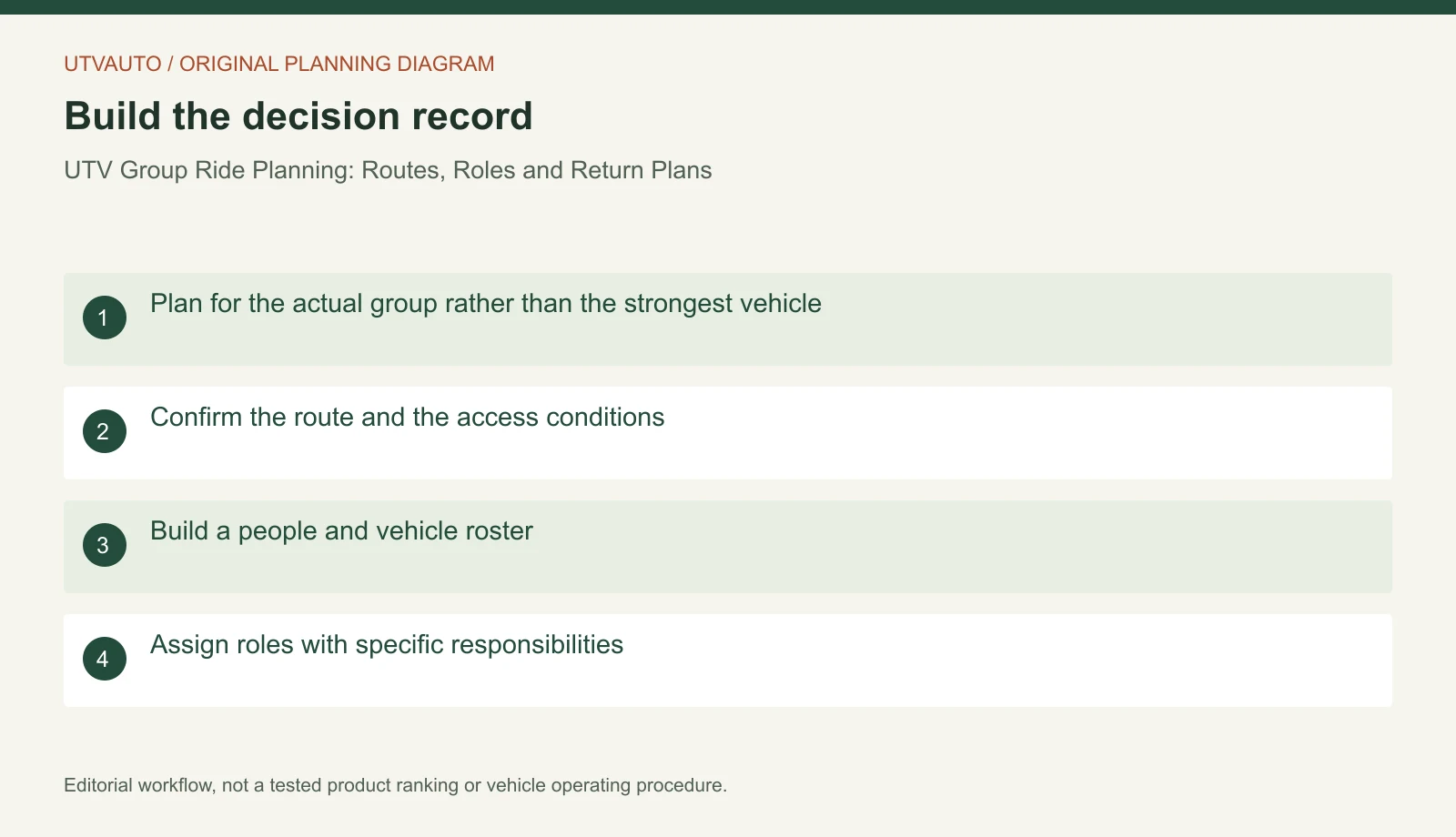
Assign roles with specific responsibilities
Identify the person coordinating the route, the person checking the roster and the people responsible for any shared equipment. Explain the limits of each role. Being the ride coordinator does not make someone a mechanic, instructor or emergency responder. Participants should understand who can make a group decision and how concerns can be raised without pressure to continue.
For a mixed-experience group, agree on a pace and stop arrangement consistent with the route and vehicle requirements. Do not let a role label substitute for a practical communication method. A coordinator who cannot receive a message from a stopped participant may not know that the plan has already changed. Walk through a simple separation scenario while parked and resolve the response before relying on the arrangement.
Check communications before departure
List the communication methods the group intends to use and their limitations. Test the actual equipment in an appropriate stationary setting and identify any charging or battery needs. Do not assume that a phone displaying service at the parking area will have reception throughout the route. Nor does owning a radio establish that every participant knows the agreed process or that the equipment is suitable for the intended use.
Keep an accessible copy of essential route and contact information where practical. Identify what information a message should contain, such as the reporting vehicle, location as understood and the nature of the concern. Avoid inventing a universal signal system or emergency frequency. Follow the applicable equipment, route and local guidance, and verify any communication arrangements on which the group expects to depend.
Inventory equipment without assuming repair capability
Assign shared supplies to a named vehicle and person, then check that the group can actually locate them. Include relevant manuals and contact information as well as physical items. A group can carry many tools yet still lack the correct part or the capability to perform an appropriate repair. Keep vehicle-specific fitment and the owner’s permitted procedures visible.
Count the equipment in the load budget of the vehicle carrying it. Avoid concentrating a large shared kit in one cargo area merely because that bed looks empty. Cargo, accessory and occupant restrictions still apply. If a vehicle becomes unavailable, reassess the new load and seating arrangements rather than transferring everything and everyone to the nearest machine without checking the relevant limits.
Agree on stop, change and return decisions
Write down how the group will handle a concern, a route change or separation. The plan should support stopping when a vehicle, participant or condition makes continuation unsuitable. Avoid commitments that pressure someone to keep operating because the group promised to finish a loop. A route objective is less important than recognizing that the assumptions supporting it no longer hold.
Give a trusted contact the planned area and expected return arrangement, together with an agreed response process appropriate to the location. Do not assume that a general article can prescribe one overdue time or one response for every region. Explain how a genuine change will be communicated and who will close the plan at the end. An unclosed plan can create confusion even after everyone has returned.
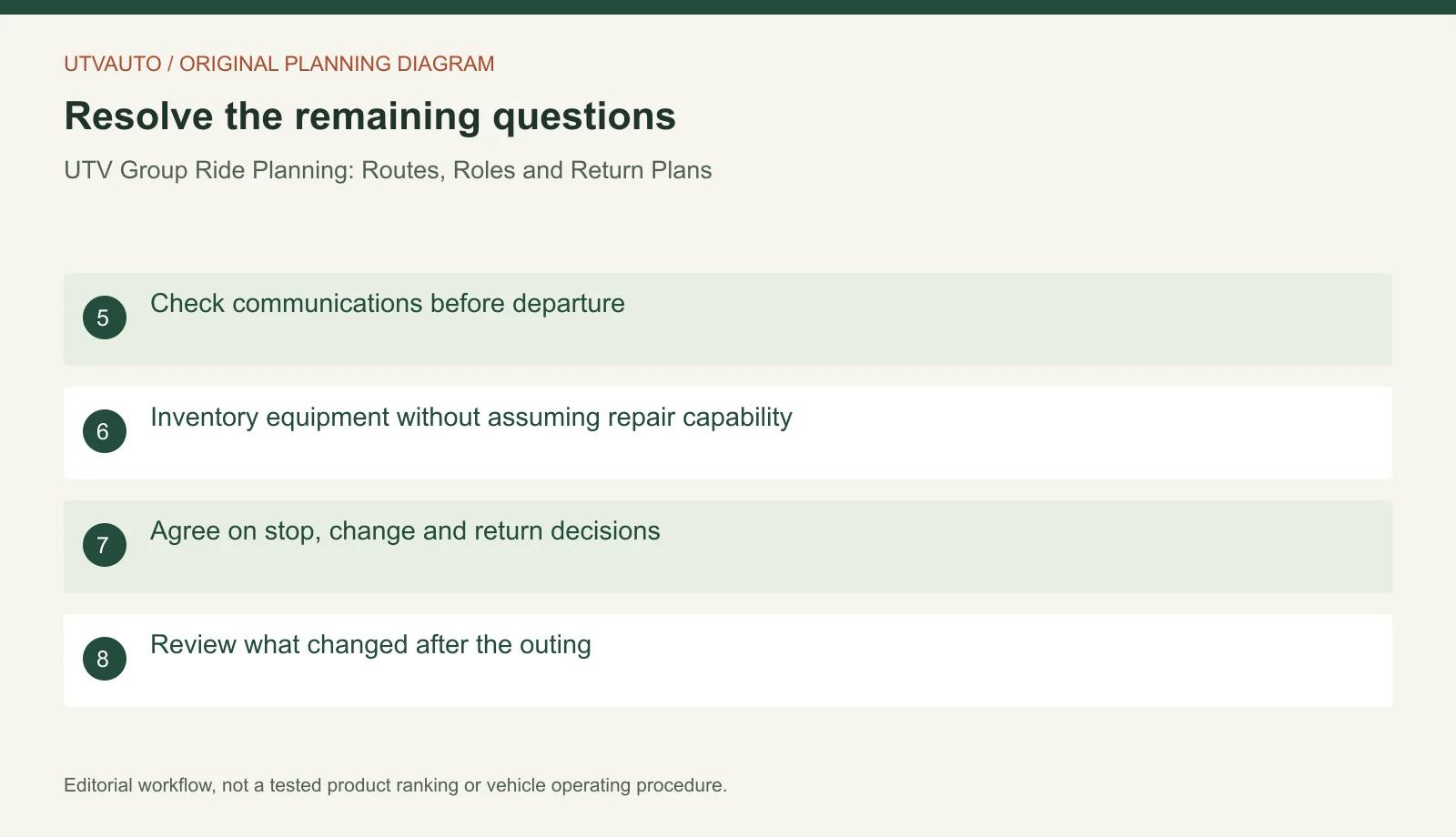
Review what changed after the outing
Close the roster and return-contact arrangement, then record useful changes for the next plan. Note a source that proved outdated, equipment that was hard to access or a communication assumption that did not work. Keep these as observations with their conditions, rather than turning one trip into proof of universal route or equipment performance.
A practical example is a group that discovers a planned information source does not describe the complete vehicle restriction. The improvement is to identify the responsible manager and the missing confirmation before the next outing, not to copy the same plan with a new date. A good ride plan is a record of verified inputs and explicit decisions. Its value comes from the group understanding and using it, not from the number of pages it contains.
A one-page briefing that exposes the missing pieces
Build the briefing around five headings: people and vehicles, route and verification source, roles and communications, carried equipment, and return arrangements. Put unresolved questions at the top rather than hiding them in an attachment. A participant should be able to identify the planned activity and the decision process without reading a large folder. Keep any private contact details available only to the people who need them.
Walk through a hypothetical change while everyone is still parked. One vehicle cannot continue, or the intended access point is unavailable. Ask which part of the plan addresses that situation and what information is still needed. Do not use the exercise to invent a recovery maneuver. Use it to discover whether the group knows how to stop, communicate and obtain appropriate support without making unsupported assumptions about another machine’s capacity or the availability of a route.
Revise the briefing when the roster or route changes. A new participant, different vehicle or heavier shared load can alter several decisions at once. Keeping an old plan with a different date can conceal those changes. A concise plan is useful when its inputs are current and the group understands its limits. The goal is not to promise that nothing unexpected will happen; it is to reduce confusion about the information, people and support available when a decision is required.
Related UTVAUTO resources
- Prepare each vehicle before departure
- Build a model-specific spare kit
- Account for shared cargo and occupants
Sources and scope
This is a research-based planning guide, not a UTVAUTO product test, installation or professional inspection. Manufacturer and safety references were checked November 9, 2026. Use the exact vehicle and component instructions for operational requirements.
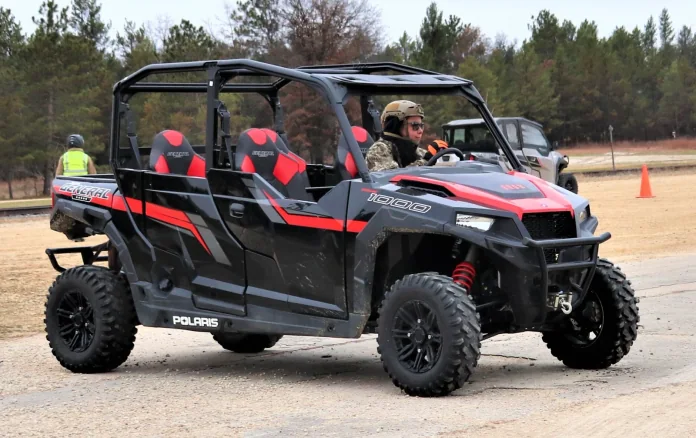
Featured archival reference photograph: Polaris General Off-road vehicle safety training at Fort McCoy (37). It illustrates vehicle context, not a UTVAUTO test, the exact equipment discussed or an endorsement. Scott T. Sturkol/Fort McCoy Public Affairs Office / Wikimedia Commons / Public domain. Resized and converted to WebP; photograph retains its stated license.


