
Editorial collection: November 2026. Collection month is an editorial label; the page retains its actual first-publication date.
Featured image: original UTVAUTO diagram; supporting sources are explained in the article.
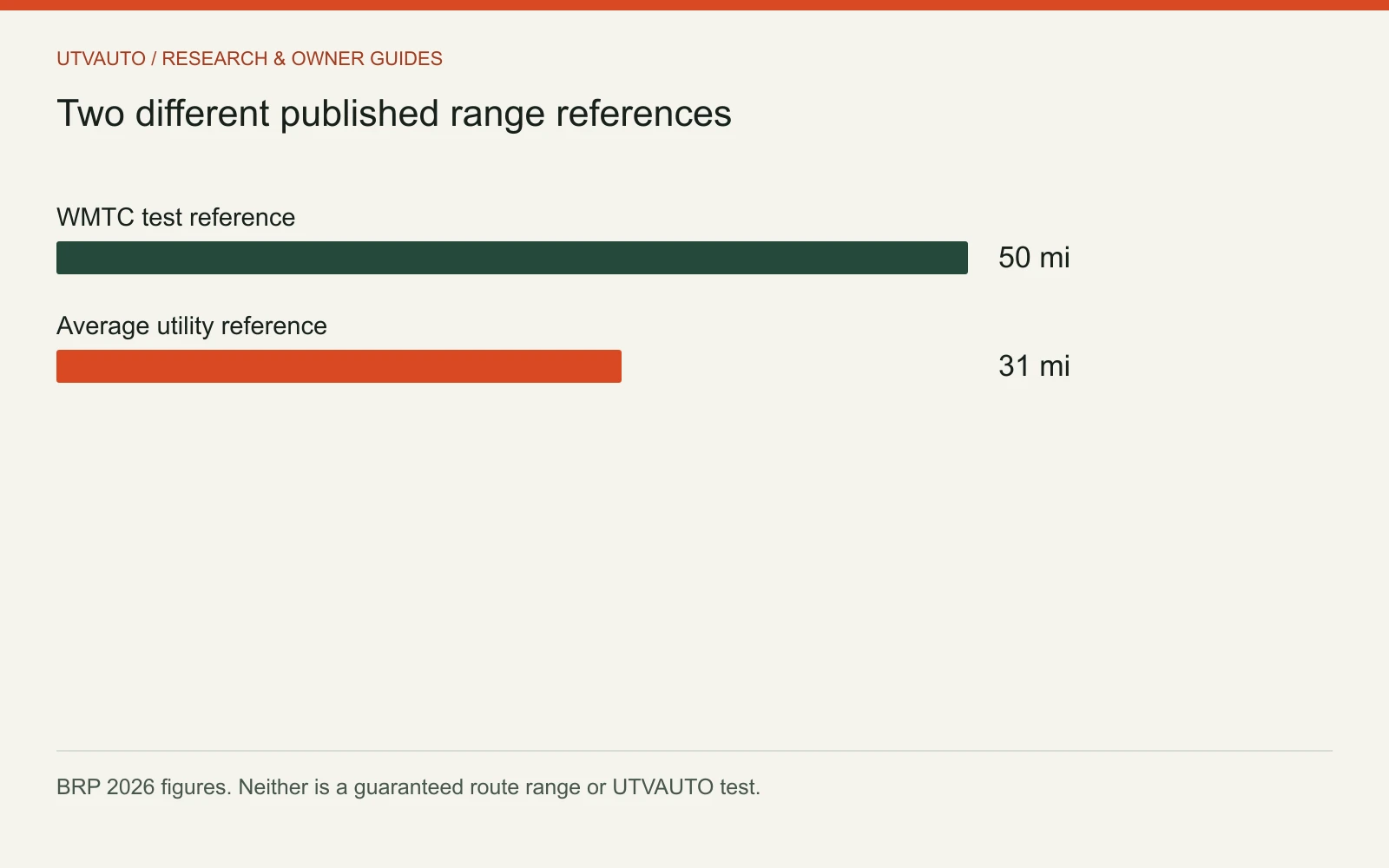
For the 2026 Can-Am Outlander Electric, BRP publishes two different range references: 50 miles under the stated WMTC test and 31 miles average utility range. Do not treat the larger number as a guaranteed working-day distance. Route, load, temperature and charging access belong in the purchase decision.
This U.S./North American research guide uses BRP’s official 2026 Outlander Electric specification sheet. We have not performed a range or charging test. It concerns the ATV, not the Mitsubishi Outlander passenger vehicle or Can-Am’s electric motorcycles.
Read the range and power labels precisely
| Manufacturer-published field | 2026 Outlander Electric |
|---|---|
| Battery capacity | 8.9 kWh |
| Range reference 1 | 50 mi / 80 km, WMTC test |
| Range reference 2 | 31 mi / 50 km average utility range |
| Peak / continuous power | 47 / 27 hp |
| Peak / continuous motor torque | 53 / 21 lb-ft |
| Charging connection | Type 1 J1772 |
| Onboard charging | 6.6 kW Level 2; Level 1 compatible |
Peak and continuous ratings are different operating quantities. Neither alone establishes endurance with your actual work cycle. The nominal battery-capacity figure also should not be treated as a guaranteed amount of energy available for every route.
Build the route around uncertainty, not the best number
List every expected trip, side task and return journey, then identify where charging is actually available. Include an operating reserve and a recovery plan suited to the location. Repeated short property loops and a remote all-day route are different applications even if their odometer totals match.
Illustrative planning screen: reserving 20% of the published 31-mile utility reference leaves 31 × 0.8 = 24.8 miles mathematically. Applying the same arithmetic to the 50-mile test figure gives 40 miles. Neither result is a safe-route promise or a prediction of linear battery discharge. The gap shows why the test basis matters before choosing a reserve.
Ask to evaluate the actual work pattern and record starting charge, ending charge, distance, terrain, temperature and load. A few short observations are not a lifetime battery-health study, but they are more relevant to the job than repeating the largest brochure number without its conditions.
Compare the correct charging window
| Published charging window | Level 2, 240 V | Level 1, 120 V |
|---|---|---|
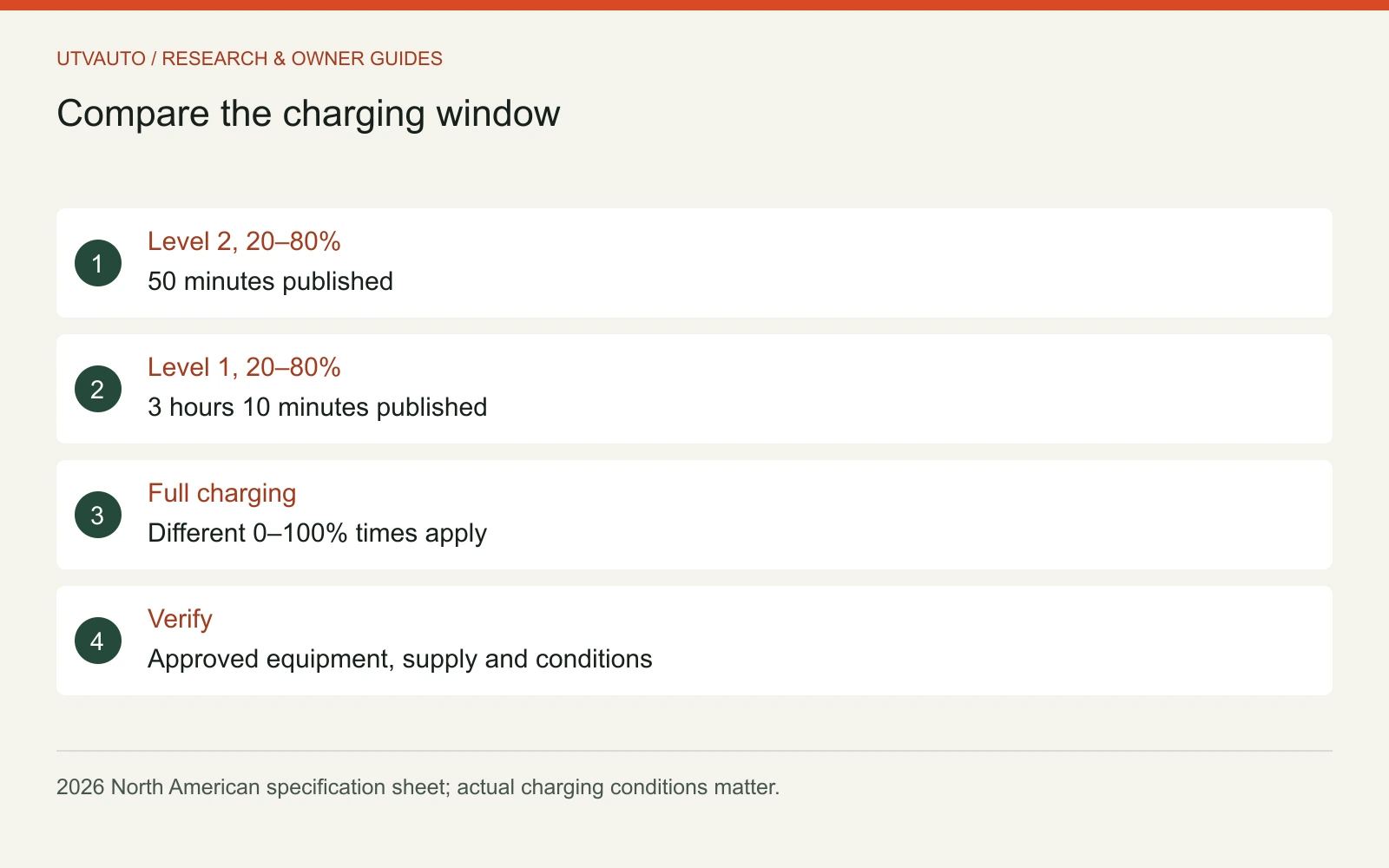
| 20% to 80% | 50 minutes | 3 hours 10 minutes |
| 0% to 100% | 1 hour 30 minutes | 5 hours 15 minutes |
These are the manufacturer’s published times for the identified vehicle, not promises for every outlet, power supply, ambient condition or battery state. A 20–80% time is not a full-charge time. Confirm suitable charging equipment and supply with the manufacturer and a qualified electrician as appropriate.
Cold use and charging need the actual instructions
The sheet lists a battery operating-temperature range of −20°C to 40°C and an integrated AC heater for cold-temperature charging. That operating range is not, by itself, a complete charging-temperature or storage procedure. Obtain the exact operator guide before planning winter use or leaving the machine connected for long periods.
Do not improvise an extension arrangement, change protective equipment or work on the high-voltage system. Damaged charging equipment, impact damage, a battery warning or suspected water intrusion needs qualified assessment. A shorter recharge after one trip does not prove a fault, and an electrical warning is not something to clear merely to finish the route.
Electric power does not remove load restrictions
BRP lists 120 lb front-rack and 240 lb rear-rack maxima and a 1,830 lb towing maximum. They remain distinct from total vehicle loading, hitch restrictions and terrain instructions. The instantaneous response associated with electric drive does not authorize a heavier trailer or an unapproved cargo arrangement.
Before purchase, obtain the exact loading instructions, warranty terms, local service capability and a complete equipment-and-charging quote. Compare the total setup needed for your job. For gasoline alternatives, Outlander DPS 500 and 700 provide a separate model comparison, not a substitute electric range test.

