
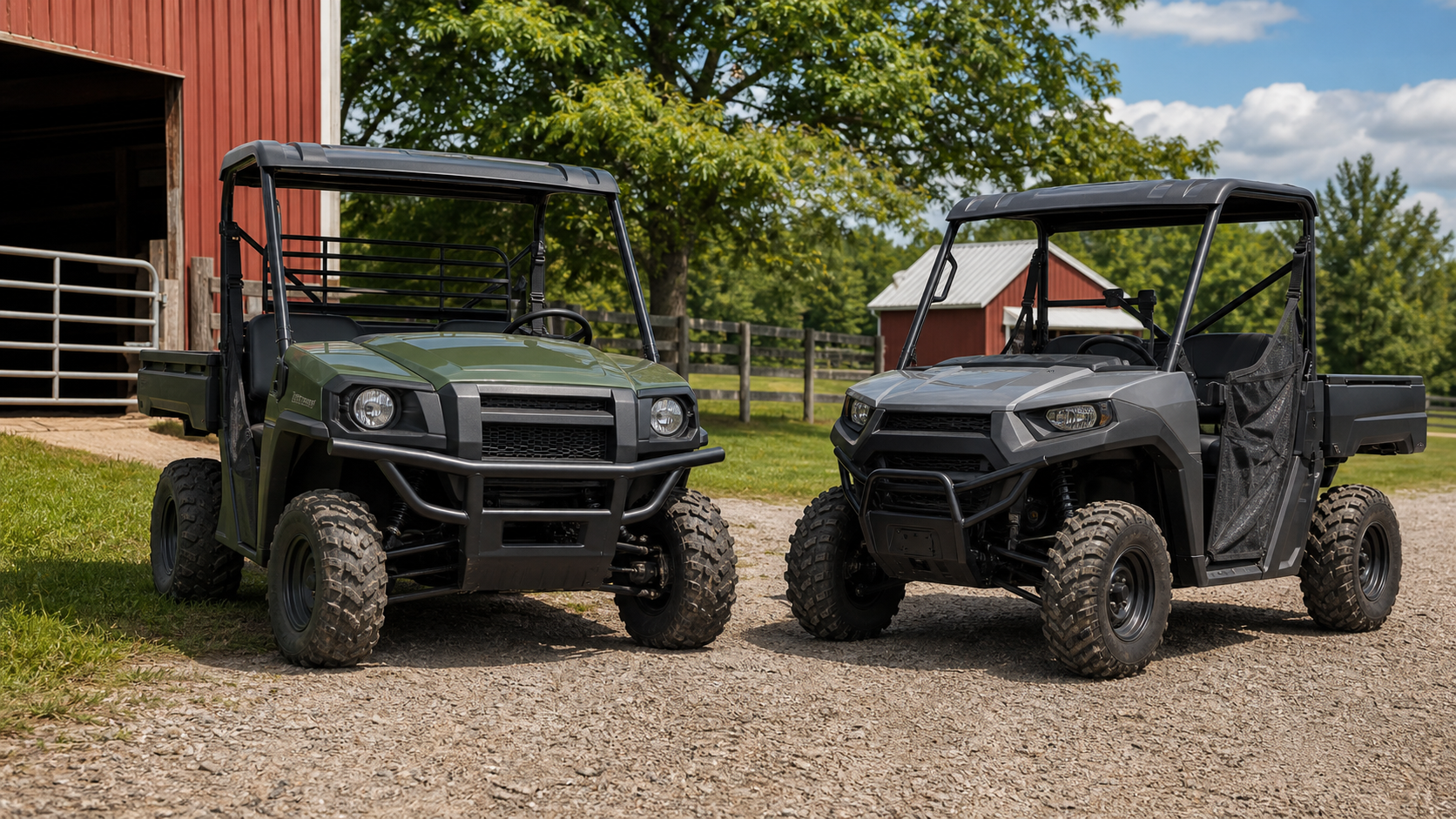
Quick verdict: choose the Kawasaki Mule if your UTV will spend most of its life doing slow, practical property work with people, tools, feed, fencing supplies, or hunting gear. Choose the Polaris Ranger if you want a stronger work-and-play balance, higher listed horsepower in XP 1000 trims, more factory cab paths, and one of the largest accessory ecosystems in the utility UTV market.
The Kawasaki Mule vs Polaris Ranger comparison is really a question about how the machine will be used after the new-purchase excitement fades. A Mule PRO-FXT makes sense for owners who want a steady work vehicle with flexible seating and bed use. A Ranger XP 1000 makes sense for owners who still need serious utility ratings but also want more speed, sharper throttle response, stronger recreational comfort, and a wider upgrade path.
Both brands sell multiple trims, and the exact answer changes by model year. For a fair comparison, this guide uses the Kawasaki Mule PRO-FXT 1000 LE and Polaris Ranger XP 1000 as reference points because they represent common full-size utility UTV shopping decisions. Before buying, verify current specifications for the exact trim, color, cab package, and model year you are considering.
Kawasaki Mule vs Polaris Ranger spec snapshot
| Category | Kawasaki Mule PRO-FXT 1000 LE | Polaris Ranger XP 1000 Premium | Why it matters |
|---|---|---|---|
| Engine | 999cc liquid-cooled 2-cylinder gas engine | 999cc ProStar twin-cylinder engine | Both are full-size utility choices, but their power tuning feels different. |
| Horsepower | Kawasaki lists 70.0 hp at 6,500 rpm | Polaris lists 82 hp | Ranger has the stronger published horsepower number. |
| Transmission | CVT with H, L, N, R | Automatic PVT with H, L, N, R, P | Both need smart belt and clutch care in hard use. |
| Seating | 3 to 6 passengers with Trans Cab system | 3 passengers in standard XP 1000, crew models available separately | Mule’s flexible cabin is a major work-site advantage. |
| Box capacity | 999 lb in 3-passenger mode; lower in 6-passenger mode | 1,000 lb box capacity on common XP 1000 specs | Both are strong, but Mule capacity changes with seating configuration. |
| Towing capacity | 2,000 lb | 2,500 lb | Ranger has the higher published tow rating in this comparison. |
| Width | 64.0 inches | 62.5 inches | Both are full-size machines; measure gates, trailers, barns, and trails. |
| Best fit | Farm, ranch, hunting property, crew chores | Work plus trail riding, cab builds, accessories, faster mixed use | Choose by weekly use, not by brand loyalty. |
Where the Kawasaki Mule is stronger
The Mule’s strongest argument is practical flexibility. Kawasaki lists the Mule PRO-FXT 1000 LE with a 3- to 6-passenger Trans Cab system, a 999cc Kawasaki-built engine, 999-pound cargo bed capacity in 3-passenger mode, and 2,000-pound towing capacity. The Trans Cab layout is the feature that separates it from many utility UTVs. If you often switch between carrying workers, family, hunting partners, tools, and cargo, that flexibility matters more than peak horsepower.
The Mule is especially convincing for farms, ranches, large properties, horse barns, orchards, hunting leases, campgrounds, maintenance crews, and landowners who value predictable slow-speed work. It is the kind of machine that makes sense when the route is familiar and the job is repetitive: checking fences, hauling bags, moving sprayers, carrying firewood, pulling a small trailer, or transporting people across private land.
The Mule is less compelling if your main goal is fast trail riding. It can leave the work site, but its personality is utility-first. If you want a machine that feels exciting at speed, has a huge modification culture, and offers many recreational trim choices, the Ranger is probably a better starting point.
Where the Polaris Ranger is stronger
The Ranger’s strongest argument is balance. Polaris lists the Ranger XP 1000 Premium with an 82-hp engine, 1,000-pound box capacity, 2,500-pound towing capacity, 14 inches of ground clearance, and 29-inch tires on current specification information. Those numbers make it a serious work vehicle, but the Ranger also feels more oriented toward mixed use. It can handle chores during the week and still feel appropriate for trail rides, hunting trips, family weekends, and accessory-heavy cab builds.
The second Ranger advantage is the ecosystem. Polaris has a broad accessory catalog and a large aftermarket around roofs, windshields, doors, heaters, HVAC cab models, winches, plows, lighting, storage, audio, tires, wheels, and protection parts. For buyers in North America, this can make ownership easier because parts knowledge is widely distributed. Many dealers, shops, and owners already know how to build a Ranger for winter work, mud, hunting, or trail comfort.
The tradeoff is complexity and temptation. A Ranger can become expensive quickly once you add a cab, heater, glass windshield, wiper, winch, plow, sound system, roof lighting, and premium tires. Compare out-the-door price with the accessories included, not just base MSRP.
Farm and ranch use
For farm and ranch work, the Mule usually makes the cleaner case when passengers and cargo flexibility are constant needs. The Trans Cab lets owners shift the layout around the job. If one hour requires people and the next hour requires more bed space, that system can reduce the need for a second machine.
The Ranger makes the stronger case when the property includes longer distances, rougher roads, winter cab needs, plowing, trail sections, or recreational riding after work. Its higher listed towing rating and stronger horsepower number can matter if the job includes pulling, climbing, or moving at higher speeds. Still, towing ratings are not permission to overload the machine. Payload, tongue weight, hills, braking, tires, and surface conditions all affect safe use.
Hunting and outdoor property use
Hunters should focus on noise, storage, passenger needs, tire choice, ground clearance, and how the machine behaves at low speed. The Mule’s flexible seating is useful when carrying people to stands, moving gear, or changing from passenger duty to cargo duty. The Ranger’s accessory ecosystem is useful when building a machine with a roof, windshield, rear panel, gun storage, lighting, winch, and cargo management.
If your hunting land has narrow timber trails, measure before buying. Both machines are full-size UTVs. A 62.5-inch or 64-inch width can still be too wide for older trails cut around ATVs. Also measure trailer deck width, ramp angle, garage door clearance, barn aisles, and storage height with roof accessories installed.
Cab comfort and weather protection
Cab comfort can change the whole comparison. An open Mule and a fully enclosed Ranger cab are not in the same practical category. If winter feeding, snow plowing, rain, dust, or cold hunting mornings matter, compare factory cab availability, heater output, windshield material, wiper options, door sealing, defrosting, and how easy the cab is to service.
For hot climates, do not assume a full cab is better. Airflow, dust sealing, engine heat, windshield choice, and roof design matter. A half windshield or vented windshield can be more comfortable than a sealed cab in some regions. Our best UTV windshields guide explains the tradeoffs between glass, polycarbonate, half, and flip windshields.
Maintenance and belt ownership
Both machines use CVT-style automatic drivetrains, so belt and clutch care matter. Hard towing, mud, oversized tires, heavy cargo, heat, dust, and aggressive throttle use can shorten belt life. Use low range when the manual recommends it, avoid prolonged slipping, keep intake and clutch areas clean, and give the machine time to cool during heavy work.
Basic utility UTV maintenance is not glamorous, but it is where ownership quality is won. Check engine oil, coolant, brake fluid, air filter, tire pressure, lug nuts, suspension bushings, driveline boots, battery condition, and accessory wiring. If the machine lives on a farm, dust and chaff can accumulate quickly. If it lives in mud, brakes, bearings, and electrical connectors need more attention.
Used buying checklist
- Ask for service records, hours, miles, and the reason for selling.
- Inspect the bed, tailgate, hitch, frame, skid plates, suspension arms, and underbody for overload damage.
- Check CV boots, wheel bearings, steering play, brake pedal feel, and parking brake function.
- Look for mud, dust, or oil around the clutch intake and air filter area.
- Test 2WD, 4WD, turf mode or differential functions, low range, reverse, and lights.
- Confirm accessory wiring is fused, secured, and not draining the battery.
- Verify the VIN and check for open recalls or title issues before paying.
Which one should you buy?
Buy the Kawasaki Mule if your UTV is primarily a work tool and you regularly need flexible passenger and cargo use. It is the stronger fit for landowners who think in terms of chores, people-moving, property loops, livestock, tools, and hunting camp logistics.
Buy the Polaris Ranger if your UTV needs to be more versatile across work, trails, accessories, and comfort upgrades. It is the stronger fit for owners who want higher published power, more towing capacity in the XP 1000 comparison, and a larger path for cab, lighting, storage, and seasonal builds.
If the choice is still close, do a real ownership-cost comparison. Price the machine, freight, setup, tax, warranty, roof, windshield, doors, heater, winch, tires, storage, trailer changes, and first-year service. A UTV that looks cheaper on the showroom floor may not be cheaper once both machines are equipped for the same job.
FAQ
Is the Kawasaki Mule more reliable than the Polaris Ranger?
Reliability depends on maintenance, load, terrain, model year, accessories, and dealer support. The Mule has a strong utility reputation, while the Ranger has a larger performance and accessory ecosystem. Inspect the individual machine and service records rather than relying only on brand reputation.
Which is better for farm work, Mule or Ranger?
The Mule is often better for pure farm and property work because of its work-first layout and Trans Cab flexibility. The Ranger is better if the same machine also needs higher-speed trail comfort, a larger accessory path, or stronger published towing capacity in XP 1000 trims.
Which has more power?
In this reference comparison, Kawasaki lists the Mule PRO-FXT 1000 LE at 70.0 hp, while Polaris lists the Ranger XP 1000 Premium at 82 hp. Confirm exact current specs for the trim you plan to buy because model-year details can change.
Can a Kawasaki Mule or Polaris Ranger fit on a standard trailer?
Measure the exact trailer. The Mule PRO-FXT 1000 LE is listed at 64.0 inches wide and 135.8 inches long. The Ranger XP 1000 Premium is listed at 62.5 inches wide and 120 inches long. Add roof height, mirrors, tires, and ramp angle before assuming fit.
Which is better for hunting?
The Mule is strong for carrying people and gear around private land. The Ranger is strong when you want more accessories, cab options, lighting, storage, and trail comfort. For hunting, tire choice, quiet operation, cargo layout, and local dealer support may matter more than peak horsepower.

