
A quiet impression is not an exposure measurement
Do not assume that a UTV is safe for hearing because it has a closed cab, a stock exhaust or a comfortable sound at idle. Noise exposure depends on the level and duration under the actual conditions. This guide helps owners organize the questions needed for a measured assessment and select compatible protective equipment with qualified guidance. It does not assign an unmeasured decibel level to your machine.
The distinction matters for property work as well as recreation. A short demonstration and a full working day are different exposure situations. Keep the vehicle configuration, operating task and measurement conditions together in your notes. UTVAUTO has not measured these vehicles. The planning examples here are not individual medical advice or certification that a particular helmet, headset or hearing protector is suitable for your use.
Understand what the NIOSH numbers describe
NIOSH recommends an occupational exposure limit of 85 dBA averaged over an eight-hour workday, with recommended duration halved for each 3 dBA increase. This is occupational guidance, not a promise of zero risk or a UTV-specific legal operating limit. Use the linked NIOSH explanation for the original context and consult an occupational-safety professional when evaluating work exposure.
Avoid turning that reference into a simple safe-versus-unsafe dashboard for a recreational ride. Individual circumstances and the full pattern of exposure still matter. The numbers are useful for understanding why a louder task deserves attention, not for granting yourself an exact unprotected riding allowance from an uncertain reading. Record the source and purpose of any limit used so the next reader knows what the comparison does and does not establish.
Define the operating conditions before collecting data
Write down the vehicle, cab and exhaust configuration, rider position, task and approximate operating pattern. Note other relevant equipment that contributes to the work environment. A measurement taken at a different location or with a different arrangement may not answer the same question. Ask the person performing the assessment to document the method and equipment rather than accepting a bare number in a text message.
Keep a distinction between a screening observation and a professional exposure assessment. A phone recording that sounds loud does not provide a calibrated exposure result. If you use a screening tool, understand its limitations and preserve the settings and context. Do not compare screenshots from unrelated apps as if they were controlled vehicle tests. The value of a record comes from repeatability and appropriate interpretation, not the number of digits displayed.
Look for ways to reduce exposure before shopping
Begin by asking whether the noisy task or unnecessary exposure can be reduced through an appropriate change in the work plan. Do not modify a vehicle’s exhaust, structure or protective systems to pursue an improvised noise solution. Any equipment change should follow the manufacturer’s requirements. Ask a qualified assessor which controls make sense for the real task rather than assuming that protective equipment is the only available response.
For a hypothetical property job, the first useful question may be whether the UTV needs to remain running beside a stationary work area. The correct answer depends on the job and vehicle instructions; this is a planning prompt, not a universal shutdown procedure. Look at the whole day and the avoidable portions of exposure. A more deliberate workflow can be evaluated without promising that it will achieve a particular numerical reduction.
Choose hearing protection as part of the gear system
NIOSH emphasizes correct fit and compatibility with other protective equipment. Its current guidance also distinguishes noise-canceling consumer devices from hearing protection labeled with a noise reduction rating. Do not assume a music earbud, intercom speaker or helmet automatically supplies the protection needed for your exposure. Ask the equipment manufacturer about the actual product and application.
Evaluate the helmet, eye protection, communication equipment and hearing protector together, following their respective instructions. A combination that seems comfortable in the hand can fit differently when worn. Do not alter required protective equipment to make an incompatible accessory fit. If you cannot achieve an appropriate combination, ask qualified suppliers or safety personnel for alternatives. The objective is a coherent protection system, not the most impressive advertised specification on one isolated item.
Make communication a planned requirement
Discuss how riders or workers will communicate before selecting a headset or protector. Identify ordinary messages, stop signals and situations that require stopping before discussion. Do not rely on shouted instructions becoming audible under every operating condition. Evaluate any proposed communication equipment within the complete protective arrangement rather than treating amplified speech as proof that the exposure problem has been solved.
Document a simple fallback for communication failure. If a message cannot be understood, the plan should allow a safe pause instead of encouraging people to remove protection while the noisy task continues. The appropriate procedure depends on the operation, participants and equipment. Test the communication arrangement in a controlled, appropriate setting and revise it with qualified guidance where needed. A group agreement should be understandable without requiring riders to interpret complicated hand gestures while managing terrain.
Keep a practical equipment and assessment record
Record the protector model, fitting instructions, compatibility questions and the person who provided guidance. Preserve any professional assessment with its date and operating conditions. If a task or vehicle configuration changes, identify which assumptions may no longer apply. A new cab panel, accessory or work pattern is a reason to reconsider the assessment, not evidence that exposure necessarily became better or worse.
Include storage and inspection requirements from the product manufacturer so equipment remains available in usable condition. Do not invent a replacement interval for every protector type. Keep spare supplies appropriate to the actual equipment where the work plan requires them. If the chosen arrangement is repeatedly left behind because it is uncomfortable or inconvenient, treat that as a problem to resolve with a better fitting and supported solution, rather than as proof that protection is unnecessary.
Know when the question needs professional help
For work use, involve the responsible employer or occupational-safety professional when assessing exposure and selecting controls. If you experience new ringing, muffled hearing or another hearing concern, seek advice from a qualified health professional; do not use this article to diagnose the cause or decide that symptoms are harmless. Urgent or sudden symptoms warrant prompt professional attention appropriate to the situation.
Your final record should identify what was measured, what was assumed, which protective arrangement was selected and when it needs review. It should not say that a machine is universally quiet enough or that a premium headset guarantees safety. The most useful outcome is a plan grounded in the actual task, a compatible equipment choice and a clear path to qualified help when the evidence or fit remains uncertain.
Example: distinguish a cabin comparison from a safety conclusion
Imagine an owner comparing an open vehicle with a closed-cab alternative for repeated property work. During a brief stationary demonstration, the owner perceives the closed machine as more comfortable. That observation is worth recording, but it does not establish the exposure during a working day. Save it as a comfort impression and keep the hearing-assessment question open.
Ask what operating conditions need assessment and whether the proposed protective arrangement remains compatible with the complete riding equipment. Record any advice from a qualified assessor in its original context. If the work pattern changes, review whether the assessment still applies instead of assuming that the cab choice settled the issue permanently. A subjective preference and a measured exposure result can both be useful while answering different questions.
This separation also improves buying decisions. The owner can decide that an enclosure has other practical benefits without advertising it as hearing protection. If a supplier claims a numerical reduction, request the underlying method and applicable configuration. Do not convert a relative reduction into a declaration that no further protection is required. The final plan needs to address the resulting exposure and the person using the equipment, rather than only the advertised difference between two products.
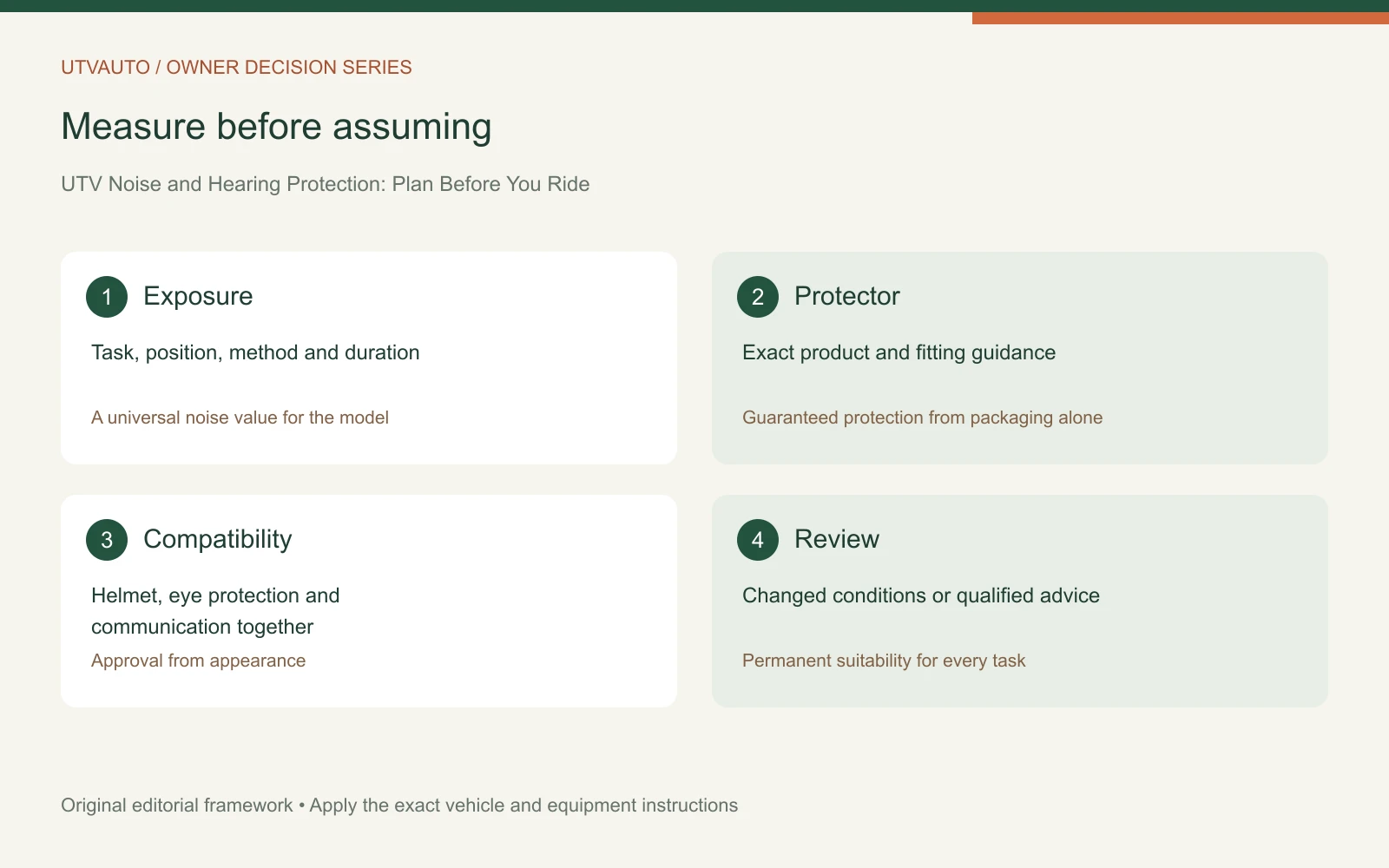
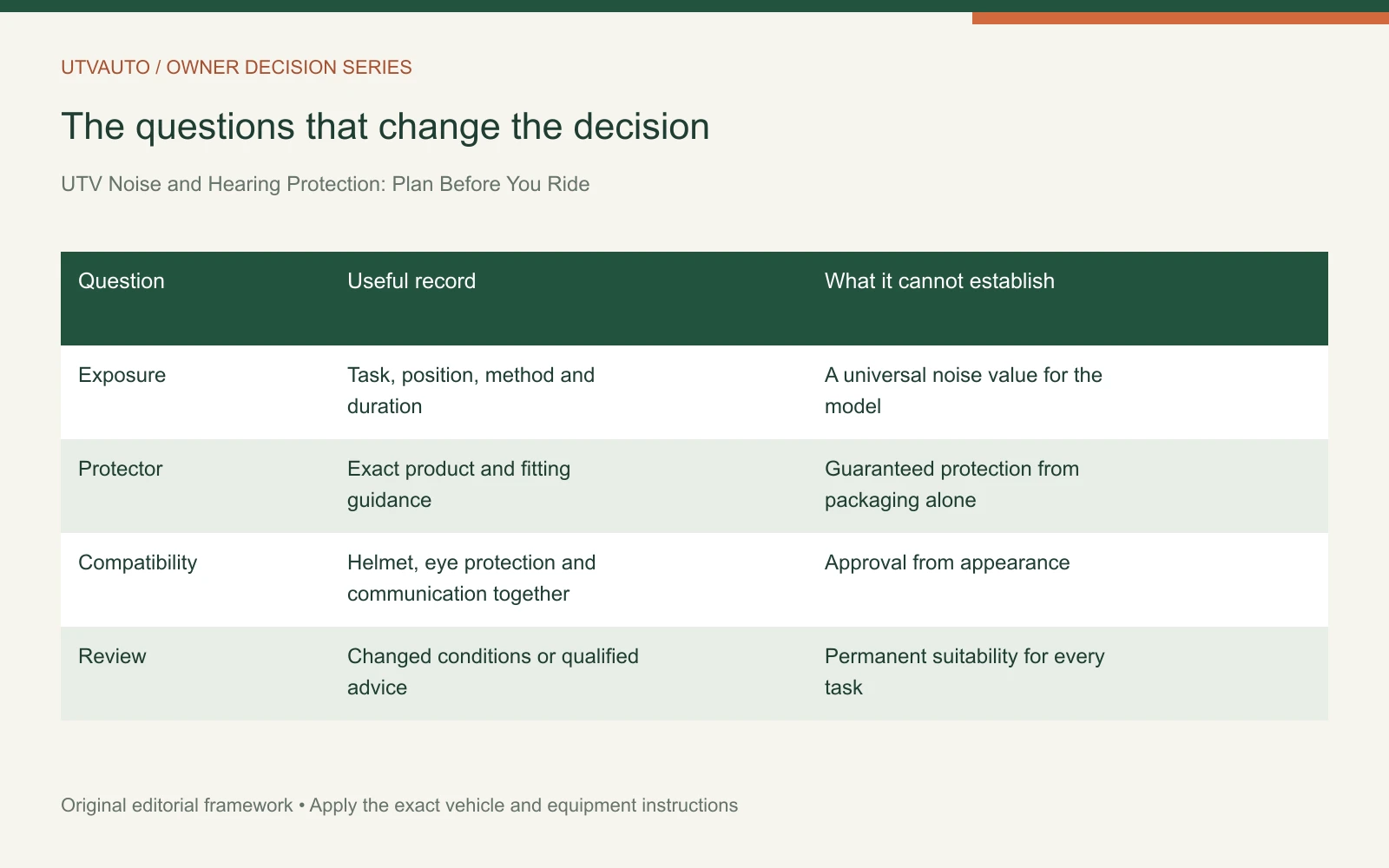
Working reference table
| Question | Useful record | What it cannot establish |
|---|---|---|
| Exposure | Task, position, method and duration | A universal noise value for the model |
| Protector | Exact product and fitting guidance | Guaranteed protection from packaging alone |
| Compatibility | Helmet, eye protection and communication together | Approval from appearance |
| Review | Changed conditions or qualified advice | Permanent suitability for every task |
Related UTVAUTO resources
Sources and scope
Research and editorial planning framework, checked November 9, 2026. UTVAUTO has not tested these vehicles, measured their noise, or inspected the reader’s machine. Examples are explicitly hypothetical. Use the exact vehicle manual and obtain qualified assistance for unresolved safety questions.
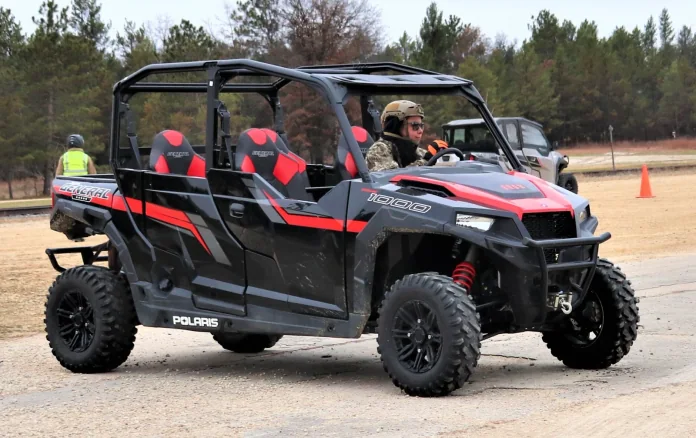
Featured archival reference photograph: Polaris General Off-road vehicle safety training at Fort McCoy (37). It illustrates vehicle context, not a UTVAUTO test, the exact equipment discussed or an endorsement. Scott T. Sturkol/Fort McCoy Public Affairs Office / Wikimedia Commons / Public domain. Resized and converted to WebP; photograph retains its stated license.


