
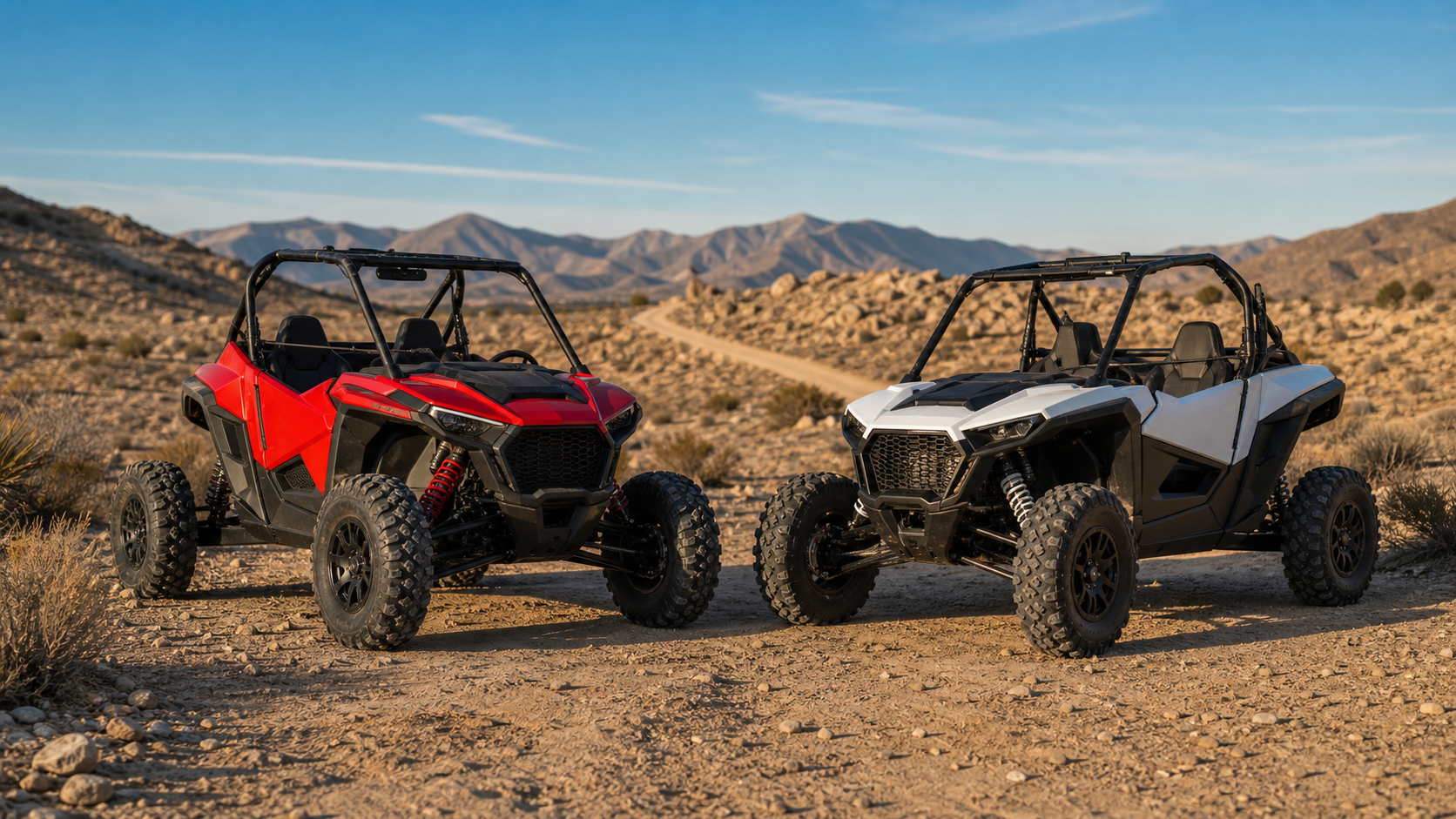
Quick verdict: choose the Honda Talon if you want a sport UTV with a gear-driven Dual-Clutch Transmission, predictable engine braking, and a more mechanical driving feel. Choose the Polaris RZR if you want stronger lineup depth, higher listed horsepower in common XP trims, broader accessory support, and a sport platform that is easier to build for dunes, desert, trail, or weekend recreation.
The Honda Talon vs Polaris RZR decision is not simply “Honda reliability versus Polaris performance.” That shortcut misses the real buying question. These two sport side-by-sides feel different because their drivetrains, trim strategy, suspension packages, owner communities, and accessory ecosystems are different. A Talon buyer is often trying to avoid the belt-driven CVT ownership routine and wants a more direct connection between throttle, shifting, and engine braking. A RZR buyer is often shopping the largest sport UTV ecosystem in North America and wants more trim choices, parts availability, and future upgrade paths.
This comparison focuses on the practical decision points that matter after the first test drive: terrain, transmission feel, suspension priorities, maintenance expectations, accessory plans, dealer support, and long-term ownership cost. Model-year specifications change, so use this guide to build your shortlist, then confirm exact numbers on the current Honda and Polaris spec pages before placing a deposit.
Honda Talon vs Polaris RZR quick comparison
| Decision point | Honda Talon advantage | Polaris RZR advantage | Buyer note |
|---|---|---|---|
| Transmission feel | Six-speed automatic Dual-Clutch Transmission on Talon 1000R spec information | Automatic PVT/CVT layout on common RZR XP trims | Talon feels more gear-driven; RZR feels more familiar to many sport SxS owners. |
| Power and speed focus | Strong 999cc sport engine with direct response | RZR XP 1000 spec information lists 114 hp | Do not compare only horsepower; suspension, weight, gearing, and terrain matter. |
| Width and trail access | Talon 1000R spec information lists a 68.1-inch width | RZR XP 1000 Sport spec information lists a 64-inch width | Check local trail width limits before buying either machine. |
| Suspension travel | Talon 1000R lists 17.6 inches front and 20.1 inches rear travel | RZR XP 1000 Sport lists 20 inches usable travel, with 16 inches front and 18 inches rear wheel travel | Shock tuning and trim level can matter more than a single travel number. |
| Aftermarket ecosystem | Good but more focused | Very broad | RZR is usually easier to customize because more owners and suppliers build around it. |
| Best buyer profile | Driver who values DCT behavior and Honda engineering priorities | Driver who values lineup breadth, power options, accessories, and community support | The better machine is the one that fits your trails, body, dealer network, and budget. |
What makes the Honda Talon different?
The Talon’s main identity is its drivetrain. Honda’s Talon 1000R specification page lists a 999cc liquid-cooled parallel-twin engine and a six-speed automatic Dual-Clutch Transmission. That DCT is the reason many riders put the Talon on their shortlist. It shifts through gears rather than using the typical belt-driven CVT feel found in many sport UTVs. For drivers who like engine braking, paddle-shift control, and a more mechanical connection, this is a meaningful difference.
The Talon can also appeal to owners who want fewer belt-related decisions. That does not mean the Talon is maintenance-free. Air filters, fluids, cooling system condition, driveline inspection, suspension hardware, brake wear, and tire condition still matter. The point is that the Talon changes the maintenance conversation. Instead of thinking mainly about belt break-in, belt heat, and clutch cleanliness, the Talon owner needs to stay current on Honda’s service schedule and pay attention to DCT fluid and operating behavior.
From an editorial standpoint, the Talon is strongest when the buyer values consistency and driving feel more than modification culture. It makes sense for riders who enjoy technical trails, mixed-speed terrain, and a transmission that behaves closer to a geared vehicle. It is less ideal for someone who wants the deepest race-style aftermarket, the broadest number of trim choices, or the easiest path to a highly customized desert build.
What makes the Polaris RZR different?
The Polaris RZR is the sport UTV benchmark because the platform has scale. The RZR family covers many trims, widths, seating layouts, shock packages, technology packages, and accessory paths. The RZR XP 1000 Sport specification information lists a 999cc ProStar engine, 114 horsepower, 64-inch width, 14 inches of ground clearance, 9.5-gallon fuel capacity, and 300-pound box capacity. Those numbers explain why many buyers see the RZR XP as the default sport side-by-side comparison point.
The RZR’s bigger advantage is not just the spec sheet. It is the ecosystem around the machine. Dealers know them. Forums and owner groups have years of setup notes. Wheels, tires, cages, roofs, storage, lighting, seats, harnesses, audio systems, clutch kits, and suspension upgrades are easy to find. If your plan is to buy a sport UTV and slowly tune it for your local riding area, the RZR gives you more paths.
The tradeoff is that a large ecosystem can tempt buyers into solving every problem with accessories or modifications. Before adding power, larger tires, or weight, make sure the machine still fits your trailer, garage, local trail width limits, and service budget. A RZR that is built carefully can be extremely capable. A RZR that is modified without a plan can become louder, hotter, heavier, and more expensive to maintain.
Terrain fit: trail, desert, dunes, and woods
For open desert and fast two-track, many buyers lean toward the RZR because of the lineup depth and performance ecosystem. The 64-inch RZR XP footprint also fits some trail systems where wider sport machines may be restricted. If your local area rewards speed, suspension tuning, and aftermarket support, the RZR is often easier to build around.
For tighter technical riding, the decision becomes more personal. The Talon’s DCT can feel controlled and confidence-building because the vehicle gives a clearer sense of what gear it is in and how engine braking will respond. Some drivers like that when descending, crawling through rocks, or riding mixed terrain. Others prefer the smoother, continuously variable feel of the RZR’s PVT/CVT layout. Neither response is universal, so the best test drive is one that includes the kind of terrain you actually ride.
Dune buyers should pay close attention to tire package, clutching, cooling, engine load, and passenger weight. A spec-table winner on hardpack may not feel the same in sand. Woods buyers should measure width and turning needs first. A machine that looks better online can be frustrating if it is too wide for gates, trees, bridges, or local trail rules.
Maintenance differences that matter
The maintenance conversation is one of the clearest reasons to compare these machines carefully. On a RZR, belt health is part of ownership. Owners should understand belt break-in, belt temperature, clutch cleanliness, air intake condition, and how aggressive throttle use affects belt life. Carrying a spare belt and knowing how to inspect the clutch area makes sense for many RZR owners. Our UTV CVT belt maintenance guide explains the basic ownership routine.
On a Talon, the DCT changes those concerns, but it adds its own need for disciplined service. Follow Honda’s owner manual for fluids, intervals, warning lights, and operating procedures. If shifting behavior changes suddenly, if warning lights appear, or if the machine refuses to shift normally, stop riding and involve a Honda dealer rather than guessing.
Both machines need the boring checks that prevent expensive weekends: clean air filter, correct tire pressure, intact CV boots, tight lug nuts, healthy battery, good brake pedal feel, and no coolant or oil leaks. Before any ride, especially after washing, mud, dust, or storage, use a simple pre-ride routine. See our UTV pre-ride inspection checklist for a practical baseline.
Comfort, cab feel, and ergonomics
Sport UTV comfort is not only suspension. It is also seating angle, pedal position, steering wheel adjustment, sight lines over the hood, door opening, heat around the cabin, and noise at cruising speed. Sit in both machines wearing the shoes, helmet, and gear you normally use. Check whether your knees clear the dash, whether the passenger has room, and whether you can see obstacles close to the front tires.
The Talon may feel more mechanical and connected. The RZR may feel more familiar if you have owned belt-driven sport machines before. Neither feel is objectively better for every rider. What matters is whether the machine reduces fatigue on your normal trail. A five-minute dealer-lot impression is not enough; ask for a real demo opportunity if your dealer offers one.
Accessory and upgrade planning
If accessories are a major part of the purchase, RZR has the advantage. Polaris and the aftermarket offer many roofs, windshields, mirrors, bumpers, lighting systems, storage boxes, doors, audio systems, tires, wheels, and suspension parts. That makes the RZR easier to personalize for a specific region.
The Talon still has useful accessory support, but the ecosystem is narrower. That can be a positive if you want a cleaner ownership path and fewer upgrade distractions. It can be a negative if your local riding group runs specialized equipment and you want many choices. Before buying either machine, price the real package you need: roof, windshield, spare tire setup, lighting, storage, communication, winch, and tires. A cheaper base machine can become more expensive after accessories.
Used buying checklist
- Check hours and miles together; low miles with high hours can mean slow, hot, hard use.
- Inspect skid plates, A-arms, trailing arms, radius rods, tie rods, wheel bearings, and CV boots.
- Look for dust past the air filter, which can signal poor filter service.
- On a RZR, inspect belt condition, clutch cleanliness, and signs of heat.
- On a Talon, check DCT behavior, service records, and warning-light history.
- Confirm the VIN, title status, recalls, and whether accessories were wired cleanly.
- Drive it cold and hot if possible, not only around a parking lot.
Which one should you buy?
Buy the Honda Talon if you value DCT feel, engine braking, a gear-driven character, and a sport UTV that feels less like the standard CVT formula. It is especially appealing if you ride mixed terrain and want the drivetrain to feel deliberate.
Buy the Polaris RZR if you want the broader sport UTV ecosystem, more trim choices, strong listed performance, and easier aftermarket planning. It is especially appealing if you ride with a group that already knows RZRs, if your local dealers stock RZR parts, or if you plan to customize the machine over time.
If the decision is still close, compare exact trims rather than brand names. A base Talon and a premium RZR are not the same comparison as a Talon FOX Live Valve model and an entry RZR XP. Build a spreadsheet with sale price, freight, setup, warranty, accessories, trailer fit, local trail width limits, service intervals, and dealer distance. The right answer usually becomes clearer when the total ownership package is visible.
FAQ
Is the Honda Talon better than a Polaris RZR?
The Honda Talon is better for buyers who want a Dual-Clutch Transmission feel, engine braking, and Honda’s drivetrain approach. The Polaris RZR is better for buyers who want broader trim choices, higher listed horsepower in common XP trims, more accessories, and a larger sport UTV community.
Does the Honda Talon use a belt?
No. Honda Talon 1000 models are known for using a six-speed automatic Dual-Clutch Transmission rather than the belt-driven CVT layout common in many sport UTVs. Owners still need to follow Honda service guidance for fluids, filters, and drivetrain checks.
Is the Polaris RZR better for dunes?
The RZR is often easier to build for dunes because of its accessory and tuning ecosystem, but the right setup depends on tire choice, clutching, cooling, passenger load, and trim. Confirm your exact model and setup with a dealer or experienced local shop.
Which is better for trail width restrictions?
Check the exact trim. Honda’s Talon 1000R spec page lists 68.1 inches wide, while RZR XP 1000 Sport spec information lists 64 inches wide. Local trail systems may have 50-inch, 60-inch, 64-inch, or other rules, so measure before buying.
Which one is cheaper to maintain?
There is no universal answer. The RZR may require more attention to belt and clutch condition. The Talon removes that belt concern but still requires proper DCT-related service, fluid care, filters, brakes, tires, and suspension checks. Dealer labor rates and parts availability in your area can matter more than the badge.

