
Editorial collection: September 2026. Collection month is an editorial label; the page retains its actual first-publication date.
Featured image: original UTVAUTO diagram. Supporting sources and the scope of the illustration are explained below.
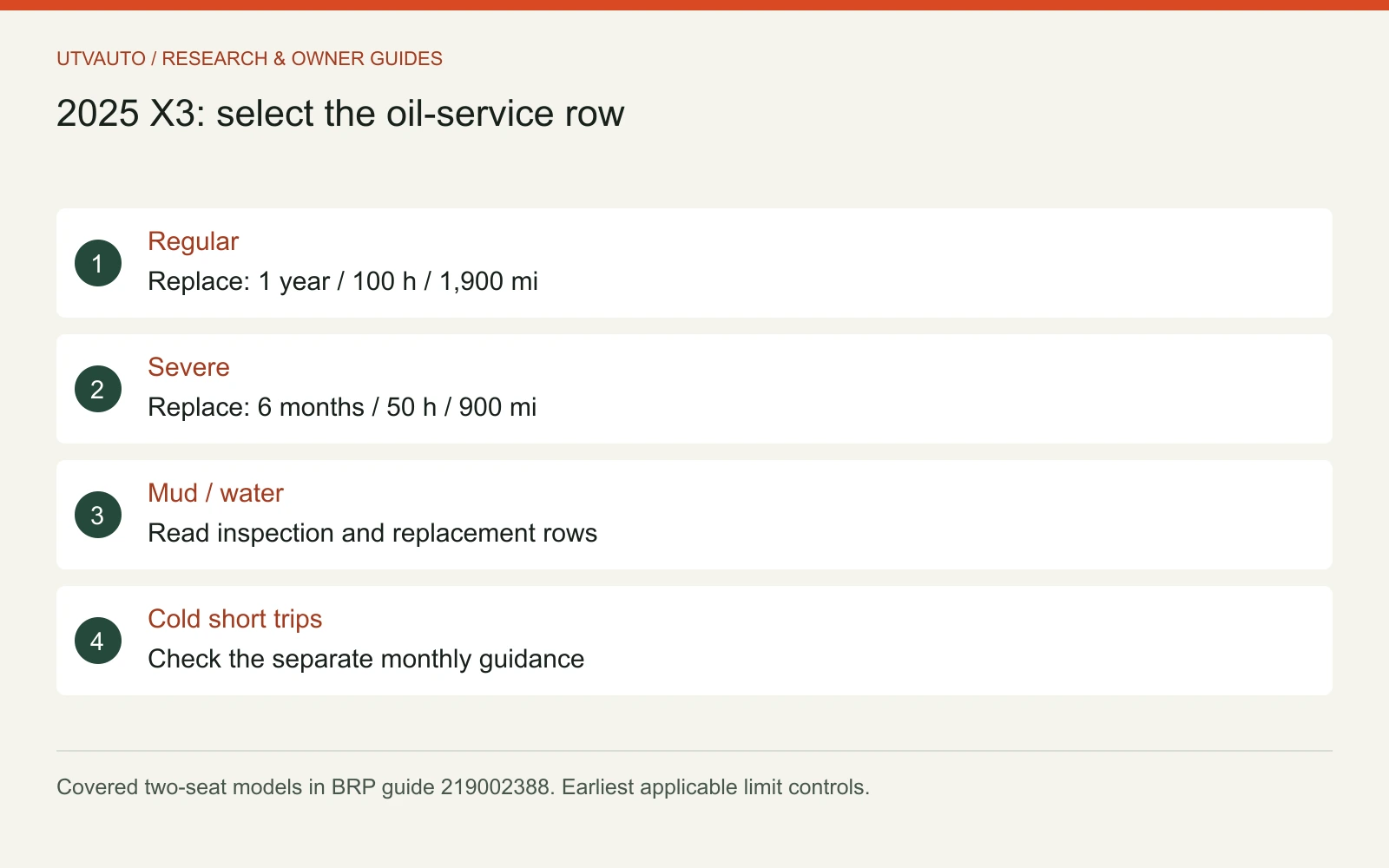
For the covered 2025 Can-Am Maverick / Maverick X3 two-seat models in BRP operator guide 219002388, the regular-duty engine-oil-and-filter replacement interval is every year, 100 hours or 3,000 km (1,900 mi), whichever comes first. The severe-duty table shortens replacement to six months, 50 hours or 1,500 km (900 mi). The exact duty category matters as much as the model name.
The guide’s covered-model list includes DS Turbo, DS Turbo RR, RS Turbo, RS Turbo RR, X ds Turbo RR, X rc Turbo RR, X rs Turbo RR and X rs Turbo RR with Smart-Shox. This article does not transfer that schedule to Maverick R, MAX, a different year or a separately issued guide. Confirm your model in BRP’s official 2025 operator guide before using the numbers.
Read the oil row, not merely the column heading
| 2025 guide duty table | Oil and filter action | Timing in that table |
|---|---|---|
| Regular duty, printed p. 138 | Replace | 1 year / 100 h / 3,000 km (1,900 mi), first reached |
| Severe duty, printed p. 141 | Replace | 6 months / 50 h / 1,500 km (900 mi), first reached |
| Deep mud / water, printed p. 144 | Inspect at A+; replace at A | A+: 6 months / 50 h / 1,500 km; A: 1 year / 100 h / 3,000 km |
The letters in BRP’s table distinguish inspection from replacement. The deep-mud/water oil row has an inspection at A+ and replacement at A; it is not identical to the severe-duty row. This is a summary of those specific rows, not a complete maintenance chart or permission to extend an interval when severe-duty or contamination conditions also apply. See Maintenance Schedule, printed pages 134–146.
Which duty schedule applies?
BRP’s severe-duty discussion includes repeated hauling above 75% of maximum capacity and prolonged excessive-speed operation, and directs commercial/work and rental vehicles to the severe schedule. These are manufacturer classifications, not our invented definition of “hard riding.” If your use spans categories, obtain a model-specific service plan rather than choosing the longest interval from the table.
The guide treats deep mud and water separately because debris or water can enter mechanical systems. If oil is contaminated or water ingestion is suspected, a future calendar due date is not a reason to continue driving. Stop operation and have the condition assessed. Do not attempt to solve suspected internal contamination merely by clearing a reminder.
Extreme cold can add a different oil-service requirement
On printed page 135, BRP discusses frequent operation at or below −25°C (−13°F), especially repeated starts, short idling or short low-rpm trips that do not bring the engine fully to operating temperature. For the described use pattern, BRP strongly recommends oil changes at least monthly. That is a specific cold-use condition, not a universal monthly rule for every X3 owner.
The reason given is accumulation of water and fuel residue in oil when the operating pattern does not allow condensate to evaporate. A seasonal owner should therefore record trip pattern and temperature as well as mileage. Idling a stored vehicle briefly every few days is not automatically protective.
Use three clocks in your service log
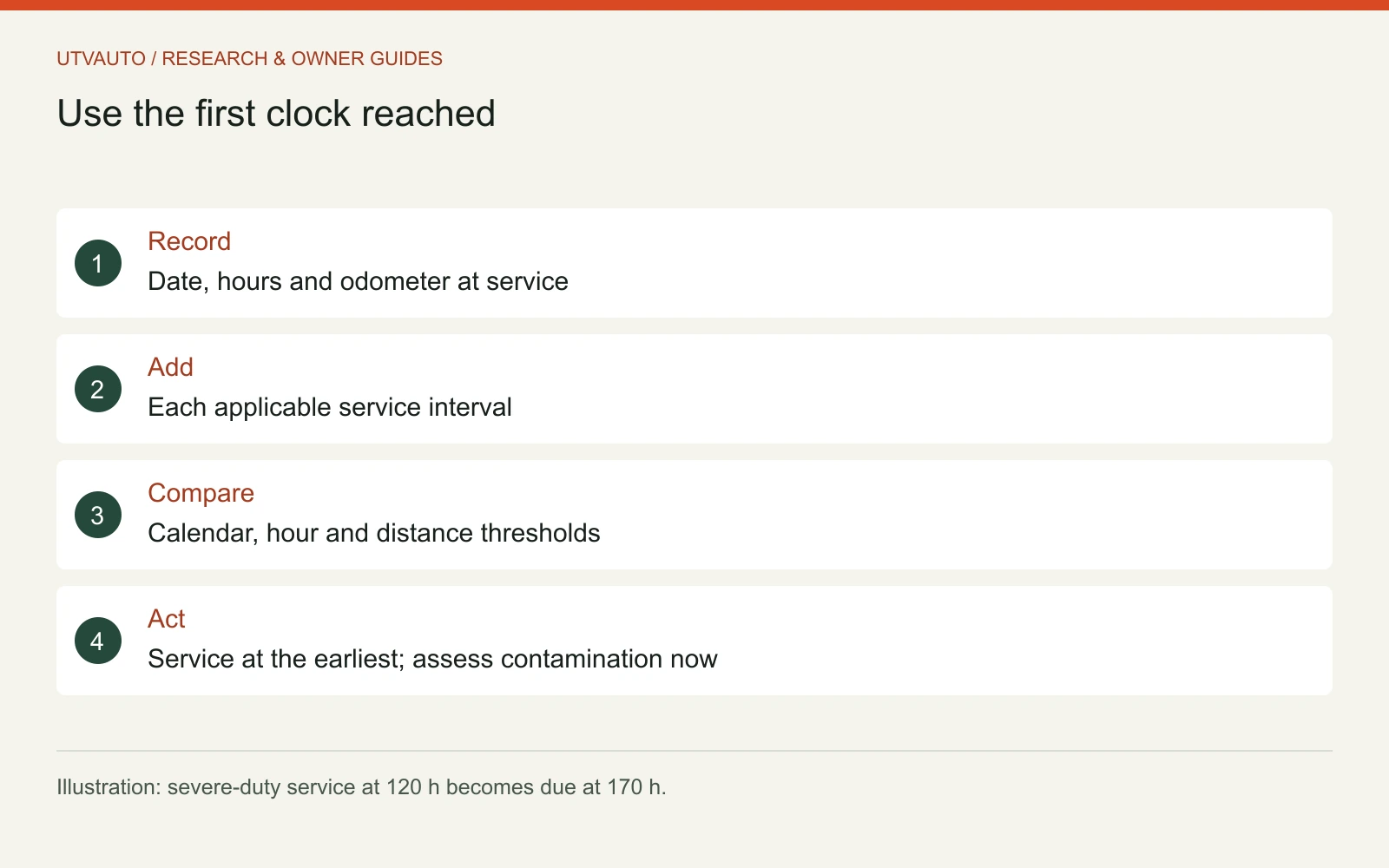
Record the date, engine hours and odometer at the completed oil-and-filter service. Calculate all three next-due thresholds for your applicable schedule, then act at the earliest. A low mileage figure does not overrule the hour or calendar limit.
Example for severe duty: a service completed at 120 engine hours reaches its 50-hour threshold at 170 hours. If the machine reaches 174 hours after only three months and 600 miles, it has already crossed the hour threshold even though the other two clocks have not expired. The arithmetic is 120 + 50 = 170; it is not a forecast of oil condition.
An interval answer is not an oil-change procedure
BRP specifies replacing the engine oil and filter together in the referenced procedure. Oil specification, level-check method, sealing parts and tightening values are separate instructions. Use the complete matching procedure and the correct parts, rather than borrowing a generic automotive drain-and-fill method.
Do not guess at oil quantity based on how much came out, reuse a sealing part contrary to the guide or diagnose visible debris as normal without assessment. If you find metal debris, persistent leaks, an oil-pressure warning or suspected water contamination, stop and obtain qualified service. A fresh filter does not establish that an underlying problem is repaired.
What to write on the next-service record
- Full model year and model; guide number and revision checked.
- Duty category and the reason it applies, including commercial use or cold short-trip operation.
- Service completion date, hours and odometer; oil/filter identification and invoice.
- Next calendar, hour and distance thresholds, with any additional inspection or condition-triggered work.
For the broader pre-trip checks that remain necessary between oil services, use our pre-ride inspection checklist. Winter storage has its own preparation tasks; the winterization guide separates storage from active cold-weather use.

