
Choose the seating arrangement before the engine
The 2025 CFMOTO UFORCE 600 and UFORCE 800 XL answer different packaging needs. The cited U.S. brochure lists two seats for the 600 and four for the 800 XL, alongside a substantial length difference. If you regularly need the extra designated places, that can decide the shortlist before an engine comparison. If you do not, the longer vehicle still needs a reason to occupy more space in your transport and storage plan. Check the first configuration’s original specification source.
This is a comparison of the 2025 U.S. 600 and 800 XL columns. It does not substitute UFORCE 1000, 1000 XL, U10 Pro or U10 XL Pro figures. The brochure contains several adjacent model columns, so copying a nearby rating can produce a plausible but incorrect answer. We keep the model identity visible throughout the table and explain what the published differences can support.
The 800 XL adds 32 inches of overall length
The listed lengths are 111 inches for the UFORCE 600 and 143 inches for the 800 XL. Their difference is 32 inches, or 2 feet 8 inches. Width moves from 57 to 60 inches and height from 76 to 79 inches. The change is therefore not limited to adding a second row inside an otherwise identical exterior envelope.
Check the actual storage route as well as the parking space. A vehicle may fit in a marked bay while creating a separate question at the doorway or loading area. Use the published dimensions to screen candidates, then measure the complete offered configuration when the available margin matters. Avoid adding a generic clearance allowance and presenting the result as proof of access through an entrance you have not assessed.
Published specifications: exact configurations
| Specification | 2025 CFMOTO UFORCE 600 Standard | 2025 CFMOTO UFORCE 800 XL Standard |
|---|---|---|
| Engine displacement | 580 cc | 800 cc |
| Engine layout | Liquid-cooled SOHC single-cylinder | Liquid-cooled SOHC V-twin |
| Published engine power | 36 hp | 63 hp |
| Published engine torque | 33 lbft | 51 lbft |
| Transmission | CVTech CVT; P/R/N/H/L | OmniDrive CVT; P/R/N/H/L |
| Drive system | 2WD / 4WD / 4WD lock | 2WD / 4WD / 4WD lock |
| Overall length | 111 in | 143 in |
| Overall width | 57 in | 60 in |
| Overall height | 76 in | 79 in |
| Wheelbase | 76 in | 109.1 in |
| Ground clearance | 10.5 in | 11.8 in |
| Seating capacity | 2 | 4 |
| Cargo bed load rating | 600 lb | 660 lb |
| Towing rating | 1500 lb | 1500 lb |
| Front suspension travel | 7.9 in | 8.9 in |
| Rear suspension travel | 8.3 in | 8.9 in |
| Front tires | 26 x 8-12 | 27 x 9-14 |
| Rear tires | 26 x 10-12 | 27 x 11-14 |
| Power steering | Electronic power steering | Electronic power steering |
| Dry weight | 1345 lb — Manufacturer dry weight; a different weight basis is not directly comparable. | 1629 lb — Manufacturer dry weight; a different weight basis is not directly comparable. |
| Fuel capacity (U.S. gallons) | 9.25 gal | 10.5 gal |
Wheelbase explains a packaging distinction, not handling
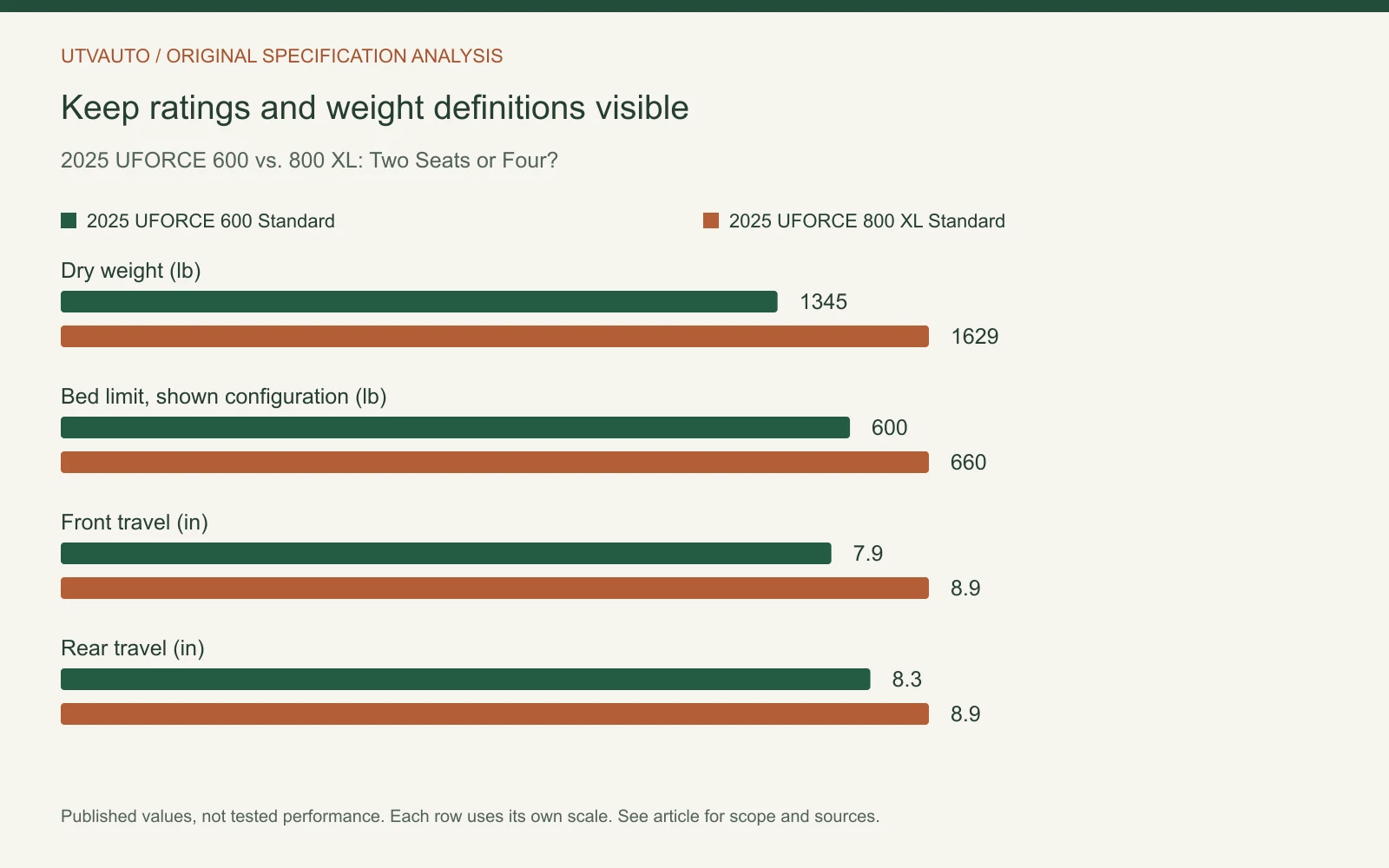
The brochure lists a 76-inch wheelbase for the 600 and 109.1 inches for the 800 XL. The calculated difference is 33.1 inches. This is a useful description of how different the two packages are. It does not establish a turning circle, breakover result, ride feel or slope capability, because those conclusions need additional information and appropriate evaluation.
For a property route with gates and frequent stops, record where the actual longer configuration might matter and ask for a suitable demonstration. Do not test a guessed turning requirement around people or obstacles. The goal is to verify an ordinary task safely, with instruction where needed. A shorter wheelbase is not a universal advantage, and a longer one is not proof of better comfort for every passenger.
Extra seats do not make every load possible
Count the people who actually need designated places, then identify the tools and supplies required on the same trip. Do not assume that the four-seat vehicle can carry every group and load just because there are enough places to sit. Obtain the correct total loading instructions for the exact machine; a cargo-box rating is only one part of the problem.
The brochure lists bed limits of 600 pounds for the 600 and 660 pounds for the 800 XL. That 60-pound difference is much smaller than the visual change in overall length might suggest. It is not a statement about available total payload after adding people and accessories. If your calculation depends on a total payload figure not established here, resolve that input using the vehicle label and matching manual rather than inventing one from dry weight.
The shared towing number does not settle towing suitability
Both cited columns list a 1,500-pound towing capacity. A higher model number and larger engine therefore do not justify claiming a higher brochure towing rating in this pair. Keep the rating attached to the exact model and the relevant operating conditions. The trailer, hitch equipment, tongue load and actual vehicle loading require their own verification through the proper instructions.
Write the proposed towing job separately from the passenger-and-cargo job, then assess the combination if both occur together. Do not treat unused cargo-box allowance as extra towing capacity or subtract trailer weight from an unrelated vehicle specification. A clear worksheet keeps each constraint separate. If a dealer proposes a different number, request the year-specific document and check that it describes the offered vehicle rather than another UFORCE family member.
Compare power as published, not as measured performance
The brochure states 36 horsepower for the 600 and 63 for the 800 XL, with different engine configurations. Those are manufacturer-published figures. They do not establish how the two complete vehicles accelerate with your passengers and equipment, nor do they provide a measured fuel-consumption or reliability comparison. A larger number can be relevant without answering every ownership question.
Ask what ordinary task would make the power distinction valuable to you. If the answer is only that the larger badge sounds more capable, return to the actual job brief. Conversely, do not dismiss a real power requirement simply because the smaller machine is easier to store. The right decision combines the relevant capability evidence with seat, fit, loading and support requirements rather than ranking the engine in isolation.
Dry weight changes the transport starting point
The U.S. brochure lists 1,345 pounds for the UFORCE 600 and 1,629 pounds for the 800 XL, both as dry weight. The calculated difference is 284 pounds. Use that difference as a specification comparison, not as a complete prediction of the weight on your trailer. The actual transport load includes the relevant operating contents, installed equipment and other items carried.
If a trailer worked with the smaller machine, repeat both the physical-fit and weight checks for the larger one. The 32-inch length increase and 284-pound dry-weight difference create separate questions. Solving one does not solve the other. Do not infer approval from deck length alone, and do not compare a trailer’s headline capacity with a dry vehicle figure while omitting the rest of the system.
Price the complete supported configuration
Obtain an itemized quote for the exact model, required equipment and installation. Do not copy a historical brochure starting price into a current delivered-price claim. For a used or remaining-stock candidate, inspect condition and documents just as carefully as the asking price. The age of the model year does not by itself tell you whether it is a used machine, unused stock or a suitably maintained vehicle.
Ask where service and replacement support will come from for the actual configuration. Keep those answers distinct from unsupported claims that one engine or transmission is universally cheaper to own. A practical shortlist may favor the 600 when two seats meet the job and its smaller package fits better. It may favor the 800 XL when four places are required and the larger transport and loading plan works. If neither passes those checks, change the shortlist rather than buying around an unresolved requirement.
Test a transport plan with the actual length increase
Suppose an owner has a hypothetical 132-inch usable straight deck before considering any other loading requirements. Subtracting the 600’s published 111-inch length leaves 21 inches; subtracting the 800 XL’s 143-inch length gives a negative 11 inches. The example identifies a dimensional problem for the longer stock specification. It does not approve the smaller machine, because ramps, securing, load position and the complete transport system remain unresolved.
Do not solve the negative result by assuming that a tailgate extension, diagonal placement or other improvised arrangement is acceptable. Obtain a suitable documented transport solution or change the shortlist. The calculation is valuable precisely because it can eliminate a tempting option before a purchase requires an unsupported workaround.
If four designated places are a recurring requirement, the transport change belongs in the complete 800 XL cost comparison. If two places cover the task, the smaller vehicle remains worth evaluating without paying for length you do not need. Keep both decisions explicit: what the job requires and what it costs to support the corresponding configuration.
Sources and research scope
U.S.-market specification research; source access reviewed November 20, 2026. UTVAUTO has not test-driven, measured or inspected these configurations. Differences calculated from published values are editorial calculations, not proof of a particular engineering cause. Unverified fields remain unverified. Vehicle labels and current configuration govern your machine.
Continue your research
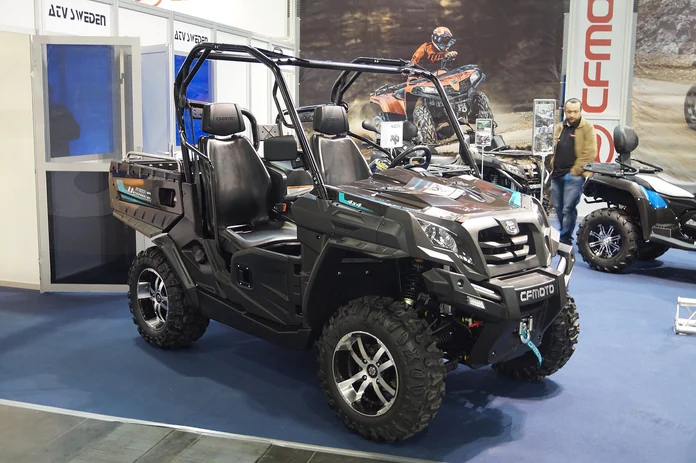
Cover: CFMOTO UFORCE utility side-by-side displayed at a motor show (reference photo). Photo: Jakub "Flyz1" Maciejewski · CC BY-SA 4.0. Resized.