
The useful differences are height and configuration
For a buyer comparing these exact U.S. Premium configurations, the published differences in height, ground clearance and dry weight deserve attention before any general claim that the newer RANGER is better. The 2023 and 2025 RANGER 1000 Premium share several headline dimensions and listed capacities. That does not make two used examples equivalent, but it does mean that a higher asking price needs a more specific explanation than model year alone. Check the first configuration’s original specification source.
This is the three-seat RANGER 1000 Premium, not a RANGER XP 1000, CREW, NorthStar or a California-specific configuration. The sources are the two matching Polaris owner-manual specification sections. They provide the starting point for identifying a candidate; the actual vehicle, its labels, equipment, history and condition still need inspection. No road test or workshop comparison is claimed here.
Read what stayed the same before pricing an upgrade
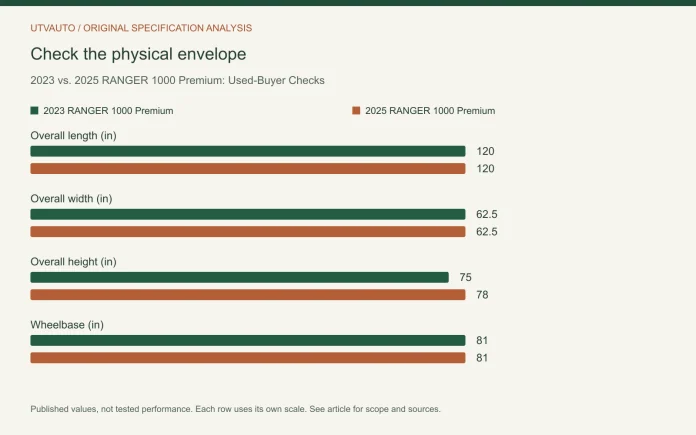
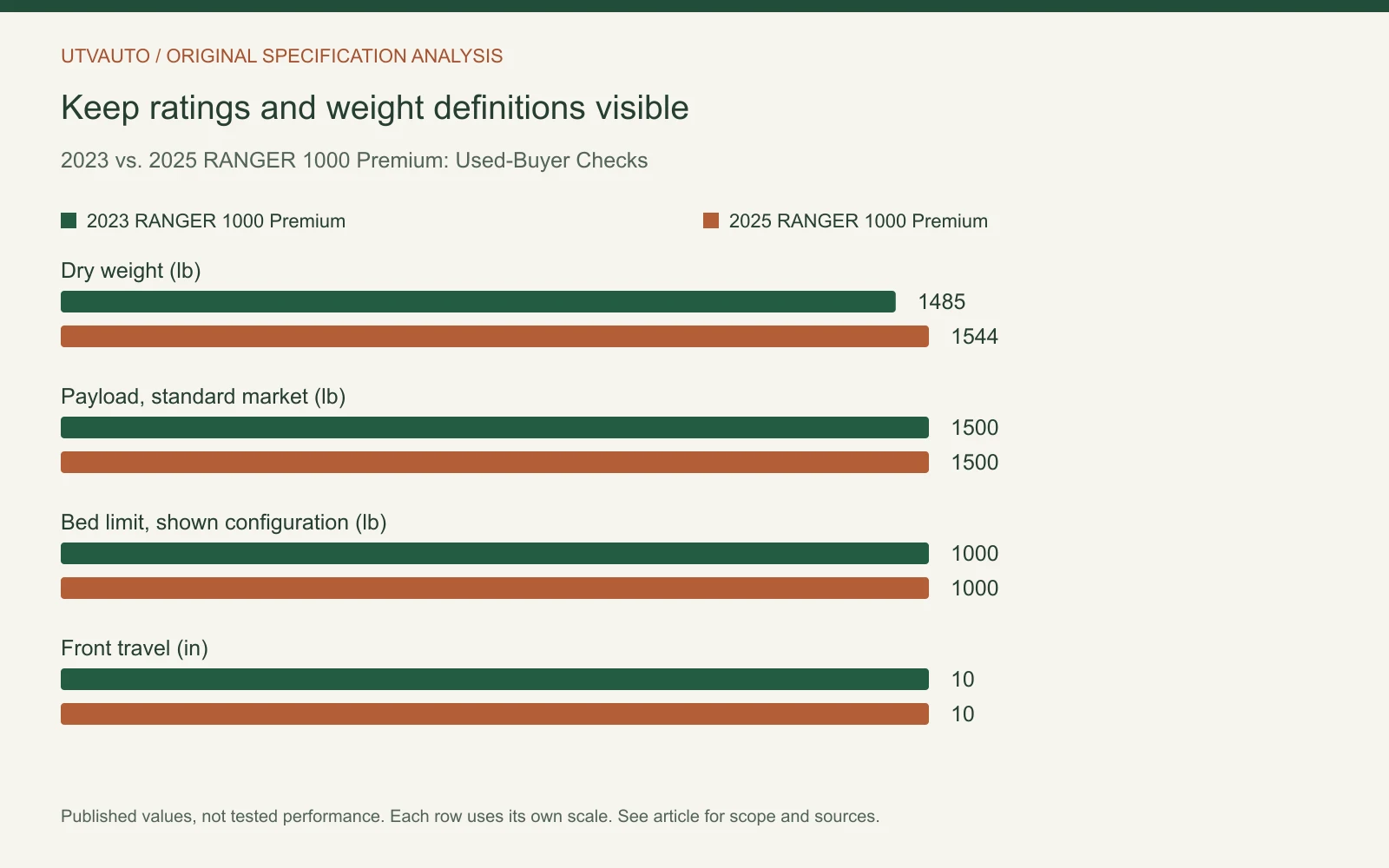
The cited Premium columns list the same overall length, width and wheelbase: 120, 62.5 and 81 inches. Their listed standard-market payload, cargo-box and towing ratings also match at 1,500, 1,000 and 2,500 pounds respectively. These are separate limits with different applications, not quantities to add together. A buyer should not describe an unchanged rating as extra capability simply because it appears in a newer advertisement.
That continuity can be useful if your primary task is carrying a known work load within the correct restrictions. It can also help identify a misleading listing that uses figures from another RANGER family. Ask the seller for the complete vehicle identity when an advertised capacity differs. Do not resolve a discrepancy by selecting whichever brochure number makes the deal look most attractive.
Published specifications: exact configurations
| Specification | 2023 Polaris RANGER 1000 Premium | 2025 Polaris RANGER 1000 Premium |
|---|---|---|
| Engine displacement | 999.0 cc | 999.0 cc |
| Engine layout | Liquid-cooled SOHC twin-cylinder | Liquid-cooled SOHC twin-cylinder |
| Transmission | PVT CVT; H/L/N/R/P | PVT CVT; H/L/N/R/P |
| Overall length | 120.0 in | 120.0 in |
| Overall width | 62.5 in | 62.5 in |
| Overall height | 75.0 in | 78.0 in |
| Wheelbase | 81.0 in | 81.0 in |
| Ground clearance | 12.0 in | 12.5 in |
| Cargo bed dimensions | 36.5 x 54 x 11.5 in (L/W/H) | 36.5 x 54 x 11.5 in (L/W/H) |
| Cargo bed load rating | 1000.0 lb — California: 600 lb. Occupant, cargo and accessory loads also count toward total payload. | 1000.0 lb — California: 600 lb. Occupant, cargo and accessory loads also count toward total payload. |
| Total payload rating | 1500.0 lb — California: 1,100 lb. Total includes occupants, cargo and accessories. | 1500.0 lb — California: 1,100 lb. Total includes occupants, cargo and accessories. |
| Towing rating | 2500.0 lb | 2500.0 lb |
| Front suspension travel | 10 in | 10 in |
| Rear suspension travel | 10 in | 10 in |
| Front tires | 26 x 9-12 | 26 x 9-12 |
| Rear tires | 26 x 11-12 | 26 x 11-12 |
| Dry weight | 1485.0 lb — Manufacturer dry weight; a different weight basis is not directly comparable. | 1544.0 lb — Manufacturer dry weight; a different weight basis is not directly comparable. |
| Fuel capacity (U.S. gallons) | 11.35 gal | 11.35 gal |
The three-inch height difference changes the fit question
The manual figures are 75 inches for the 2023 Premium and 78 inches for the 2025 Premium. Their difference is 3 inches. A garage or enclosed-trailer arrangement that worked with a particular 2023 machine therefore needs another check for a 2025 candidate, especially when a roof or other equipment is fitted. These are published stock figures, not measurements of the vehicles in an advertisement.
Suppose a hypothetical storage opening is 80 inches high. The corresponding static arithmetic margins would be 5 inches and 2 inches. Neither proves passage through that entrance. The actual lowest opening, approach and installed configuration can control the result. Use the calculation to identify a question worth measuring, not to create a universal clearance rule or justify forcing a machine through a tight opening.
Ground clearance is not a complete explanation
The listed clearance changes from 12.0 to 12.5 inches. It is tempting to subtract that half-inch from the overall-height change and invent an explanation for the rest. The specification table alone does not support that reasoning. Overall height and underbody clearance refer to different parts of the vehicle, and the published data does not identify a single component responsible for every dimensional change.
Keep the observations separate: one table says the Premium is taller, and another field gives a different listed clearance. To understand an actual vehicle, examine its configuration and supporting equipment documents. Avoid converting the half-inch into an unsupported claim about obstacle performance, stability or ride quality. A dimensional specification can narrow a fit question without becoming an off-road performance test.
Dry weight increased without changing the listed payload
The Premium dry-weight figures are 1,485 pounds for 2023 and 1,544 pounds for 2025, a calculated increase of 59 pounds. Dry weight is not a ready-to-haul scale weight for an equipped machine. Do not add cargo to the dry number and call the result complete while omitting the relevant fluids, accessories or other items carried. Use a properly established loaded weight for the actual transport plan.
The unchanged listed payload also should not be reconstructed from guessed chassis totals. Use the vehicle’s documented rating and include people, accessories and cargo as required. A lighter-looking used machine is not automatically permitted to carry more than its label allows. Keeping manufacturer ratings and your own measured loads in different columns avoids a surprisingly common mistake in buyer spreadsheets.
Value the fitted equipment only after identifying it
Two Premium listings may differ more in their roofs, glazing, tires, storage and electrical additions than in their stock specification. Make a part-number inventory and check the complete installation against the appropriate application documents. A seller’s receipt can help identify an accessory but does not establish that it is correctly installed or still in usable condition.
Value equipment according to what you need and what can be supported. An expensive accessory that conflicts with your required configuration is not automatically an upgrade for you. If an item must be removed or replaced, obtain an appropriate quote before comparing complete costs. Avoid giving full retail credit for an unidentified bundle simply because the advertisement describes it as ready for work.
Use condition evidence without inventing a failure rate
Ask for dated service records that identify the machine, operating readings and actual work completed. Distinguish a performed task from a reminder or an invoice for parts that may not have been installed. Have unresolved mechanical concerns assessed by a qualified technician. A model-year comparison cannot tell you whether either individual vehicle has been maintained correctly.
Do not treat an online list of complaints as a statistical reliability ranking between 2023 and 2025. Usage, modifications and reporting patterns can differ, and a forum count is not a controlled ownership sample. The useful record is the history of the candidate you can inspect, together with applicable campaign checks and the findings of a competent inspection. Keep those findings attached to the specific vehicle rather than the whole product family.
Compare the complete cost of the two candidates
Create a separate line for purchase price, required work, configuration changes and transport changes. Use actual written quotes where available, and label missing amounts as unresolved. A low advertised price is not a complete comparison when one machine needs work before it can perform your task. Conversely, a newer machine should not receive an assumed resale or reliability benefit that you cannot substantiate.
The decision can be simple when the records are good. Choose the candidate that meets the actual seat, load, fit and condition requirements at an acceptable complete cost. Walk away from either one when a critical question remains unresolved. The value of this year-specific comparison is that it identifies the changed measurements and unchanged ratings, leaving you better prepared to judge the machines that are actually for sale.
Build a price-gap worksheet without forecasting repairs
Suppose two hypothetical sellers ask $12,000 and $14,000 for the identified Premium candidates. The $2,000 difference is only the vehicle-price gap. If the older candidate needs documented work quoted at $800 and a required equipment change quoted at $400, its assessed purchase-and-preparation total becomes $13,200 before the other applicable transaction costs. The remaining $800 difference is still not a prediction of lifetime ownership cost.
These invented figures show a method, not current RANGER market prices or an expected repair bill. Replace them with actual offers and qualified findings. If the inspection has not yet established the work, leave that line unresolved rather than inserting the hypothetical $800 because it appeared in an example. Do the same for fees and transport changes so the two totals describe equivalent ready-for-task candidates.
Then ask what the remaining difference buys. A verified equipment feature, a documented condition advantage or a transaction term can be discussed directly. A statement that the newer year must save that amount in future repairs cannot be accepted without evidence. Keep optional preferences separate from hard requirements so a desirable feature does not conceal a failed garage or load check.
If several important amounts remain unknown, the worksheet has still produced a useful result: you know which quote or inspection to request next. It should not force a premature winner. A purchase comparison becomes stronger as uncertainties are resolved, even when the arithmetic is simpler than a polished online ownership-cost forecast.
Sources and research scope
U.S.-market specification research; source access reviewed November 20, 2026. UTVAUTO has not test-driven, measured or inspected these configurations. Differences calculated from published values are editorial calculations, not proof of a particular engineering cause. Unverified fields remain unverified. Vehicle labels and current configuration govern your machine.
- 2023 RANGER 1000 / RANGER CREW 1000 owner manual: Specifications
- 2025 RANGER 1000 / RANGER CREW 1000 owner manual: Specifications
Continue your research
- Browse RANGER model and ownership research
- Keep payload and towing separate
- Audit a modified used vehicle
Compare other documented UTV and ATV configurations
Cover image: Original UTVAUTO diagram calculated from the linked manufacturer specifications. Each row uses its own scale. No measured performance or universal winner is implied; see the table for market, seating-mode and weight-basis qualifications.

