
Shared displacement does not mean the same package
The 2025 Yamaha Grizzly EPS and Kodiak 700 EPS both list a 686cc engine, but their published width, seat height, tires and wet weight differ. Start with rider fit and the space in which the ATV will be used, rather than treating the 700 badge as the complete comparison. The narrower and lower-seated candidate can be worth examining even when the wider alternative has larger numbers elsewhere. Check the first configuration’s original specification source.
This comparison concerns the U.S. EPS versions on Yamaha’s year-specific 2025 pages. It does not substitute Grizzly XT-R, Special Edition or another Kodiak package. It also does not establish a horsepower ranking, because the cited specification pages do not provide the comparable engine-output figures needed for that claim. We use published specifications and transparent calculations, not a trail test.
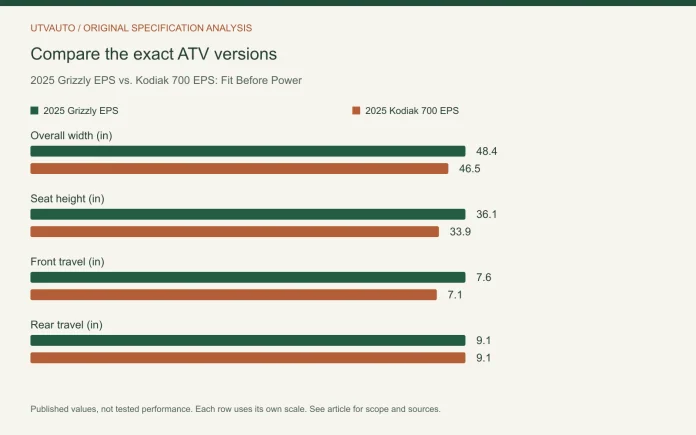
Width differs by 1.9 inches
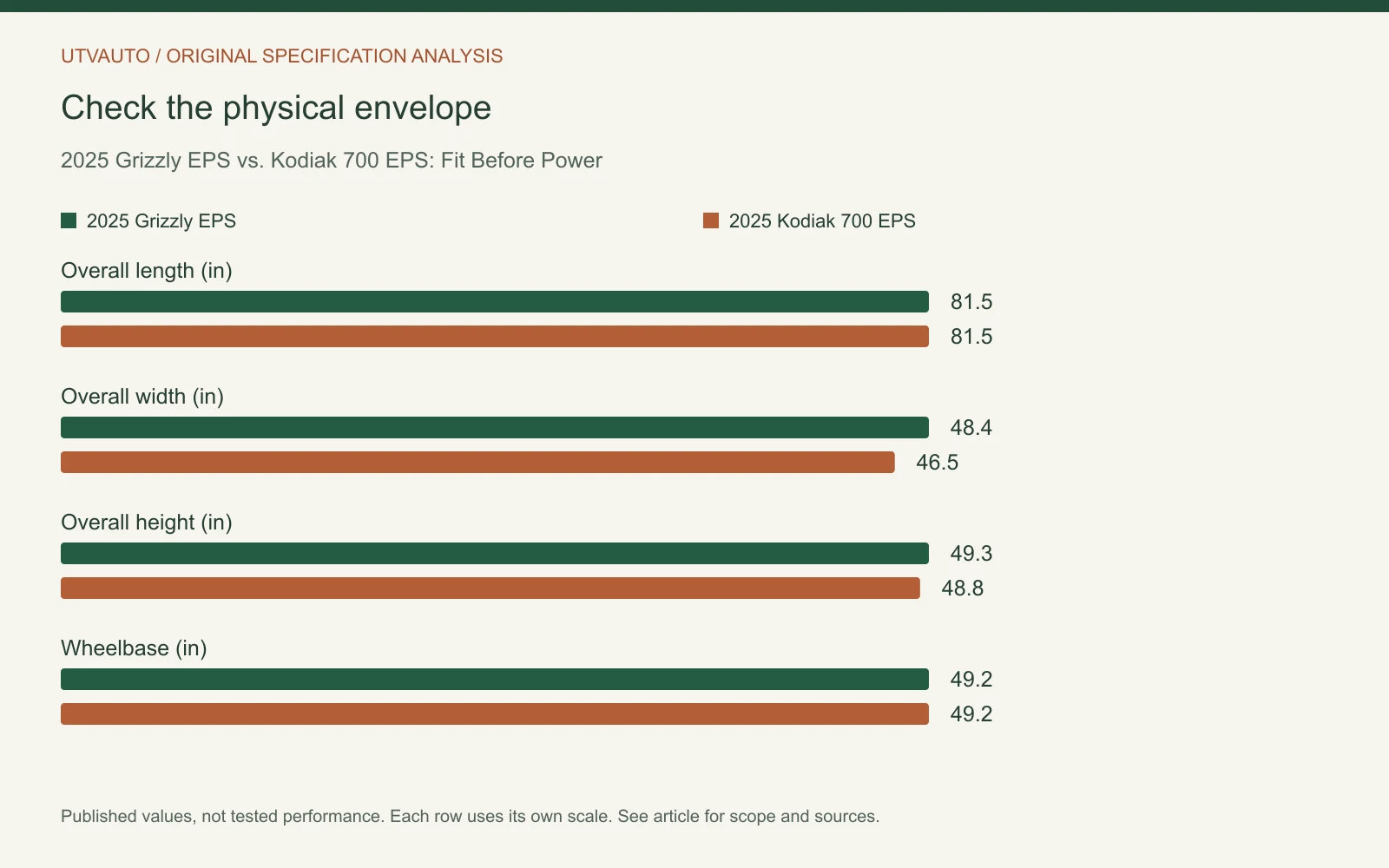
Yamaha lists the Grizzly EPS at 48.4 inches wide and the Kodiak 700 EPS at 46.5 inches. The calculated difference is 1.9 inches. Both list the same 81.5-inch length and 49.2-inch wheelbase, so a buyer comparing only length could easily miss the packaging distinction. Check the actual width of a modified candidate rather than assuming that an original brochure still describes its wheel arrangement.
For a hypothetical 50-inch physical opening, subtracting these widths gives 1.6 and 3.5 inches of total remaining width. Those figures are not per-side clearances or permission to use a route. They simply show why nominally similar ATVs can produce a different fit question. The actual opening, approach and vehicle configuration need checking, and route access depends on the responsible authority’s rules as well as physical space.
Published specifications: exact configurations
| Specification | 2025 Yamaha Grizzly EPS | 2025 Yamaha Kodiak 700 EPS |
|---|---|---|
| Engine displacement | 686.0 cc | 686.0 cc |
| Engine layout | Liquid-cooled SOHC single-cylinder | Liquid-cooled SOHC single-cylinder |
| Transmission | Ultramatic V-belt CVT; H/L/N/R/P; all-wheel engine braking | Ultramatic V-belt CVT; H/L/N/R/P; all-wheel engine braking |
| Drive system | On-Command 2WD / 4WD / locked 4WD; shaft | On-Command 2WD / 4WD / locked 4WD; shaft |
| Overall length | 81.5 in | 81.5 in |
| Overall width | 48.4 in | 46.5 in |
| Overall height | 49.3 in | 48.8 in |
| Wheelbase | 49.2 in | 49.2 in |
| Ground clearance (maximum where specified; see note) | 11.3 in — Manufacturer maximum ground clearance; not directly comparable with a standard-setting value. | 10.8 in — Manufacturer maximum ground clearance; not directly comparable with a standard-setting value. |
| Seat height | 36.1 in | 33.9 in |
| Front suspension travel | 7.6 in | 7.1 in |
| Rear suspension travel | 9.1 in | 9.1 in |
| Front tires | AT26 x 8-12 Maxxis® MU05Y | AT25 x 8-12 Maxxis® MU19 |
| Rear tires | AT26 x 10-12 Maxxis® MU06Y | AT25 x 10-12 Maxxis® MU20 |
| Wet weight | 701.0 lb — Manufacturer wet weight; a different weight basis is not directly comparable. | 686.0 lb — Manufacturer wet weight; a different weight basis is not directly comparable. |
| Fuel capacity (U.S. gallons) | 4.8 gal | 4.8 gal |
Seat height deserves a controlled fit assessment
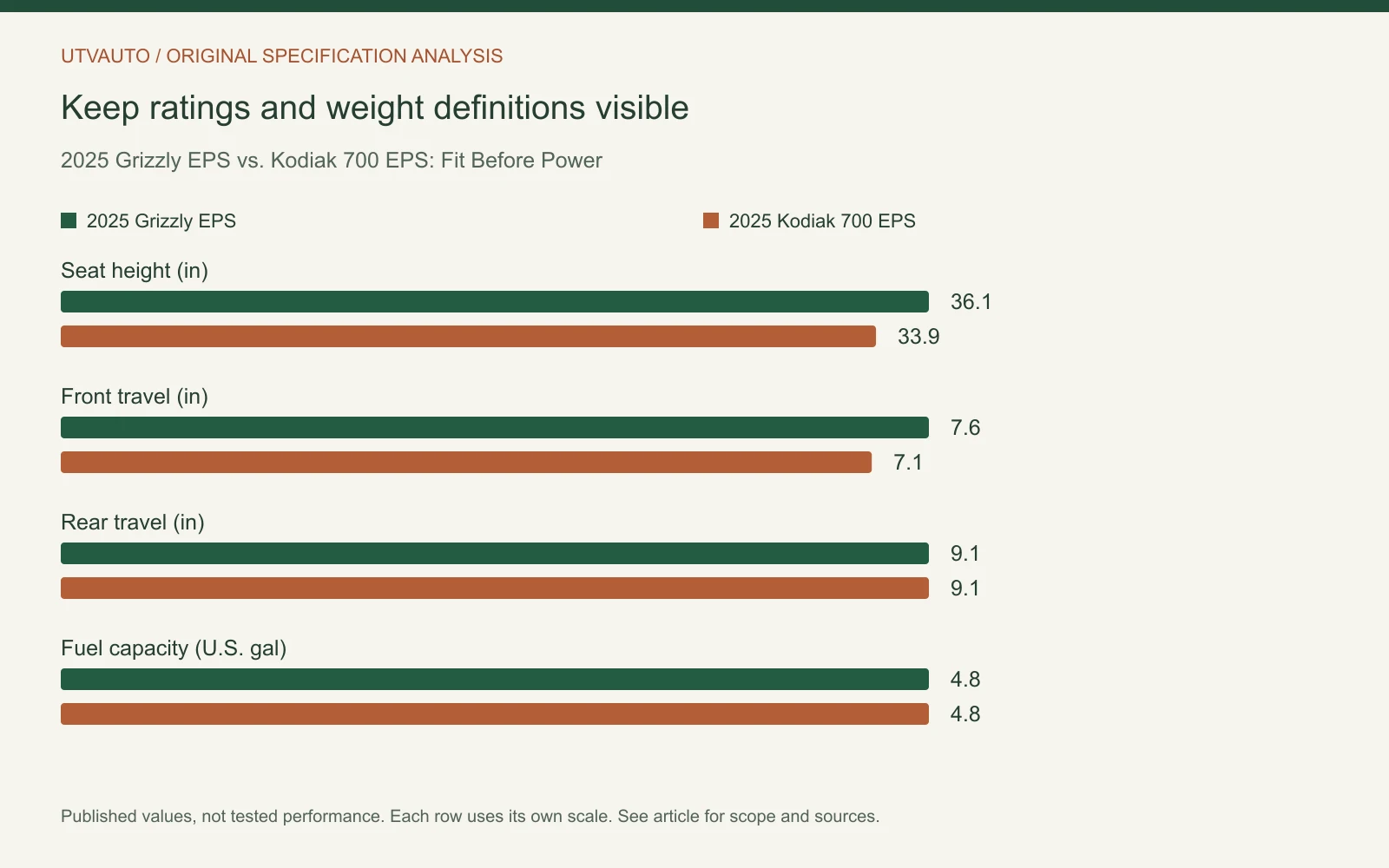
The published seat heights are 36.1 inches for the Grizzly and 33.9 inches for the Kodiak, a difference of 2.2 inches. This provides a concrete reason to evaluate the two machines in person with appropriate supervision. It does not tell us which ATV fits every rider of a given height, nor does it replace the manufacturer’s rider requirements or instruction.
Do not infer a universal stability or safety advantage from the lower seat-height number. Rider interaction with an ATV is more complicated than one static dimension, and a specification table does not measure an individual’s ability to control either vehicle. Ask an appropriate instructor or provider to help assess suitability. A buyer should leave the evaluation with observations about the identified machine, not a stereotype about all lower or taller ATVs.
The suspension figures describe travel, not a ride verdict
The cited front-travel figures are 7.6 inches for the Grizzly EPS and 7.1 inches for the Kodiak EPS, while both list 9.1 inches of rear travel. The half-inch front difference is a published measurement. It is not proof that one suspension feels smoother, carries a load better or gives better control for a particular rider. Those conclusions require appropriate evidence under comparable conditions.
When evaluating used candidates, record actual suspension condition and configuration separately from the stock figures. A damaged or altered component can matter more than the original travel difference. Do not manipulate preload settings or perform a demanding demonstration simply to reproduce an internet comparison. Follow the correct instructions and use qualified assistance where suitability or condition is uncertain.
Tire packages change the replacement question
The 2025 Grizzly EPS specification lists 26-inch front and rear tire designations with different front and rear widths. The Kodiak EPS lists 25-inch designations, also with distinct front and rear widths. Use the full size and application information when requesting replacement prices. The nominal diameter alone is not a tire order, and a larger tire on another Yamaha is not automatic approval for your machine.
Keep the wheel application and installed configuration with the quote. If a seller has changed tires or wheels, identify the actual parts and supporting fitment information before relying on the published width, clearance or wet-weight comparison. A modified ATV may need a separate assessment. Avoid treating a larger-than-stock tire as free capability without considering the complete approved arrangement and the information still missing.
Compare wet weight with wet weight
Yamaha lists 701 pounds for the Grizzly EPS and 686 pounds for the Kodiak 700 EPS, a 15-pound difference. The pages define wet weight to include the standard vehicle and fluids while excluding optional equipment or accessories. That common basis helps make a responsible specification comparison, but it is not the actual loaded transport weight of every example offered for sale.
If you carry an accessory, tools or other equipment with the ATV, identify those items in the transport plan. Do not assume a ramp or trailer is suitable solely because its advertised capacity is above the brochure vehicle weight. The relevant instructions and complete loaded arrangement still matter. The 15-pound difference can inform a calculation without becoming a substitute for checking every component of the transport system.
Do not turn shared controls into a reliability claim
The specification pages describe Yamaha’s Ultramatic transmission and On-Command drive arrangements for both EPS candidates. These descriptions establish common published features, not equal lifetime repair costs or a guaranteed reliability advantage over another brand. A buyer needs the actual service history and condition of each used ATV to assess its ownership position.
Request dated maintenance records tied to the vehicle and have unresolved issues inspected appropriately. A low operating reading without supporting history is not the same as documented gentle use. Similarly, an attractive accessory list should not hide uncertainty about the base machine. Keep configuration, maintenance and seller statements in separate parts of your file so one favorable detail does not silently approve everything else.
Make the shortlist fit your own work
For the Kodiak, investigate whether its narrower published width and lower seat height address a genuine fit requirement. For the Grizzly, investigate whether its listed tire and suspension configuration matches the tasks you can support with evidence and an appropriate evaluation. The specification comparison creates questions to assess; it does not award a universal winner for farm work or recreation.
Obtain itemized prices for the actual candidates and any required equipment, then add documented condition-related work. If both are suitable, the complete cost and support arrangements can decide the purchase more usefully than their names. If neither fits the rider or permitted route, widen the shortlist. A disciplined comparison should help you eliminate unsuitable options before it encourages you to spend more.
Separate a width decision from a seating preference
Imagine an owner whose work route includes a hypothetical 48-inch physical opening. The published Kodiak width is below that number, while the published Grizzly width is above it. This does not approve the Kodiak for passage: the actual opening, approach, operating requirements and vehicle configuration still need assessment. It does establish that the Grizzly’s stock specification cannot be treated as narrower simply because both machines share the same listed length.
Now imagine a different owner with no meaningful width constraint. That buyer may give more attention to an appropriate rider-fit assessment, actual equipment and condition. The 2.2-inch seat-height difference is a reason to compare the machines in a suitable setting, not a formula for choosing from the rider’s height alone. Keep the observations from that assessment separate from any assumptions about how a lower or taller ATV ought to feel.
For either owner, write the two decisive requirements before requesting prices. If width is the hard constraint, resolve it first. If rider suitability is unresolved, do not let an attractive discount decide the question in advance. When both machines pass the genuine requirements, the comparison can move to supported equipment and complete cost rather than a general contest between the Grizzly and Kodiak names.
A record organized this way is also useful later. If you alter the wheel package or the work route, you know exactly which original assumption needs a new check instead of assuming that the purchase decision covered every future change.
Sources and research scope
U.S.-market specification research; source access reviewed November 20, 2026. UTVAUTO has not test-driven, measured or inspected these configurations. Differences calculated from published values are editorial calculations, not proof of a particular engineering cause. Unverified fields remain unverified. Vehicle labels and current configuration govern your machine.
Continue your research
- Arrange appropriate ATV instruction
- Read complete front and rear tire sizes
- Check passenger designation separately
Featured original diagram: Overall width: 2025 EPS 48.4 in versus 2025 EPS 46.5 in; Seat height: 2025 EPS 36.1 in versus 2025 EPS 33.9 in; Front travel: 2025 EPS 7.6 in versus 2025 EPS 7.1 in; Rear travel: 2025 EPS 9.1 in versus 2025 EPS 9.1 in. Image scope and attribution: Original UTVAUTO diagram calculated from the linked manufacturer specifications. Each row uses its own scale. No measured performance or universal winner is implied; see the table for market, seating-mode and weight-basis qualifications. Reference photographs do not prove the exact model-year configuration or a UTVAUTO test.

