
Trim names are not a substitute for the loading row
The 2025 Pioneer 1000 Trail and Forest share the same published engine family, but a buyer should not assume that every capacity or measurement transfers between them. Honda’s U.S. specification table identifies the Trail as SXS10M3DT and the Forest as SXS10M3DF. Use those exact columns when comparing the offered machines, particularly where a grouped table contains several three-seat and five-seat variants. Check the first configuration’s original specification source.
This guide is for the three-seat 2025 Trail and Forest, not the Pioneer 1000-5 Trail Special Edition or the 2026 Deluxe. It is a specification analysis rather than a terrain test. The main contribution is showing how to preserve the trim-specific information while assessing work loads, fit and complete cost. A name that suggests a particular environment does not establish which machine suits every buyer in that environment.
Read the table by model code and column span
Honda’s release uses grouped cells where some values apply to several variants and other values apply to a single column. A plain-text extract can hide those spans. Start with the model-code row, then follow the correct column through measurements, weights and capacities. If a number looks unusual, return to the original table instead of selecting a familiar figure from an adjacent trim.
This matters especially for cargo-bed capacity: the standard-market Forest column lists 600 pounds, while the Trail lists 1,000 pounds; California qualifications are also shown. Do not treat the smaller Forest value as automatically a California-only footnote or quietly replace it with the broader family maximum. Check the actual vehicle label and matching owner information before planning a load, particularly if a sales listing gives a different figure.
Reading the source in context: the 2025 features release discusses a 1,000-pound bed figure in its five-seat QuickFlip paragraph. That passage should not override the separately identified three-seat Forest column. Keep seating layout, trim and California qualifications attached to the correct row.
Published specifications: exact configurations
| Specification | 2025 Honda Pioneer 1000 Trail | 2025 Honda Pioneer 1000 Forest |
|---|---|---|
| Engine displacement | 999.0 cc | 999.0 cc |
| Engine layout | Liquid-cooled SOHC parallel twin | Liquid-cooled SOHC parallel twin |
| Transmission | Six-speed automatic DCT; reverse; high/low | Six-speed automatic DCT; reverse; high/low |
| Drive system | 2WD / 4WD / Turf / differential-lock 4WD | 2WD / 4WD / Turf / differential-lock 4WD |
| Overall length | 120.4 in | 120.4 in |
| Overall width | 63.0 in | 63.0 in |
| Overall height | 76.1 in | 76.6 in |
| Wheelbase | 80.2 in | 80.2 in |
| Ground clearance | 12.8 in | 13.2 in |
| Seat height | 33.6 in | 34.2 in |
| Cargo bed load rating | 1000.0 lb | 600.0 lb |
| Towing rating | 2500.0 lb | 2500.0 lb |
| Front suspension travel | 10.6 in | 10.6 in |
| Rear suspension travel | 10.0 in | 10.0 in |
| Front tires | Armstrong Dirt Master 2.0, 27×9-14 | Armstrong Dirt Master 2.0, 27×9-14 |
| Rear tires | Armstrong Dirt Master 2.0, 27×11-14 | Armstrong Dirt Master 2.0, 27×11-14 |
| Curb weight | 1654.0 lb — Manufacturer curb weight; a different weight basis is not directly comparable. Non-California figure; required fluids and full fuel included. | 1676.0 lb — Manufacturer curb weight; a different weight basis is not directly comparable. Non-California figure; required fluids and full fuel included. |
| Fuel capacity (U.S. gallons) | 7.9 gal | 7.9 gal |
Turn the cargo difference into a real task question
The published standard-market bed limits differ by 400 pounds. That is a substantial distinction if your normal job carries a documented load between the two limits. It is not permission to carry 1,000 pounds in every condition on the Trail, and it does not establish available total payload after accounting for people and accessories. Both the relevant bed limit and the rest of the vehicle’s loading instructions must be satisfied.
For a hypothetical 700-pound bed load, the simple comparison places it above the cited Forest bed rating and below the cited Trail maximum. That is only the first screening result. The Trail still needs a complete assessment of occupants, installed equipment, load arrangement and operating restrictions. Do not interpret a positive result for one limit as a full approval of the job, or use a larger engine-family name to bypass an unfavorable result.
Shared outer dimensions leave other differences visible
The cited Trail and Forest columns both list 120.4 inches of length, 63.0 inches of width and an 80.2-inch wheelbase. These shared figures can simplify an initial space comparison. They do not prove that each offered vehicle has the same actual envelope after accessories or alterations. Inspect the machine in its intended setup when garage or transport margins are close.
Avoid treating equal width as proof that all glazing, roofs or storage components are interchangeable. An accessory needs its own year, model and companion-part application check. Build a separate list for equipment you already own and equipment included in the proposed purchase. A shared stock dimension is useful information, but it cannot replace the supporting installation document for the specific component you want to transfer.
Seat height and clearance should remain separate
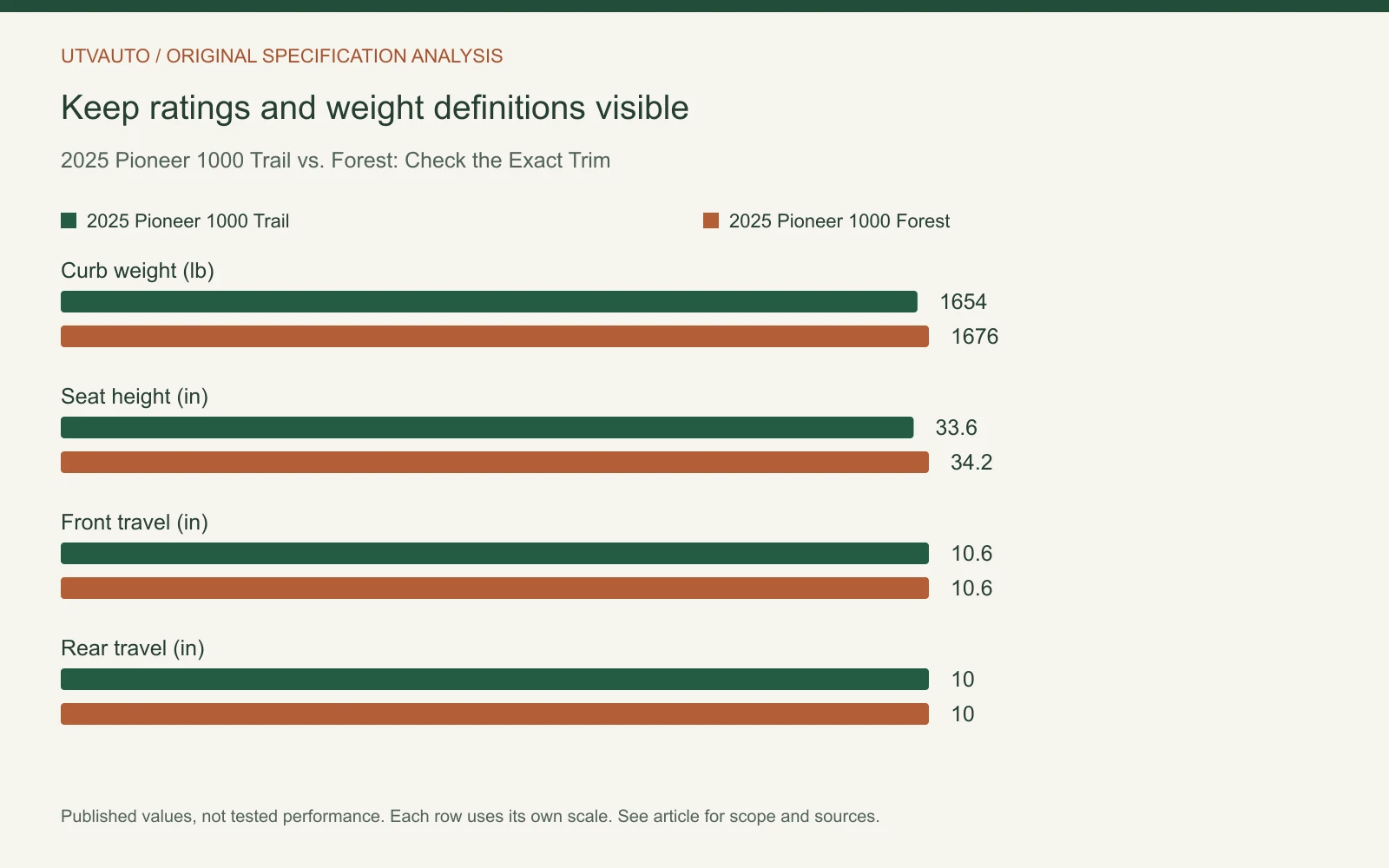
Honda lists seat heights of 33.6 inches for the Trail and 34.2 inches for the Forest, a difference of 0.6 inch. Listed clearance is 12.8 inches versus 13.2 inches, a difference of 0.4 inch. These are published measurements, not a complete explanation of the suspension setup or a prediction of comfort for a particular occupant.
Arrange an appropriate stationary fit assessment and permitted demonstration for the actual vehicle. Use the normal riding equipment and check the manufacturer’s occupant requirements. Do not infer that one trim is universally safer, easier to enter or more stable solely from those differences. Record what you actually observe and keep it separate from the conclusions you can draw from a specification page.
A 22-pound curb difference is not a cargo calculation
The listed standard-market curb weights are 1,654 pounds for the Trail and 1,676 pounds for the Forest. The difference is 22 pounds. Honda’s release defines curb weight using standard equipment, required fluids and a full fuel tank. Use that common basis when comparing the figures, while recognizing that installed optional equipment can change the offered machine’s actual weight.
Do not subtract 22 pounds from the cargo-bed difference and infer a hidden common total capacity. The specification table does not support that reconstruction. A vehicle’s permissible loads must come from the correct ratings and instructions, not from a guessed relationship between two published weights. For transport, obtain an appropriate actual configured weight and evaluate the complete trailer arrangement rather than assuming the stock curb number includes everything you carry.
Towing and transmission are shared descriptions, not rankings
The release lists the same 2,500-pound towing figure and six-speed automatic DCT arrangement for these columns. Those shared descriptions do not make the two work configurations identical. They also do not establish equal service cost, lifetime reliability or performance with a particular load. Use the matching manual and qualified support for maintenance and operation.
Keep towing separate from cargo and passenger planning, especially when a workday combines those tasks. Ask the seller to identify the actual hitch equipment and relevant instructions. If towing is the only reason offered for selecting the Forest over the Trail, request the exact supporting difference rather than accepting a trim-name argument. In this cited comparison, the brochure towing number itself does not supply that advantage.
Value equipment only when it solves a requirement
Prepare a complete equipment list for each actual candidate, supported by part references and documents where available. Price the additions or corrections needed for your use, not every optional feature you could imagine installing. A buyer focused on carrying a particular work load may reach a different choice from one whose recurring requirements concern another supported feature or configuration.
For used machines, obtain a qualified condition assessment and meaningful service records. The trim comparison cannot tell you which individual example is mechanically sound. Keep the condition results separate from the original specifications so a favorable package description does not conceal unresolved work. Neither an attractive paint finish nor an extensive accessory invoice proves current readiness.
Finish with two complete load and fit sheets
Write the normal occupants, cargo and installed equipment beside each candidate. Mark every rating with its model year, trim and market. If a critical value cannot be confidently located in the original source or on the vehicle, leave it unresolved and ask the manufacturer or qualified dealer to clarify it before purchase. This is more useful than copying a family-level maximum into both columns.
Choose the machine that meets the actual job with a supportable configuration and acceptable complete cost. If the intended bed load exceeds a trim’s limit, change the vehicle or the job plan; do not reinterpret a marketing name as an exemption. The Trail-versus-Forest decision becomes clearer when the exact cargo row stays visible alongside the smaller dimensional and weight differences.
Ask the dealer to resolve a conflicting cargo claim
If a Forest listing advertises the broader family’s 1,000-pound cargo figure, provide the exact 2025 model code and ask the seller to reconcile it with Honda’s grouped specification row and the actual vehicle label. A mismatch does not establish bad faith; copied listings and misread columns can produce mistakes. It does mean that the cargo claim is not ready to drive a purchase decision.
Keep the answer and supporting document with the quote. Do not erase a conflict by selecting the more generous number, and do not ask a seller’s informal assurance to replace a manufacturer restriction. Where the evidence remains ambiguous, seek clarification from an authorized source or choose a candidate whose loading requirements can be established. A slower decision is better than buying a trim around a capacity that was never applicable to the offered machine.
Sources and research scope
U.S.-market specification research; source access reviewed November 20, 2026. UTVAUTO has not test-driven, measured or inspected these configurations. Differences calculated from published values are editorial calculations, not proof of a particular engineering cause. Unverified fields remain unverified. Vehicle labels and current configuration govern your machine.
Continue your research
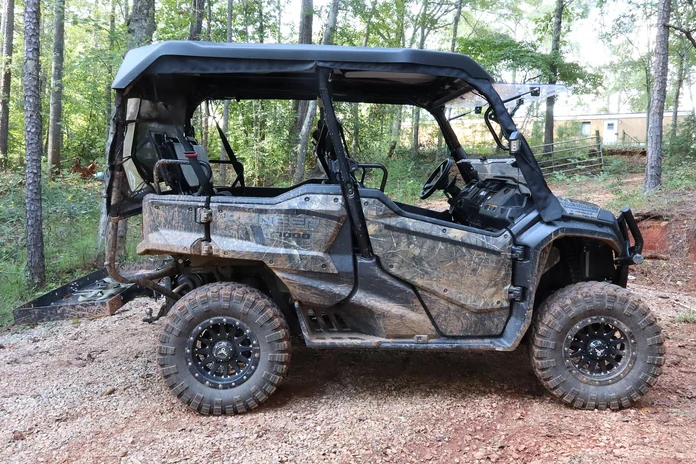
Cover: 2022 Honda Pioneer 1000-5 Forest parked beside a woodland cabin (reference photo). Photo: Big Blue Gnu · CC BY-SA 4.0. Resized.