
Editorial collection: August 2026. Collection month is an editorial label; the page retains its actual first-publication date.
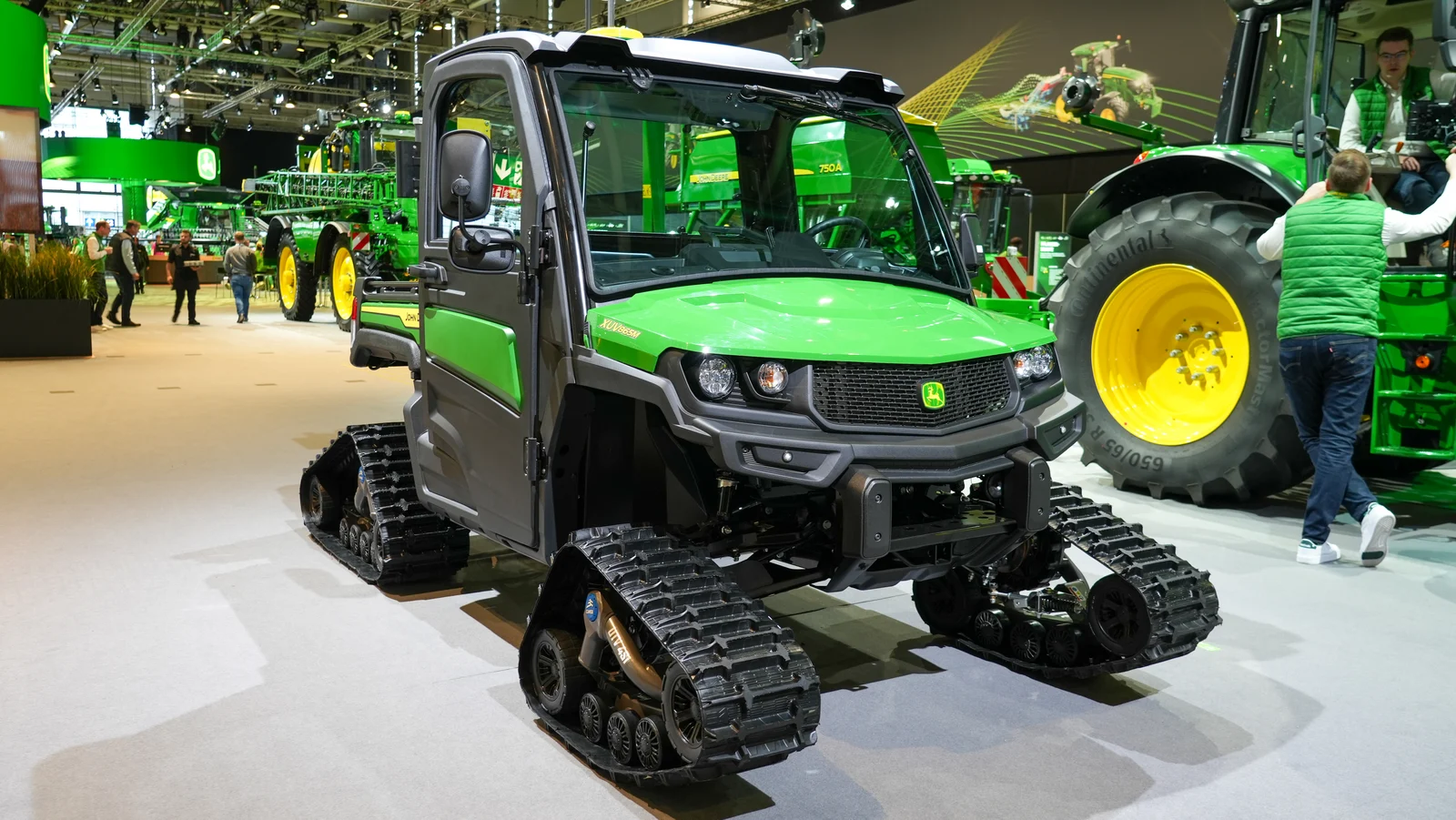
Featured photograph: John Deere Gator XUV865M diesel displayed on tracks in 2023. It illustrates the wider Gator family and is not the gasoline XUV835M example in the table. MarcelX42 / Wikimedia Commons / CC BY-SA 4.0. Resized and converted to WebP; photograph retains its stated license.
A useful John Deere Gator vs Polaris RANGER comparison starts with the exact vehicle, model year and job. “Gator” can mean several different work platforms; “RANGER” spans mid-size, full-size, cabbed and extreme-duty models. Comparing the largest tow figure in each family can produce a misleading buying recommendation.
To make the checks concrete, this guide uses a 2024 U.S. Gator XUV835M documented in Deere’s August 1, 2023 ordering guide and a 2026 RANGER XP 1000 Premium from Polaris’s 2026 catalog. This is an explicitly mixed-year example suitable for a used-versus-new shortlist, not a claim that the Deere document describes a 2026 Gator. Prices are deliberately excluded because the source dates differ.
A dated specification comparison you can audit
| Manufacturer-published field | 2024 Gator XUV835M, code 57KEM | 2026 RANGER XP 1000 Premium |
|---|---|---|
| Seats | 3 adults | 3 |
| Engine specification | 812cc gasoline triple; 54 engine hp* | 999cc twin; 82 stated hp |
| Overall L × W × H | 127 × 62.7 × 77.8 in. | 120 × 62.5 × 79.5 in. |
| Cargo-box maximum | 1,000 lb | 1,000 lb; verify region |
| Published towing entry | 2,000 lb in High; 4,000 lb in Low | 2,500 lb maximum |
| Source date / scope | August 2023 guide for model year 2024 | 2026 U.S. catalog |
Sources: Deere ordering guide, XUV835M 57KEM section, PDF pages 181–183 and Polaris’s 2026 RANGER catalog. Deere qualifies its engine-horsepower figure as supplied by the engine manufacturer, with actual operating horsepower lower. These are not matched independent power measurements.
Why the gear condition belongs beside the tow number
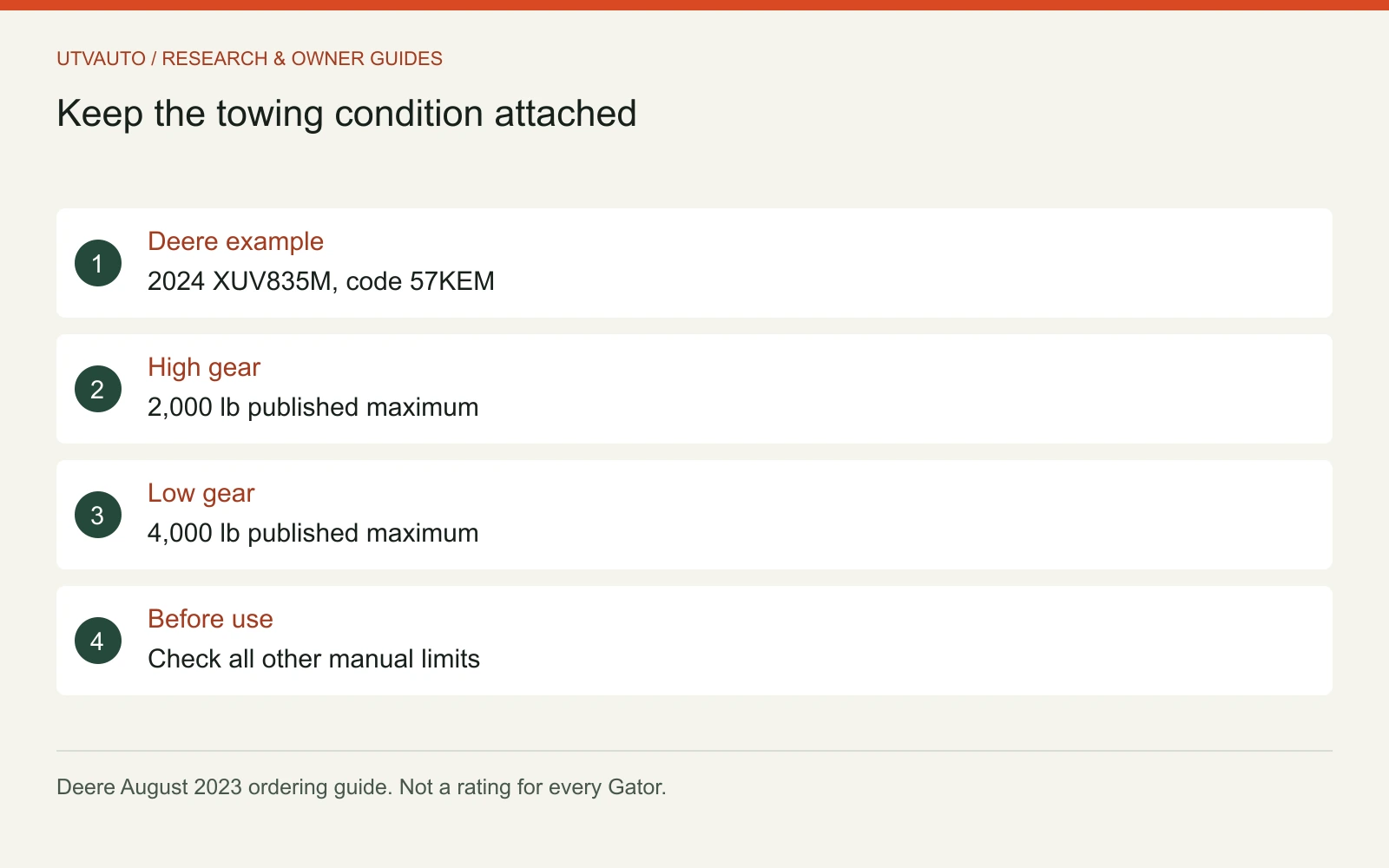
The Deere example’s 4,000 lb figure is conditional on Low gear. Removing that condition and presenting “Gator tows 4,000 lb” as a universal family claim would be wrong. The same source lists 2,000 lb in High. Neither number establishes what a different Gator model, a damaged used hitch or your chosen terrain permits.
Record loaded trailer mass and tongue weight separately. Ask for the exact operator-manual towing section, required equipment and terrain restrictions for the unit offered. Total payload, hitch rating and attachment limits must all pass. A tow figure is not a claim that a heavily loaded vehicle can stop or turn like an unloaded one.
For example, a 2,800 lb loaded trailer exceeds the RANGER catalog maximum in this example and also exceeds the Deere High-gear figure. Its mass being below the Deere Low-gear figure is only one preliminary check, not a complete towing approval. Use the load-accounting worksheet before accepting a sales comparison based on one large number.
A used Gator and new RANGER need different evidence
For the used Deere, the condition and service record are part of the product. Match the model code and year to the identification information, inspect the actual hitch and load box, and request records for scheduled service and any campaigns. Ask a qualified technician to inspect leaks, driveline wear, steering and brakes. Do not treat a low asking price as proof that deferred work is minor.
For the new RANGER, confirm the actual trim, region and installed options. An open Premium is not a NorthStar cab and an XP 1000 is not an XD 1500. Put those names on the quote. Our used UTV inspection checklist explains how to record observations without diagnosing every noise as a failed component.
Compare the cargo workflow, not just the box maximum
Both example boxes carry a published 1,000 lb maximum, but equal weight limits do not mean equal usable shape, lifting effort or access. Deere’s dated guide lists a 45 × 52 × 12-inch box for that XUV835M configuration. Place your actual storage cases or equipment dimensions beside the box drawing; check tie-downs, tailgate access and the lift arrangement on the vehicle offered.
Then write down how the job gets unloaded. A trip that ends with hand-removing equipment differs from moving approved loose material. Enclosures and rear accessories can change access. Do not assume every photographed vehicle carries the same factory lift, roof or door package.
Measure before choosing a familiar brand
The 2024 Gator reference is seven inches longer than the RANGER example but 1.7 inches lower. These differences can matter near a trailer bulkhead or garage opening. Measure the actual tires, mirrors, roof and protruding equipment. A family name is not a transport dimension, and a brochure dry weight is not the loaded hauling weight.
Take this comparison sheet to both sellers
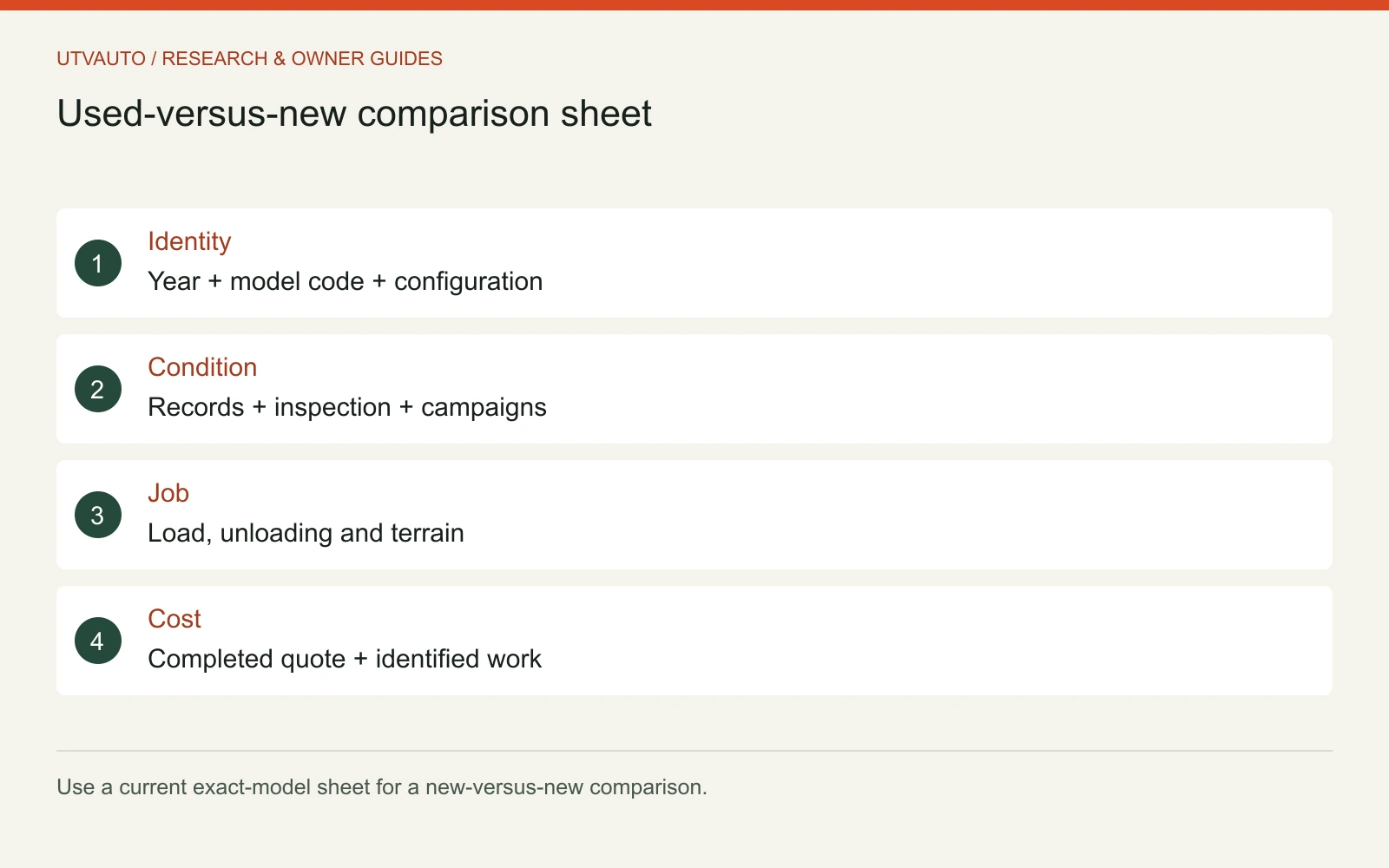
- Full model year, model code and cab or seating configuration.
- Current unit-specific box, total load, towing and tongue-load limits, including gear and terrain conditions.
- Installed equipment list, service records or new-vehicle warranty documents, and any open campaign check by identification number.
- Completed purchase quote and an estimate for the maintenance or repairs actually identified.
- Actual transport dimensions and loaded scale weight.
Choose the vehicle that meets the hard requirements with a supportable condition and cost record. If you are comparing two current new models, replace the dated Deere column with the current exact model’s official specification rather than carrying these 2024 values forward.


