
Editorial collection: July 2026. Collection month is an editorial label; the page retains its actual first-publication date.
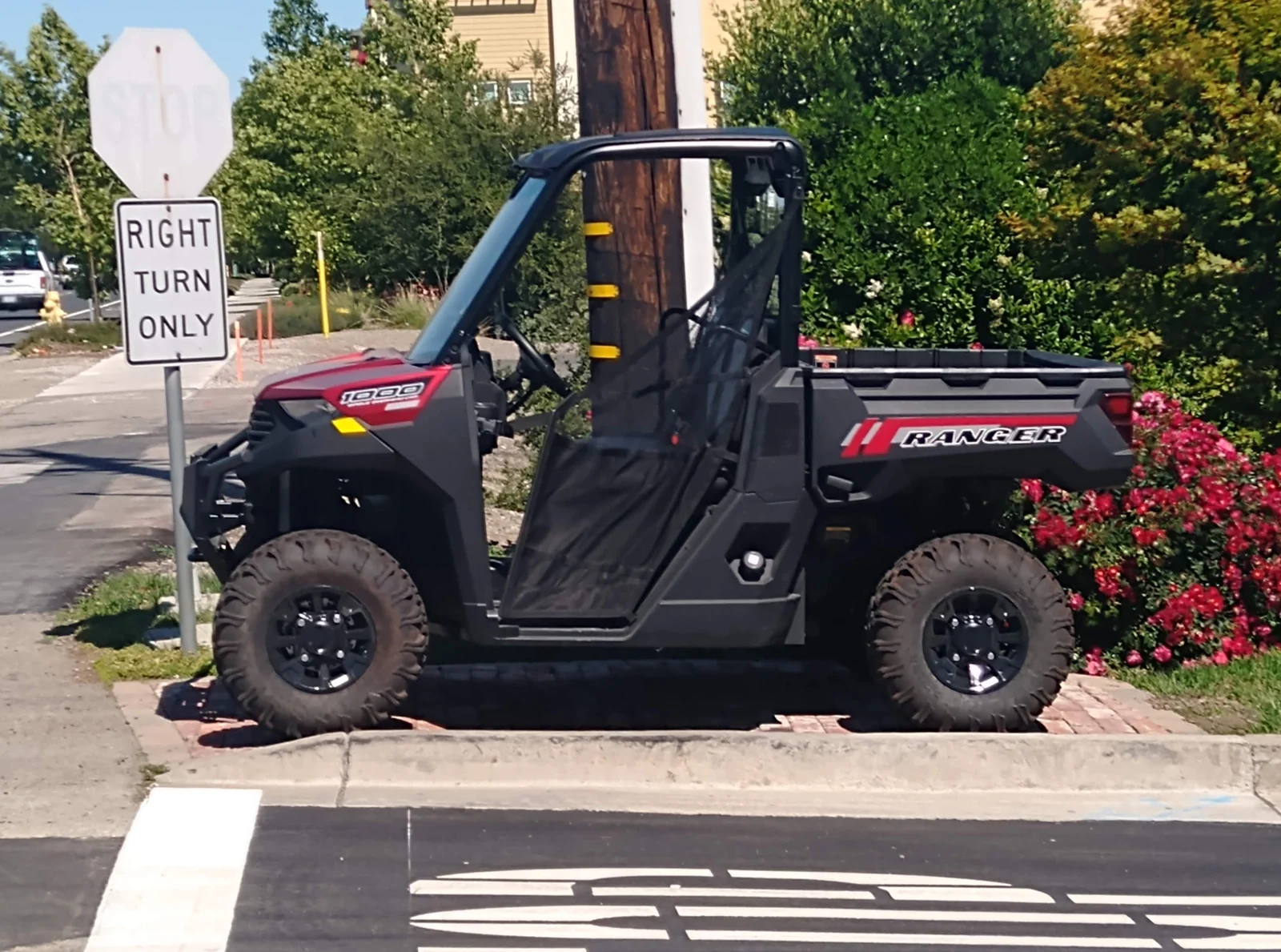
Featured photograph: 2021 Polaris RANGER 1000 photographed at a dealership; reference image, not the 2026 Premium specification. DestinationFearFan / Wikimedia Commons / CC BY-SA 4.0. Resized and converted to WebP; photograph retains its stated license.
The 2026 Polaris RANGER 1000 Premium and RANGER XP 1000 Premium have the same 999cc nominal displacement and the same published 2,500 lb towing and 1,000 lb cargo-box maxima in the U.S. catalog. The XP nevertheless has a different engine specification, higher stated horsepower, larger factory tires and more ground clearance. Pay for those differences if they solve your use case—not because “XP” automatically raises every working limit.
This guide compares three-seat Premium models. It excludes Crew, NorthStar, XD 1500 and other trims. California cargo configurations need a separate check against the vehicle label and exact specification sheet.
What actually changes on the Premium models
| 2026 U.S. Premium models | RANGER 1000 | RANGER XP 1000 |
|---|---|---|
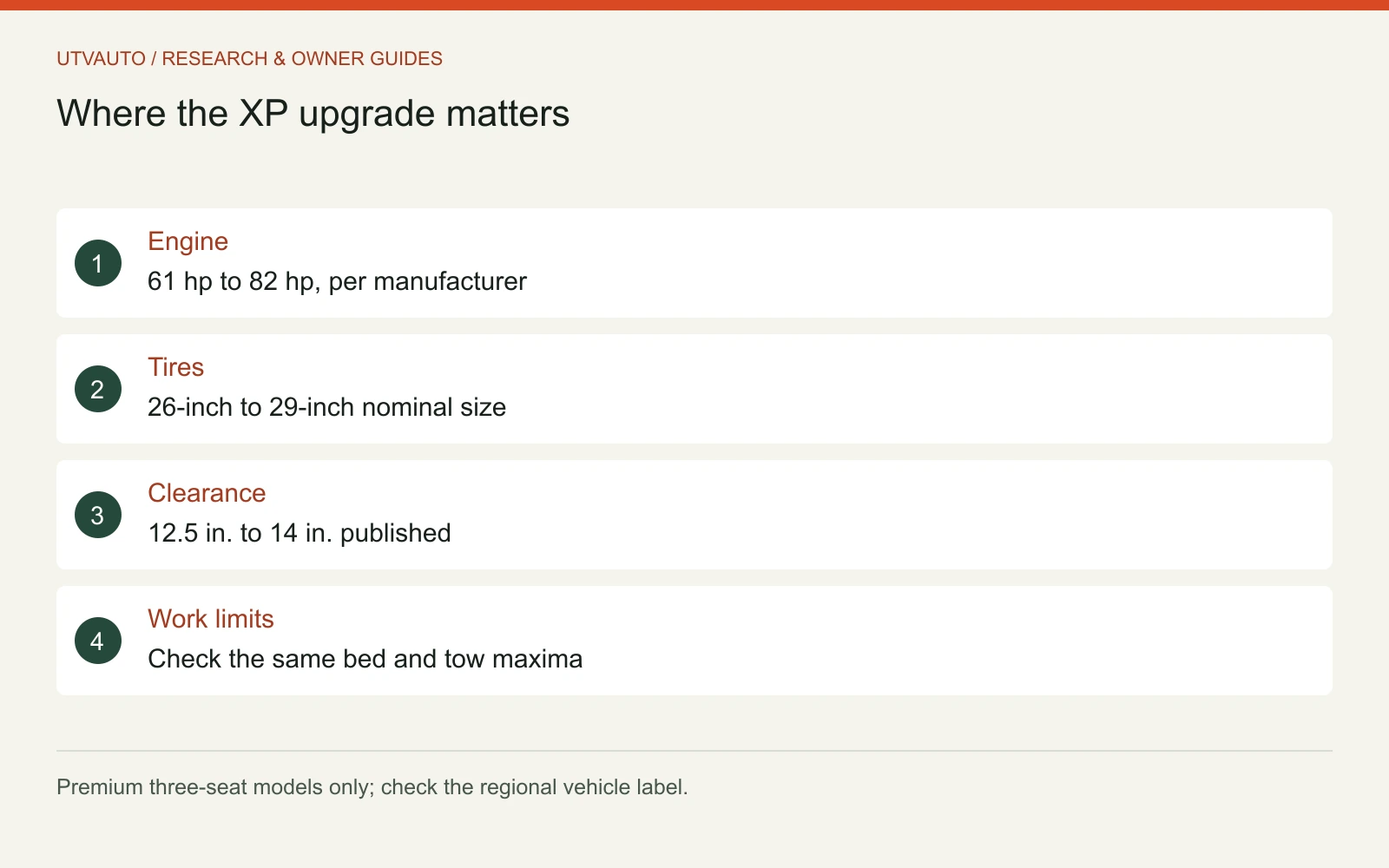
| Engine | 999cc SOHC twin | 999cc DOHC twin |
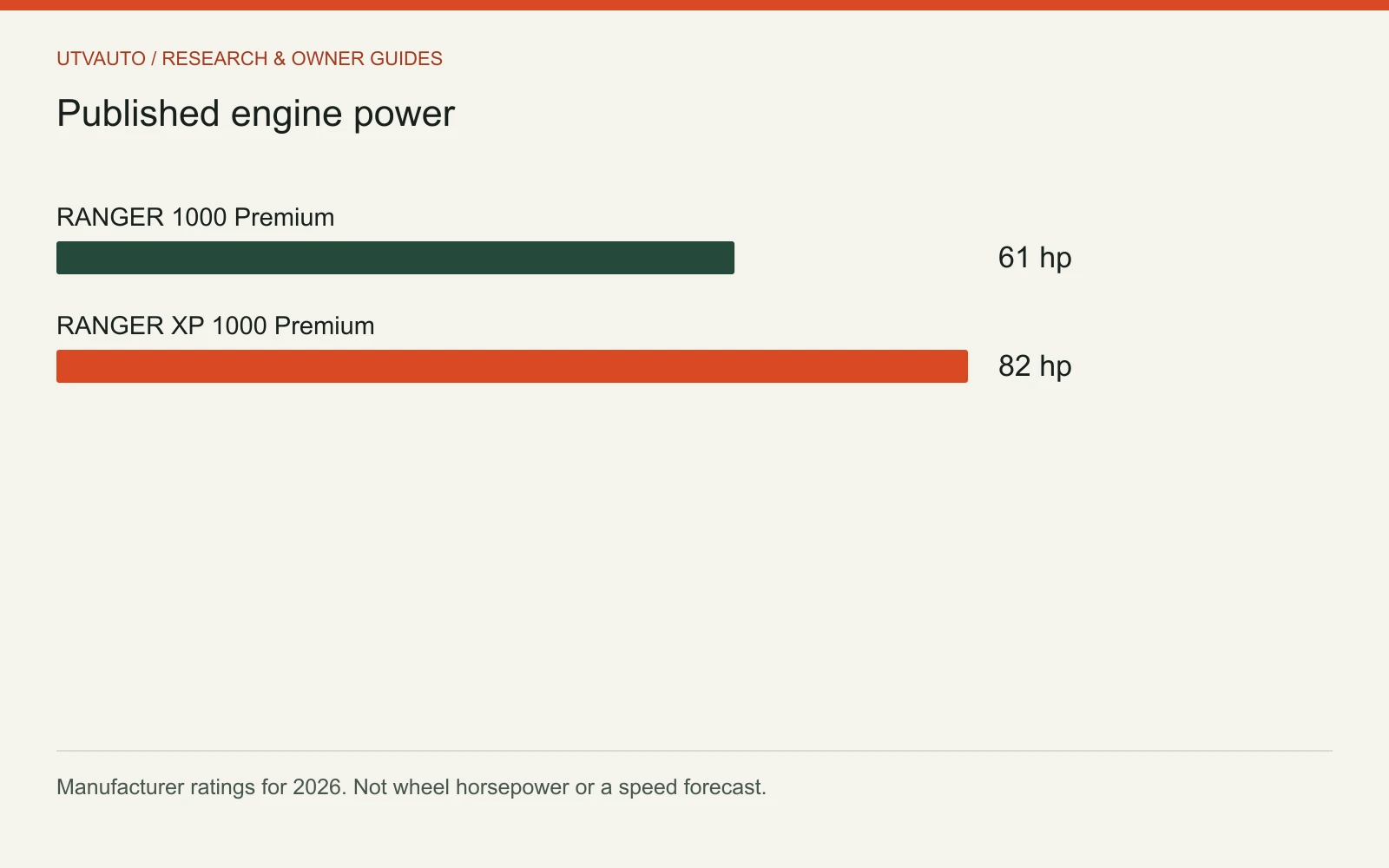
| Manufacturer-stated power | 61 hp | 82 hp |
| Overall size, L × W × H | 120 × 62.5 × 78 in. | 120 × 62.5 × 79.5 in. |
| Factory front tire | 26 × 9-12 | 29 × 9-14 |
| Factory rear tire | 26 × 11-12 | 29 × 11-14 |
| Ground clearance | 12.5 in. | 14 in. |
| Front / rear travel | 10 / 10 in. | 10 / 10 in. |
| Cargo-box / towing maxima | 1,000 / 2,500 lb | 1,000 / 2,500 lb; check regional label |
Source: 2026 Polaris RANGER catalog, full-size model specifications on pages 142–143. These are factory published values, not independent acceleration, dyno or towing tests. The catalog’s RANGER 1000 Premium column identifies the SOHC engine; do not copy a differently labeled base-model column into this comparison.
Horsepower changes the specification, not the legal load limit
The published increase is 21 hp: 82 minus 61. Dividing 21 by 61 gives about a 34% increase in the manufacturer’s horsepower figure. It does not prove a 34% speed increase, a 34% heavier safe load or a specific hill-climbing result. Transmission calibration, gearing, tires, surface and total mass all matter to the job.
If your recurring task is moving a light tool load around a flat property, the extra power may not be the constraint you need to solve. If you frequently travel varied terrain with an approved load, an appropriately conducted dealer demonstration can help you decide whether the XP’s response is worth its completed-quote difference. Use the same route and load conditions for a fair assessment.
The larger tires affect more than appearance
This Premium comparison moves from nominal 26-inch to 29-inch tires and from 12-inch to 14-inch wheels. The published ground-clearance increase is 1.5 inches, but tire size alone does not authorize fitting the XP tire package to another model. Factory suspension, clearances, calibration and approved combinations must be checked.
For a replacement tire, record the complete size, construction and load rating, not just “29-inch.” Check wheel width, offset, bolt pattern and full steering and suspension movement. Our tire-size explanation helps decode the label; the upgrade checklist covers why an apparently small size change can create other work.
Check the roof opening before choosing a garage model
The catalog gives both three-seat Premium vehicles the same 120-inch length and 62.5-inch width. The XP is 79.5 inches high versus 78 inches for the RANGER 1000 Premium. That is a meaningful difference near a low door, especially after adding roof lights or changing tires.
Measure the narrowest and lowest point along the actual route into storage, including the door hardware and ramp transition. Then measure the delivered vehicle with its roof and equipment installed. Brochure dimensions are a planning screen; they are not the clearance of your garage on uneven ground.
An equipment-adjusted price comparison is more useful
The 2026 catalog lists a factory roof and 4,500 lb winch with the RANGER 1000 Premium. That illustrates why the cheaper nameplate should not automatically be treated as a stripped model. Obtain a line-item build sheet for both exact vehicles, including any separately purchased cab equipment, installation, freight, preparation, tax and registration charges applicable to your location.
Avoid inventing a fixed annual maintenance-cost advantage from SOHC versus DOHC. Those labels describe valve-train architecture; they do not supply a repair history for your unit. Service records, correct maintenance, local labor rates and the actual duty cycle are more actionable ownership evidence.
A purchase worksheet that keeps the decision honest
- Write down your maximum passenger count and the heaviest ordinary working load. Check total payload as well as bed and trailer ratings.
- Record the smallest gate, trailer and garage clearances. Include mirrors and accessories in the actual measurement.
- Have the dealer quote both builds with the equipment you will really use. Compare the amount due for those builds.
- If the remaining choice is performance, arrange an appropriate demonstration rather than inferring a driving result from the horsepower percentage.
Choose the RANGER 1000 Premium when its approved capabilities cover the job and its complete equipment quote is the stronger fit. Choose the XP Premium when the verified power, clearance and factory tire differences matter enough to justify its price. Neither choice removes the need to respect all of the vehicle’s working-load limits.


