
The newer Deluxe needs a fresh fit check
The 2026 Honda Pioneer 1000 Deluxe is not dimensionally interchangeable with the 2024 Deluxe simply because both use the same family name. The published U.S. figures show a taller, wider and heavier 2026 configuration. If you are replacing an older machine, check your garage, trailer and installed equipment before treating the purchase as a straight swap. The useful question is which existing constraints still work with the actual replacement vehicle. Check the first configuration’s original specification source.
This comparison concerns the three-seat Deluxe columns in Honda’s two year-specific specification releases. It excludes the Pioneer 1000-5, Trail, Forest and other packages. California qualifications must be checked separately where listed. We compare published dimensions and ready-to-ride curb weights, not measured ride quality, reliability or acceleration. A shared engine displacement does not settle any of those questions.
What changed in the published measurements
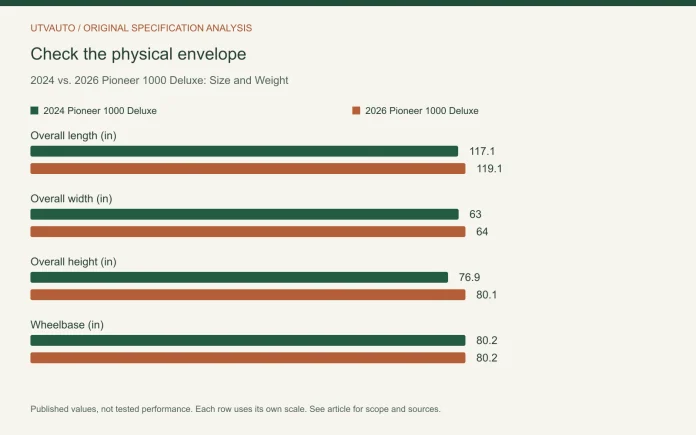
Length increases from 117.1 to 119.1 inches, width from 63.0 to 64.0 inches, and height from 76.9 to 80.1 inches. Subtracting the earlier figure from the later one gives increases of 2.0, 1.0 and 3.2 inches respectively. Those are specification differences, not allowances that can simply be added to every accessory-equipped vehicle. A roof, tires or another installation can change the physical envelope you need to measure.
The wheelbase remains 80.2 inches in the cited columns, while listed ground clearance moves from 13.6 to 13.8 inches. That combination matters: an unchanged wheelbase does not mean an unchanged exterior shape. Do not use one familiar measurement to override the others. Record length, width and height as separate constraints, and keep each number attached to the correct year and trim in your purchase notes.
Honda source note: this comparison uses the 2026 HondaNews specification release, which lists 80.1 inches for the three-seat Deluxe. Honda’s current 2026 consumer product page lists 80.0 inches. Do not average these values or use a brochure-only clearance margin as approval; measure the actual equipped machine and opening.
Published specifications: exact configurations
| Specification | 2024 Honda Pioneer 1000 Deluxe | 2026 Honda Pioneer 1000 Deluxe |
|---|---|---|
| Engine displacement | 999.0 cc | 999 cc |
| Engine layout | Liquid-cooled SOHC parallel twin | Unicam parallel-twin, liquid-cooled |
| Transmission | Six-speed automatic DCT; reverse; high/low | 6-speed DCT + reverse; high / low |
| Drive system | 2WD / 4WD / Turf / differential-lock 4WD | 2WD / 4WD / Turf / front differential lock |
| Overall length | 117.1 in | 119.1 in |
| Overall width | 63.0 in | 64 in |
| Overall height | 76.9 in | 80.1 in |
| Wheelbase | 80.2 in | 80.2 in |
| Ground clearance | 13.6 in | 13.8 in |
| Seat height | 34.5 in | 35.3 in |
| Cargo bed dimensions | Not verified | 34.8 x 54.3 x 12.1 in (L/W/H) |
| Seating capacity | Not verified | 3 |
| Cargo bed load rating | 1000.0 lb | 1000 lb — California: 600 lb. |
| Towing rating | 2500.0 lb | 2500 lb |
| Front suspension travel | 10.6 in | 10.6 in |
| Rear suspension travel | 10.0 in | 10 in |
| Front tires | Armstrong Dirt Master 2.0, 27×9-14 | 27 x 9-14 |
| Rear tires | Armstrong Dirt Master 2.0, 27×11-14 | 27 x 11-14 |
| Power steering | Not verified | EPS |
| Curb weight | 1598.0 lb — Manufacturer curb weight; a different weight basis is not directly comparable. Non-California figure; required fluids and full fuel included. | 1781 lb — Includes required fluids and full fuel. California: 1,786 lb. |
| Fuel capacity (U.S. gallons) | 7.9 gal | 8.1 gal |
Calculate the garage margin before discussing comfort
For a deliberately hypothetical garage opening of 82 inches, subtracting the stock listed heights leaves 5.1 inches above the 2024 figure and 1.9 inches above the 2026 figure. This is only a static arithmetic example. It does not prove either vehicle can pass through the opening, because the actual opening, floor transition, approach, roof and highest fitted component still need checking. Neither remaining number is a recommended clearance allowance.
Measure the narrowest and lowest usable parts of your own entrance, not the nominal door size on an invoice. Check the machine as it will be stored, including relevant fitted equipment. If a purchase depends on an uncertain margin, resolve it before delivery with an appropriate physical measurement or documented arrangement. A successful fit with the 2024 machine is evidence about that machine, not a transferable approval for the 2026 Deluxe.
Understand the 183-pound curb-weight difference
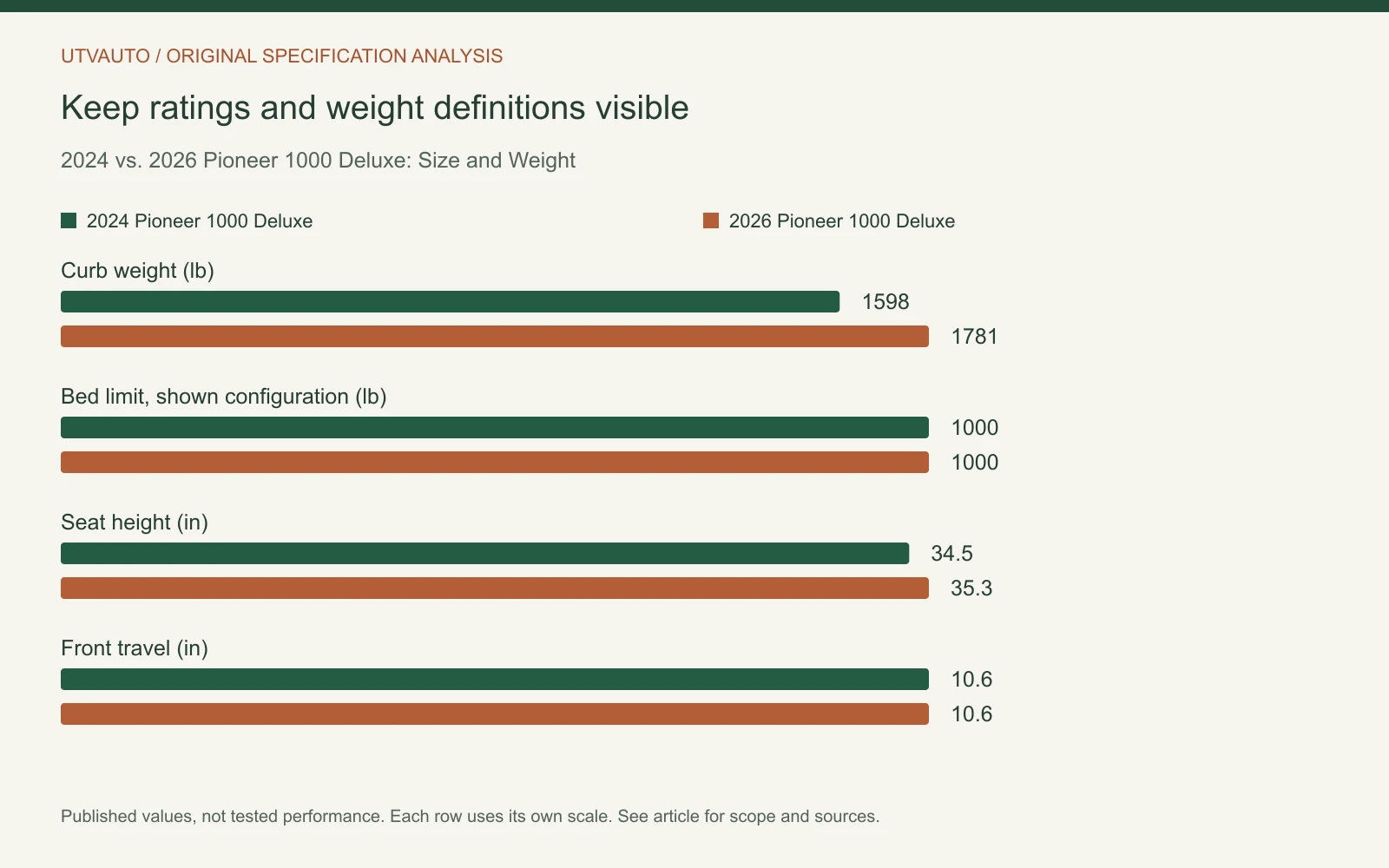
Honda lists 1,598 pounds for the standard-market 2024 Deluxe and 1,781 pounds for the corresponding 2026 Deluxe. The difference is 183 pounds. Both source releases define their curb figures as ready-to-ride configurations with standard equipment, required fluids and a full fuel tank. This makes the comparison more useful than comparing a dry weight with a curb weight, while still requiring attention to the actual installed equipment.
Do not identify a single component as the cause of the whole increase without engineering documentation. The figures establish a changed specification, not a parts-level explanation. For transport planning, use an appropriate actual loaded weight rather than assuming that the brochure figure includes every accessory or loose item. The weight change also does not establish that the later machine is stronger, less reliable or more expensive to maintain.
Recheck the trailer as a complete transport system
If the earlier vehicle already occupied much of your trailer’s usable space or load allowance, the later Deluxe deserves a new transport calculation. Include the trailer’s own weight, the actual vehicle configuration and everything else carried. Check the relevant trailer, axle, tire, hitch and tow-vehicle limits through their own documentation. More deck length alone does not resolve a weight constraint, and a favorable gross total does not establish correct load distribution.
Create a before-and-after transport sheet using the same assumptions for both candidates. Separate measured values from brochure values. If you change the roof, storage equipment or wheel package while changing vehicles, record those changes rather than attributing the entire final difference to the model year. That record can reveal whether you need a different transport arrangement or simply better information about the one you already own.
Similar drivetrains do not prove identical ownership
The two specification releases identify a six-speed automatic DCT arrangement with reverse and high/low operation. That description helps identify the kind of vehicle being compared, but it is not a reliability ranking or a complete service schedule. Use the appropriate owner manual for each year when planning maintenance, fluids and operating checks. An older service invoice should not become the source for a new machine’s requirements.
Likewise, the published towing figure is not a complete towing plan. Required equipment, loading and operating restrictions remain vehicle-specific questions. Keep the towing rating separate from the cargo-bed limit and total load planning. If a sales comparison combines these into one general claim of greater capability, ask which exact specification changed and what it means for the job you actually intend to perform.
Do not transfer accessories by family name
An existing windshield, roof, door or storage installation needs an exact application check. Ask the accessory manufacturer about the year, full model and companion components, and retain the supporting installation document. Physical resemblance is not enough to establish compatibility. Even a component that appears to attach may have an exclusion involving another part of the complete setup.
Build two equipment lists: what is included on the offered 2026 vehicle and what you plan to reuse from the 2024. Mark each reused item confirmed, excluded or unresolved. Obtain installation or replacement quotes for the unresolved items before valuing the trade. This turns an apparently simple upgrade into a reviewable configuration decision and prevents an attractive vehicle-price comparison from concealing the cost of rebuilding the required setup.
Decide between keeping and replacing with evidence
Keep the 2024 candidate in consideration when its documented condition, fit and required equipment meet your needs at an acceptable complete cost. Consider the 2026 when its actual features solve a defined requirement and the new size and transport checks work. Neither decision follows automatically from the year printed on the title. A used machine also needs a condition and records assessment that a specification comparison cannot provide.
Before committing, collect the identified vehicle description, measured fit information, transport calculation and itemized equipment quote in one file. Ask a qualified inspector to resolve condition concerns on a used vehicle and a supplier to resolve accessory questions. The result should explain why a particular machine suits your work, rather than merely recording that the newer one has larger published numbers.
A replacement decision with two independent constraints
Imagine an owner with a trailer that has ample usable length but a garage entrance that is close to the existing vehicle’s height. The 2.0-inch published length increase might have little practical consequence for that trailer, while the 3.2-inch height increase becomes the deciding storage question. The correct response is not to average the changes or assume the whole upgrade is impractical. Identify which constraint is real and measure that part of the actual arrangement.
Now consider another owner with generous overhead space but limited transport capacity. For that buyer, the 183-pound curb-weight difference can matter more than height. The two buyers are comparing the same pair of model years and can reasonably reach different conclusions because their constraints differ. Neither needs a universal upgrade score; each needs an auditable calculation and the missing configuration information.
Keep a separate yes, no or unresolved answer for garage fit, transport space, transport loading and required accessories. A yes in three boxes does not cancel an unresolved fourth box. Obtain a specific measurement or quote to close the remaining question. This method is especially useful when a dealer offers a limited-time transaction: it identifies which information is necessary to make the decision concrete without allowing urgency to substitute for verification.
After delivery, retain the measured setup with the vehicle records. If a later roof or tire change alters it, update the relevant fit calculation. A careful purchase check is a starting record for ownership, not a permanent clearance certificate for every future configuration.
Sources and research scope
U.S.-market specification research; source access reviewed November 20, 2026. UTVAUTO has not test-driven, measured or inspected these configurations. Differences calculated from published values are editorial calculations, not proof of a particular engineering cause. Unverified fields remain unverified. Vehicle labels and current configuration govern your machine.
- 2026 Pioneer 1000 Deluxe: seating and equipment
- 2026 Honda Pioneer 1000 Deluxe specifications
- 2024 Honda Pioneer 1000 U.S. specifications
Continue your research
- Explore the Pioneer research hub
- Check the complete garage opening
- Calculate trailer fit and loaded weight
Compare other documented UTV and ATV configurations
Cover image: Original UTVAUTO diagram calculated from the linked manufacturer specifications. Each row uses its own scale. No measured performance or universal winner is implied; see the table for market, seating-mode and weight-basis qualifications.