
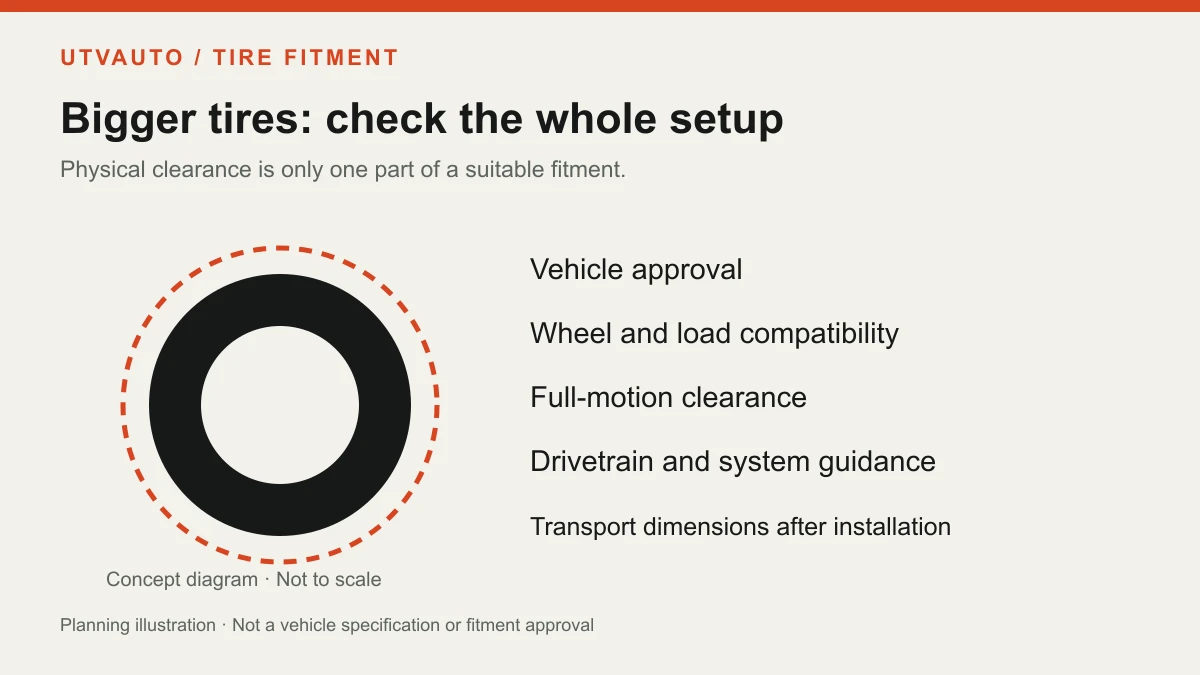
Larger tires may be physically mountable on a UTV, but that alone does not establish an approved or suitable fitment. Check the exact tire and wheel combination, vehicle approval, full-motion clearance, load requirements and drivetrain effects before buying. There is no reliable “every stock UTV can go two inches bigger” rule.
This guide is a fitment decision worksheet, not a list of maximum tire sizes for individual vehicles. It assumes a U.S. side-by-side with its existing suspension and bodywork unless you document otherwise. Our tire-size explainer covers the markings themselves.
Start with the current approved combination
Record the year, model, trim and seating version; the original approved front and rear tires; the installed tire markings; and the wheel specifications. Compare that record with the owner’s manual. A used vehicle may already have a combination that differs from stock.
Check the manufacturer’s position on tire changes before selecting a larger size. For example, the 2025 RANGER XP 1000/CREW manual specifies Polaris-approved replacement tire sizes and types. That is a reason to obtain model-specific approval, not to infer that an aftermarket tire which clears the fender is approved.
A nominal size is not an exact installed measurement
Use the tire maker’s dimensions for the exact part number and measuring rim. On the Maxxis Carnivore specification page, the nominal 28X10.00R14 entry is listed at 28.7 inches overall diameter, while 30X10.00R14 is listed at 30.5 inches. Both specify a 14X7.0 measuring rim. These published values illustrate why “28 versus 30” is not a complete clearance calculation.
Those figures are not a recommendation for your UTV and do not establish loaded rolling radius. Confirm current specifications with the manufacturer or supplier, particularly if a product name has multiple versions.
Use geometry to frame the question, not to approve the fit
For a purely hypothetical change from an actual unloaded diameter of 27 inches to 30 inches:
- Diameter difference: 30 − 27 = 3 inches.
- Radius difference: (30 − 27) ÷ 2 = 1.5 inches.
- Diameter ratio: 30 ÷ 27 = 1.111, or approximately 11.1% larger.
At the same wheel rotation rate, an ideal rigid circle with that diameter ratio would cover approximately 11.1% more distance. A pneumatic tire’s actual behavior depends on loaded dimensions and slip. This calculation does not predict a higher top speed or a guaranteed 1.5-inch increase in usable ground clearance.
It also does not resolve steering effort, braking performance, belt/clutch suitability or wheel-bearing loads. Those questions require the vehicle and component makers’ guidance for the combination. Do not buy a clutch kit or lift solely because a tire seller says it will “make anything fit.”
Check clearance through motion and load
A parked vehicle with straight wheels shows only one position. A competent installer needs to evaluate steering travel, suspension movement and the vehicle’s intended load using a safe model-specific procedure. Do not place yourself under an unsupported machine or improvise a suspension-compression test.
Swipe sideways to view every column.
| Check | Information needed | Unresolved result |
|---|---|---|
| Vehicle approval | Exact year/model guidance for proposed size and construction | Obtain manufacturer/dealer confirmation before proceeding |
| Wheel compatibility | Diameter, permitted rim width, bolt pattern, offset, rating and clearance | A matching rim diameter alone is insufficient |
| Full-motion clearance | Tire-to-body, suspension, steering and brake-component clearance throughout required motion | Static clearance does not pass this check |
| Front/rear relationship | Approved sizes, rolling relationship and drivetrain requirements | Do not assume all four positions may use the same size |
| Load and inflation | Suitable ratings and approved cold pressures for the actual load | Do not substitute the sidewall maximum for an operating setting |
| Vehicle systems | Manufacturer guidance on gearing, calibration, handling and component suitability | No generic promise that a lift or tune resolves them |
Spacers, offset and lifts change the question
Moving the wheel outward may alter where the tire clears and where it rubs. It also changes the installed width you must measure for a gate, trail restriction or trailer. A lift changes geometry rather than proving that every component remains suitable. Evaluate the complete combination; checking each part in isolation can miss an interference introduced by another part.
Ask the installer to identify the exact wheel and tire part numbers, any required hardware and every departure from the manufacturer’s approved setup. Get the assessment before ordering a nonreturnable package. A vague “fits most Rangers” statement does not identify your year or trim.
Use a buy / hold / stay-stock decision
Buy only after the checks are resolved: the proposed combination is supported for the vehicle, the installer has verified clearance and the load/inflation requirements are documented. Keep those records with the vehicle.
Hold if a critical value is missing: unclear wheel rating, uncertain rim-width compatibility or no full-motion assessment is a reason to obtain an answer, not to estimate.
Stay with an approved stock-size replacement when the job does not require a change or the larger combination cannot be supported. A different tread in an approved size may address the actual terrain problem without pursuing maximum diameter. See our UTV tire selection guide for that comparison.
Recheck transport and load assumptions after a change
Measure the finished vehicle’s outside width and height and confirm its ready-to-transport weight. Revisit your trailer clearance worksheet. Do not use the original brochure dimensions after tires, wheels, mirrors or roof components change them.
For mud use, follow the approved inflation guidance for the actual combination; our mud tire-pressure guide explains why there is no universal low-PSI shortcut.
Method: manufacturer specifications plus UTVAUTO’s transparent geometry example and fitment checklist. No fitment, handling or durability test was performed. Reviewed November 2, 2026.

