
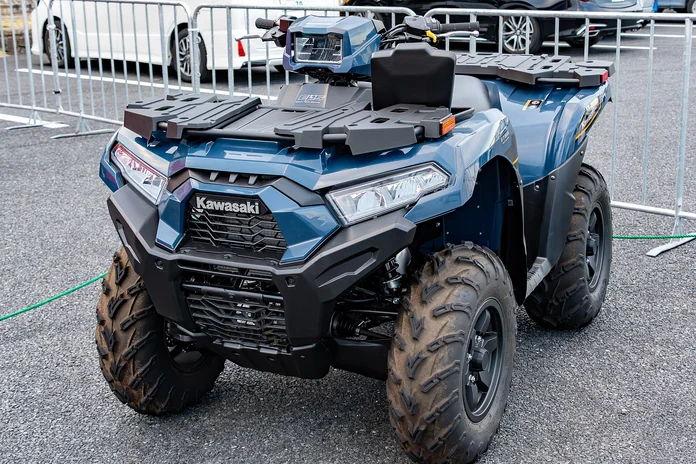
The steering designation comes before the engine badge
An advertisement for a Brute Force 750 does not automatically describe the same equipment as a Grizzly EPS. This comparison identifies the 2027 Kawasaki Brute Force 750 Standard and the 2025 Yamaha Grizzly EPS. The year mismatch is deliberate: it supports buyers considering these exact candidates, not a claim that we have conducted a same-year performance shootout. Verify the complete package before relying on a family-level comparison. Check the first configuration’s original specification source.
The Kawasaki sheet for the Standard version describes rack-and-pinion steering without the EPS designation used on other packages. Yamaha identifies this Grizzly as EPS. If power steering is a requirement, resolve that equipment question before comparing displacement. Do not transfer an EPS claim from a different Brute Force trim into the Standard column because the photographs or engine size appear similar.
Identify the actual purchase alternatives
Write the year, full name, trim and market from the vehicle documents or a reliable seller description. Ask the seller to explain any mismatch between the listing title and the offered machine. Model-family names often survive when an advertisement is copied between inventory items, making a plausible heading an unreliable substitute for exact identification.
The 2025 Yamaha candidate may be used, remaining stock or another transaction situation; the model year alone does not settle that. Likewise, a published 2027 specification sheet does not establish local stock, delivery date or the terms of an individual offer. Obtain those facts from the seller and keep them separate from the technical comparison. A useful shortlist describes vehicles you can actually obtain and support, with the uncertainty of each offer still visible.
Published specifications: exact configurations
| Specification | 2027 Kawasaki Brute Force 750 Standard | 2025 Yamaha Grizzly EPS |
|---|---|---|
| Engine displacement | 749.0 cc | 686.0 cc |
| Engine layout | Liquid-cooled SOHC V-twin | Liquid-cooled SOHC single-cylinder |
| Published engine power | 50.0 hp — Manufacturer ISO 4106 engine-power figure; test methods may differ across brands. | Not verified |
| Published engine torque | 42.8 lbft | Not verified |
| Transmission | CVT; H/L/N/R | Ultramatic V-belt CVT; H/L/N/R/P; all-wheel engine braking |
| Drive system | Selectable 2WD / 4WD; shaft | On-Command 2WD / 4WD / locked 4WD; shaft |
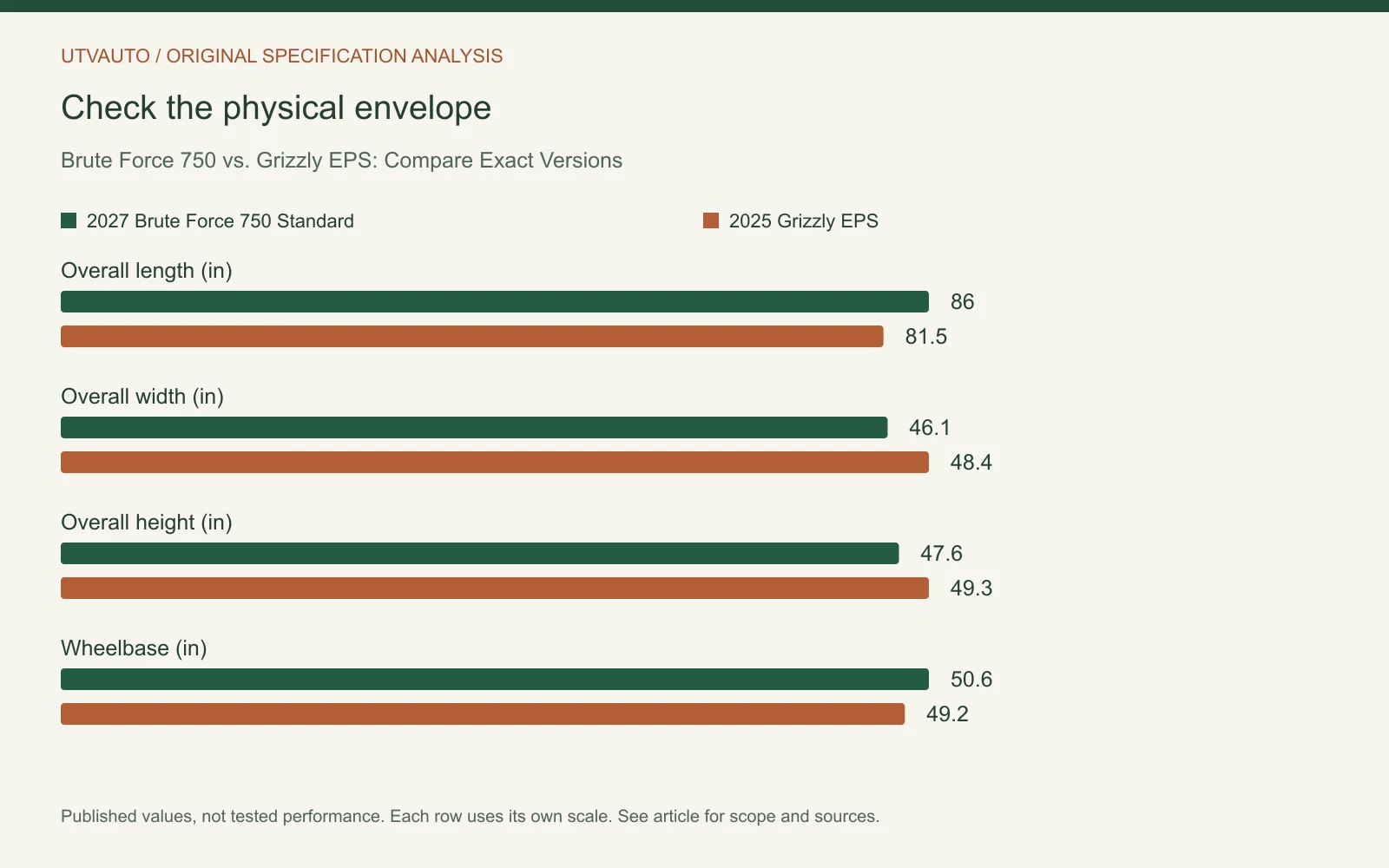
| Overall length | 86.0 in | 81.5 in |
| Overall width | 46.1 in | 48.4 in |
| Overall height | 47.6 in | 49.3 in |
| Wheelbase | 50.6 in | 49.2 in |
| Ground clearance (maximum where specified; see note) | 9.0 in — Standard setting; the sheet separately lists maximum/preload clearance. | 11.3 in — Manufacturer maximum ground clearance; not directly comparable with a standard-setting value. |
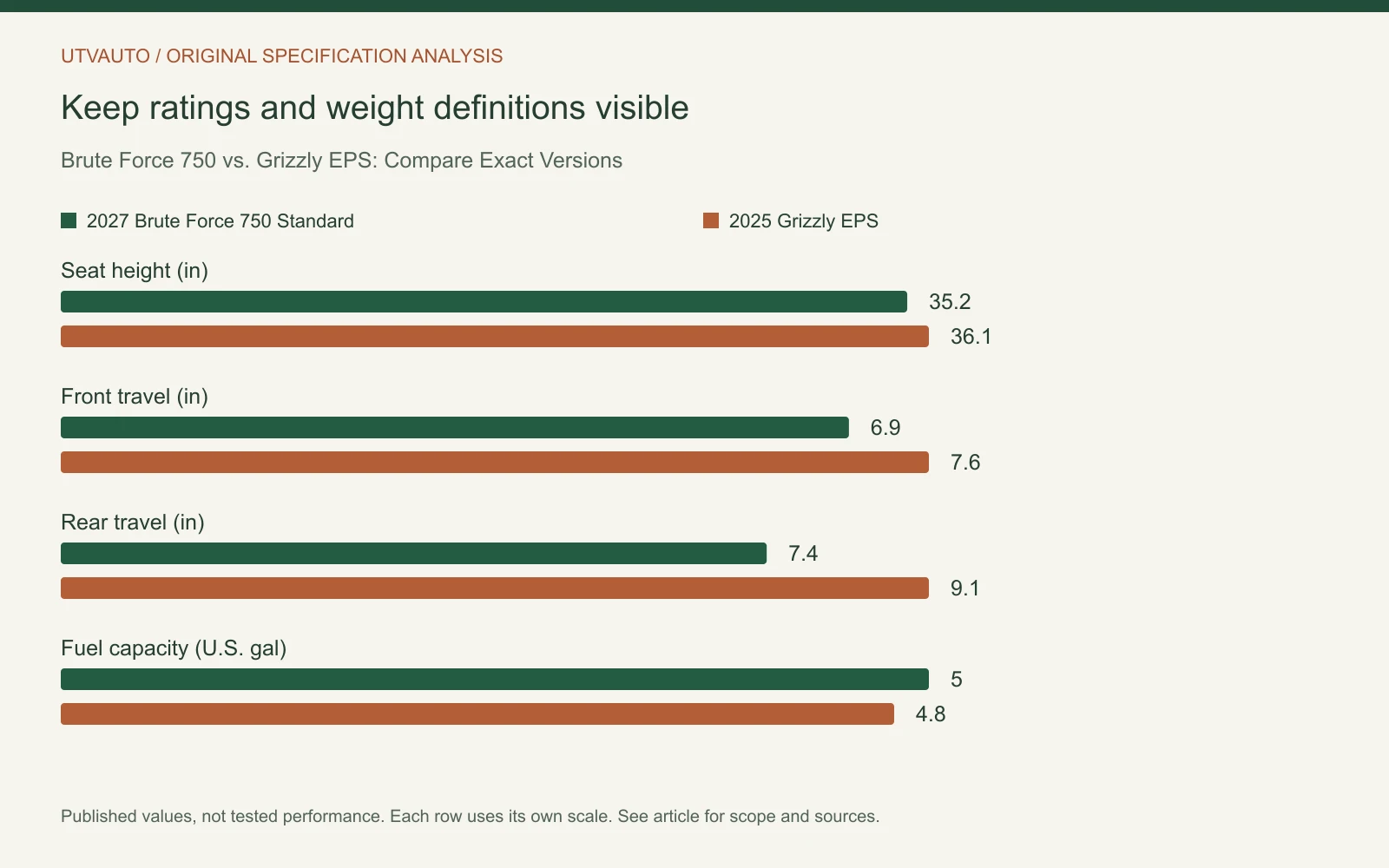
| Seat height | 35.2 in | 36.1 in |
| Seating capacity | 1 | Not verified |
| Towing rating | 1250.0 lb | Not verified |
| Front rack rating | 88 lb | Not verified |
| Rear rack rating | 176 lb | Not verified |
| Front suspension travel | 6.9 in | 7.6 in |
| Rear suspension travel | 7.4 in | 9.1 in |
| Front tires | AT25 x 8-12 | AT26 x 8-12 Maxxis® MU05Y |
| Rear tires | AT25 x 10-12 | AT26 x 10-12 Maxxis® MU06Y |
| Power steering | Rack-and-pinion | Not verified |
| Dry weight | 661.5 lb — Manufacturer dry weight; a different weight basis is not directly comparable. | Not verified |
| Curb weight | 707.8 lb — Manufacturer curb weight; a different weight basis is not directly comparable. | Not verified |
| Wet weight | Not verified | 701.0 lb — Manufacturer wet weight; a different weight basis is not directly comparable. |
| Fuel capacity (U.S. gallons) | 5.0 gal | 4.8 gal |
Engine layout is a difference, not a performance result
The Kawasaki lists a 749cc V-twin, while Yamaha lists a 686cc single-cylinder engine. Those are manufacturer descriptions of the configurations. The larger displacement does not prove a particular acceleration, fuel-consumption or towing advantage. It also does not establish that one machine is inherently smoother or more durable, because those statements need evidence beyond an engine-layout label.
Kawasaki’s newer sheet publishes an output figure, while the cited Yamaha specification page does not provide the directly comparable horsepower entry. Do not enter zero for the missing Yamaha field or calculate a winner from incomplete data. If an actual performance requirement controls your purchase, seek appropriate comparable evidence and a supported evaluation. The specification gap itself should remain visible in a responsible comparison table.
The Grizzly is shorter but wider in these sheets
Published length is 86.0 inches for the Brute Force Standard and 81.5 inches for the Grizzly EPS, making the Yamaha 4.5 inches shorter by subtraction. Width is 46.1 versus 48.4 inches, making the Yamaha 2.3 inches wider. A comparison that labels one machine simply smaller misses the fact that the answer depends on the dimension that limits your use.
Assess the specific gate, storage entrance or transport arrangement rather than averaging those differences into an invented compactness score. A shorter machine can still create a width problem. The installed wheels and accessories may also change an actual used candidate’s envelope. Measure when the margin matters and separately confirm that the intended route permits the vehicle; physical passage is not the same as access authorization.
Separate seat height from rider suitability
The listed seat heights are 35.2 inches for the Brute Force and 36.1 inches for the Grizzly, a 0.9-inch difference. These measurements can help frame a stationary assessment with appropriate instruction. They cannot certify which machine fits a rider solely from the person’s height or experience on another type of vehicle.
Use the relevant manufacturer requirements and qualified guidance to assess control access and suitability. Do not select an ATV for a child using this adult-model comparison, and do not infer a passenger arrangement from the apparent seat space. A rider-fit decision should remain attached to the actual machine and person rather than becoming a broad claim about all vehicles with lower seats or larger engines.
Travel figures need their own interpretation
The Kawasaki sheet lists 6.9 inches of front travel and 7.4 inches of rear travel; Yamaha lists 7.6 and 9.1 inches respectively. These differences describe published travel, not measured ride comfort or a guarantee of better control on every surface. Suspension condition, configuration and the actual operating task still matter.
If the used candidate has altered components, ask for identification and supporting installation information before relying on stock figures. A worn or unsuitable installation cannot be assessed by copying the original specification. Avoid using an aggressive demonstration to settle a paper comparison. The ordinary task evaluation should follow the vehicle’s instructions and appropriate training, with a clear way to stop when a question remains unresolved.
Wet and curb weights require a careful footnote
The Kawasaki lists curb weight and Yamaha lists wet weight. Both source documents explain their definitions, but the labels should remain visible rather than being silently combined into a generic weight row. Read what each includes, account for optional equipment, and use an appropriate actual loaded measurement for the transport decision. A decimal-point difference between differently labeled figures is not a complete hauling calculation.
Do not add the Kawasaki dry-weight figure to the comparison simply because it looks more favorable. Choose the basis that answers the question and explain any remaining mismatch. A transport system needs to support the actual machine, equipment and other load under the relevant instructions. The brochure comparison can identify where more information is required, but it should not pretend to replace that complete check.
Compare support and condition without brand folklore
For either candidate, request service records tied to the machine and have unresolved concerns assessed appropriately. Do not repeat a broad brand-reliability ranking without a defensible dataset. An individual used vehicle’s condition can dominate the practical purchase decision even when the original specification looks attractive. Distinguish observed findings from seller statements and general expectations.
Ask about replacement support for the actual configuration, including any identified accessory changes. Price documented work and required equipment using real quotes where available. A lower asking price is not a complete cost comparison when another arrangement must be purchased before the vehicle suits your task. Conversely, do not assign an automatic ownership saving to a feature solely because it is standard on one candidate.
Choose the configuration that passes the hard requirements
Investigate the Grizzly EPS when its documented steering equipment and wider, shorter package fit your requirements. Investigate the Brute Force Standard when the actual equipment is acceptable and the narrower listed width addresses a genuine constraint. Neither statement is a universal recommendation: the rider, route, load, transport and condition checks still decide whether the candidate belongs on your shortlist.
If steering equipment remains uncertain, stop the comparison until the exact version is established. If neither ATV fits the rider or permitted route, choose another model rather than treating this pair as the only options. The value of a version-specific comparison is that it prevents a buyer from purchasing a familiar name while expecting the equipment of a different package.
Use a two-axis size screen rather than one winner
For an illustrative 84-inch-long, 48-inch-wide static space, the cited Grizzly length is below the first number but its width is above the second. The cited Brute Force width is below the second number but its length is above the first. Neither candidate passes both of these deliberately hypothetical dimensions. Calling the Grizzly shorter or the Kawasaki narrower does not solve the whole fit problem.
This example is not a transport recommendation or an instruction to load either ATV into that space. Its purpose is to show why separate requirements must stay separate. If the actual arrangement differs, use its measured dimensions and the proper loading instructions. Do not turn diagonal positioning into an assumed solution when you have not established that the complete transport system supports it.
Apply the same approach to equipment. A candidate that fits the space but lacks a required steering configuration has not passed the purchase brief. Another that has the desired steering but cannot use the required authorized route is also unsuitable. A disciplined comparison allows both machines to fail a particular brief rather than forcing one to win because an article happens to compare only two.
Sources and research scope
U.S.-market specification research; source access reviewed November 20, 2026. UTVAUTO has not test-driven, measured or inspected these configurations. Differences calculated from published values are editorial calculations, not proof of a particular engineering cause. Unverified fields remain unverified. Vehicle labels and current configuration govern your machine.
- 2027 Kawasaki Brute Force 750 Standard U.S. specification sheet
- 2025 Yamaha Grizzly EPS U.S. specifications
Continue your research
Cover: Kawasaki Brute Force 750 ATV displayed at a motor show (reference photo).